

China makes pioneering contributions to humanity’s peaceful use of space
By He Yin, People’s Daily
The ascender of China’s Chang’e-6 probe lifted off from the lunar surface on June 4, carrying samples collected from the moon’s far side, which marked a historic step in humanity’s peaceful use of outer space.
The international community has closely followed the Chang’e-6 mission, recognizing its significant contribution to the progress of space exploration for humanity. The mission was said to be a leapfrog achievement of China’s space exploration, a key milestone of the country’s aerospace development, and a historic moment in human lunar exploration.
The Chang’e-6 mission’s voyage to the far side of the moon marked a historic milestone, not only for China’s space exploration endeavors but also for humanity’s peaceful use of space.
Before Chang’e-6 was sent to space, all 10 lunar sample return missions conducted by humans by far have taken place on the near side of the moon.
The South Pole-Aitken Basin on the far side of the moon is considered the largest, oldest and deepest basin on the lunar surface. Collecting and analyzing samples from this region would mark the first time for humanity to obtain samples from the far side of the moon, and thereby deepen humanity’s understanding of the moon’s formation and the evolution of the solar system.
To achieve this goal, Chang’e-6 incorporated a number of innovations, successfully overcoming the technical challenges in each stage of its mission, including landing on the far side of the moon, collecting samples, and lifting off from the lunar surface.
Josef Aschbacher, director general of the European Space Agency (ESA), congratulated China on the remarkable success of Chang’e-6 mission thus far, calling it a “wonderful accomplishment.”
Al Jazeera of Qatar reported that the Chang’e-6 landing marks China’s second descent on the far side of the moon, where no other country has reached. The mission “involves many engineering innovations, high risks and great difficulty,” the report added.
China has always been actively promoting international cooperation in lunar and deep space exploration, exactly mirrored by the international payloads onboard the Chang’e-6 lander, which are from the ESA, France, Italy, and Pakistan.
During the Chang’e-6 mission, Chinese scientists have shared scientific data and conducted joint research with their foreign counterparts.
For instance, the French lunar radon detector functioned during the Earth-moon transfer, lunar orbit, and lunar surface stages; the ESA’s lunar surface negative ion analyzer operated during the lunar surface stage.
Additionally, an Italian laser retroreflector mounted on the top of the lander of Chang’e-6 served as a position control point for distance measurements on the far side of the moon.
The Chang’e-6 mission also carried ICUBE-Q, a cube satellite from Pakistan, which marked the first step of Pakistan’s space exploration and signified the dedication of Pakistani scientists.
Pakistani Prime Minister Shehbaz Sharif said that the ICUBE-Q moon satellite is Pakistan’s first step in space and the country’s scientists and engineers are proving their abilities in this field just like they did in the other fields. This is a historic moment in the journey of technological advancement as with this important success, Pakistan has entered a new era of utilizing space for its objectives, he added.
This year marks the 20th anniversary of the establishment of China’s lunar exploration project. Over the past 20 years, the country has constantly set new records in humanity’s exploration of the moon: from Chang’e-1 capturing a complete map of the moon’s surface, to Chang’e-4 achieving humanity’s first soft-landing on the far side of the moon; from Chang’e-5 returning with lunar soil samples, to Chang’e-6 successfully retrieving samples from the moon’s far side.
Chinese space experts and personnel have always followed the lunar exploration spirit of pursuing dreams, daring to explore, cooperating in tackling difficulties and win-win cooperation. They are striving to make China strong in the aerospace sector, while also making pioneering contributions to humanity’s peaceful use of space and building a community with a shared future for mankind.
James Carpenter, ESA’s head of planetary science research, said that it is really fantastic to see how China’s lunar program has grown and become world class. “We feel privileged and happy to be part of it. We are also interested in further cooperation exploring the solar system.”
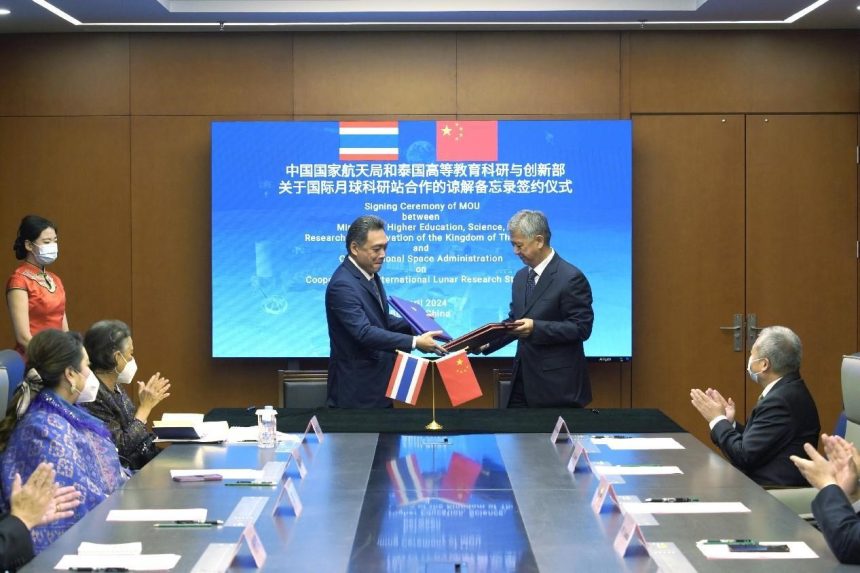
China’s Chang’e-7 lunar exploration mission, scheduled for launch around 2026, will carry six scientific instruments developed by six countries and one international organization, namely Egypt, Bahrain, Italy, Russia, Switzerland, Thailand and the International Lunar Observatory Association.
Besides, the International Lunar Research Station (ILRS), a comprehensive scientific experiment facility program initiated by China and jointly developed by multiple countries and organizations, is moving forward rapidly. Recently, the ILRS has added new partners, including Nicaragua, the Asia-Pacific Space Cooperation Organization, and the Arab Union for Astronomy and Space Sciences.
The whole world is anticipating the safe return of Chang’e-6 with the “lunar treasures.” Moving forward, humanity will never cease the steps of space exploration. China will continue to deepen international aerospace exchanges and cooperation on the basis of equality, mutual benefit, peaceful use, and inclusive development. It stands ready to share development achievements with countries around the world, and work with them to explore the mysteries of the universe, expand human knowledge, improve the well-being of humanity, and serve human civilizations.
China makes pioneering contributions to humanity’s peaceful use of space
Leave a comment