



As part of the four-person crew selected to travel on what would be the first crewed lunar mission in more than 50 years, NASA named the first female and the first African American astronauts ever assigned to a lunar mission on Monday.
The first three all-female spacewalks by NASA were led by engineer Christina Koch, 44, who currently holds the record for the longest uninterrupted spaceflight by a woman. Koch was also named as a mission specialist for the Artemis II lunar flyby, which is anticipated to take place as early as next year.
Victor Glover, a 46-year-old US Navy aviator with four spacewalks under his belt, will accompany her on the mission as Artemis II’s pilot, according to NASA. He will fly the first ever lunar mission as a Black astronaut.
Among the crew are Reid Wiseman, a former US Navy fighter pilot, and Jeremy Hansen, a colonel in the Royal Canadian Air Force and the first Canadian to be selected for a voyage to the moon. They’re both 47.
The three NASA astronauts selected for the Artemis II mission have all participated in prior space station voyages. The Canadian Space Agency’s Hansen is a brand-new space traveller.
The Artemis II quartet were introduced at a pep rally-like event attended by journalists, local elementary school students and space industry leaders, televised from Houston at the Johnson Space Center, NASA’s mission control base.
“The Artemis II crew represents thousands of people working tirelessly to bring us to the stars. This is humanity’s crew,” NASA Administrator Bill Nelson said on stage. “We are going.”
US President Joe Biden privately called the four on Sunday to congratulate them, the White House said.
The Apollo successor programme Artemis II will launch its first crewed flight, though not its first lunar landing, with the goal of bringing astronauts back to the moon’s surface later this decade and eventually establishing a permanent outpost there as a stepping stone to future human exploration of Mars.
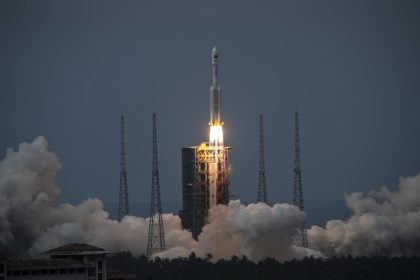
The first mission, called Artemis I, was finished in December 2022, completing the launch of NASA’s potent next-generation mega-rocket and its freshly constructed Orion spacecraft on a 25-day test trip without passengers.
The 10-day Artemis II mission’s goal is to demonstrate that Orion’s life-support systems and other systems will function as intended with humans on board in a deep space environment.
Artemis II will venture some 6,400 miles (10,300 km) beyond the far side of the moon before returning, marking the closest pass humans have made to Earth’s natural satellite since Apollo 17, which carried Gene Cernan and Harrison Schmitt to the lunar surface in December 1972.
They were the last of 12 NASA astronauts – all of them white men – who walked on the moon during six Apollo missions starting in 1969 with Neil Armstrong and Edwin “Buzz” Aldrin.