“Cold Energy” fuels innovation in Eastern China’s aquaculture and industry
June 28, 2026
6 Min Read
Updated 28/06/26 at 7:57 PM
Share
6 Min Read
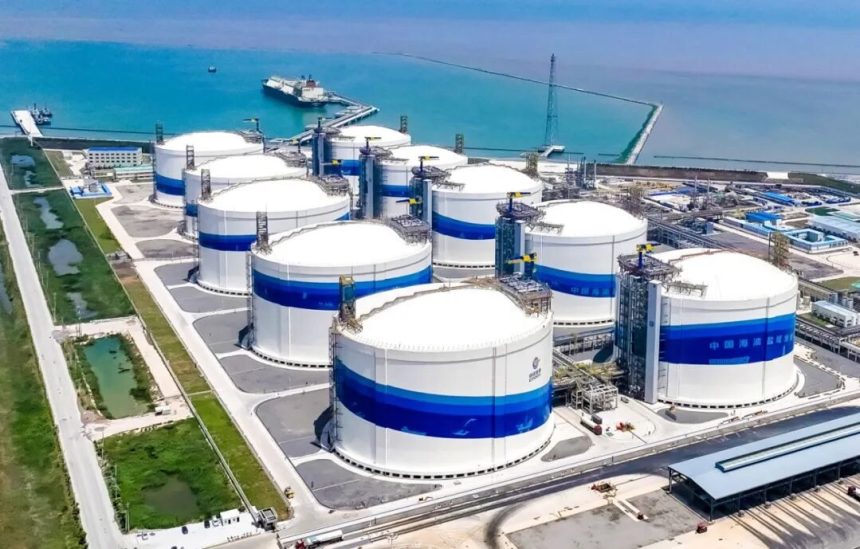
Photo shows LNG storage tanks operated by China National Offshore Oil Corporation at Binhai Port, east China's Jiangsu province.
By Yao Xueqing, People’s Daily
At Taowan Marine Ranch in Binhai county, Jiangsu province, Atlantic salmon glide through large ponds at a land-based aquaculture facility. Wang Chenhao, a freshwater fish technician with over ten years’ experience, is now pioneering marine species cultivation in this unlikely setting.
“We expect market-ready salmon by late this year, priced over 100 yuan ($14.78) per 500 grams!” he said.
How are these cold-water species thriving where average sea temperatures exceed 20 degrees Celsius? The answer lies 10 kilometers away at Binhai Port, where China National Offshore Oil Corporation operates massive liquefied natural gas (LNG) storage tanks.
As China’s largest LNG reserve base, Binhai receives approximately three million tons of LNG annually. LNG, stored at minus 162 degrees Celsius, must exchange heat with seawater to return to a gaseous state for use.
“The heat from seawater warms the gas, while the LNG transfers its cold energy to the seawater,” explained Liu Decan, director of Binhai county’s development and reform commission.
Each ton of LNG releases 50 kilowatt-hours of cold energy during regasification. Considering the port’s annual throughput, roughly 150 million kilowatt-hours of cold energy are generated every year.
Directly discharging such immense cold energy into the sea would waste resources and harm marine ecology. To cope with this issue, in June 2024, Binhai county partnered with the Yellow Sea Fisheries Research Institute of the Chinese Academy of Fishery Sciences to establish a facility using cold energy to cultivate seawater fish.
Real-time temperature sensors are installed across the seawater delivery pipelines. Constant flows of chilled seawater maintain the water temperature of all breeding ponds at roughly 16 degrees Celsius.
“The first phase is already operational, and the second phase will begin this year. Once fully operational, the facility will supply 3,000 tons of cold-water fish annually, generating around 200 million yuan ($295,612) in output,” said Lyu Haijun, chairman of Binhai County Agriculture and Tourism Group.
The “cold energy + aquaculture” model represents just the tip of the iceberg of the “cold industry.”
In the Binhai Port Economic Zone, a silver-gray “cold energy hub” stands prominently. Its one end is connected to LNG storage tanks, the other to a comprehensive cold energy utilization demonstration area.
With an ability to process 2 million tons of LNG cold energy annually, the hub recovers cold energy into liquid carbon dioxide, which is then distributed to various applications in the demonstration zone via temperature-specific exchange systems.
Inside the production workshop of Jiangsu Qinghe Freeze-Drying Technology Co., Ltd. within the demonstration zone, liquid carbon dioxide at minus 46 degrees Celsius supplied by the hub enables strawberries to undergo low-temperature dehydration. This freeze-drying technique preserves the strawberries’ original shape, safeguards their nutritional components intact, and greatly boosts their market value. Such freeze-dried strawberries are priced at 180,000 yuan($26,605) per ton and exported to European and American markets.
“Freeze-drying enterprises are major energy users; electricity accounts for half the production cost,” said Xu Da, assistant general manager of Jiangsu Qinghe “Using cold energy reduces drying time from 22 to 18 hours, cutting costs by 1/3. After being officially put into operation this fall, we expect 7,200 tons of freeze-dried products annually, with sales reaching 1 billion yuan($148 million).”
Facilities catering to a full spectrum of temperature requirements spread across the “cold energy hub”: from quick-freeze cold storage maintained at 40 degrees Celsius below zero, and cold chain logistics facilities kept at 30 degrees Celsius below zero, to ice-themed recreation areas held at 18 degrees Celsius below zero, and constant-temperature manufacturing workshops regulated at 10 degrees Celsius.
Some of these facilities remain under construction, while others are already in full operation. Through the comprehensive development and utilization of cold energy, these vastly different industrial sectors have gathered to build an entirely new industrial cluster.
Among the newly launched projects, a marine intelligent computing center topped out last year and is now advancing construction of its supporting auxiliary facilities.
“The cold energy pipeline network has been linked up to the site. It will deliver reliable cooling for 3,000 server racks with an information technology computing load of 30 megawatts,” explained Wang Huan, deputy director of the administrative committee of Binhai Port Economic Zone.
Beyond supplying general computing services, this intelligent computing center will also serve as a vital technical platform for offshore wind farm operation and maintenance, as well as marine science research simulations.
According to Kong Hui, deputy mayor of Binhai county, under the county’s comprehensive utilization plan for LNG cold energy, the cold energy industry is expected to deliver 10 billion yuan($1.48 billion) in output during the 15th Five-Year Plan period (2026-2030).