

By Ji Juesu, Liu Junguo, People’s Daily
At midday in a bustling yakiniku restaurant in Hachinohe, Japan, grills sizzled with freshly cooked meat as a delivery robot deftly navigated between tightly packed tables, serving steaming plates to diners. “The robot delivers steadily, clean and safe,” the restaurant’s manager remarked with evident approval.
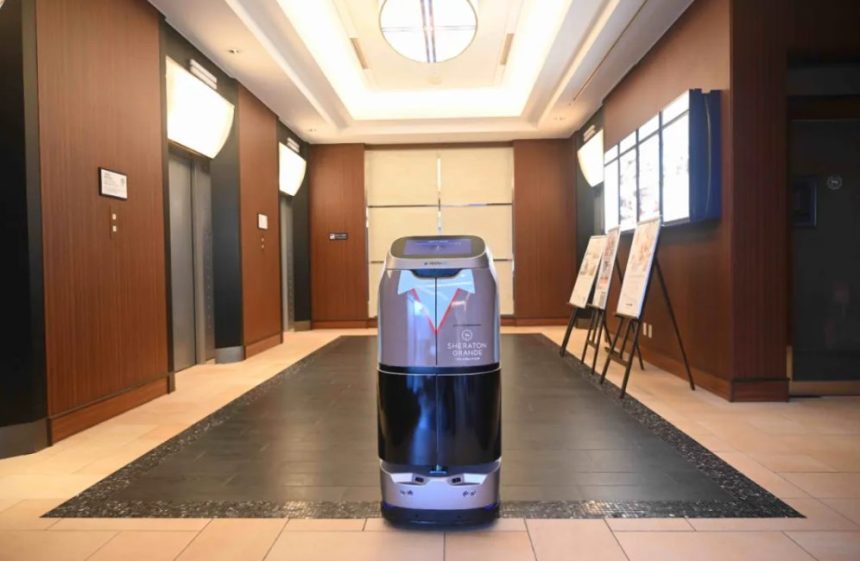
The robot was developed by Keenon Robotics, a leading commercial service robotics company based in Shanghai. It has since become an indispensable member of the restaurant’s staff. Faced with high labor costs and an aging population, an increasing number of hotels, restaurants, and other venues in Japan are turning to service robots to fill staffing shortages.
Five years ago, Keenon Robotics ventured into overseas markets, confident that its advanced technology would ensure success. To its surprise, Japanese partners repeatedly reported: “It’s hard to sell.”
What was the problem?
To investigate, the company’s team fanned out across Tokyo, speaking with locals and observing daily routines. They found that Japanese service culture moves at a gentler pace, and customers favor robots with a warm, approachable appearance, reflecting local aesthetic preferences.
The most pressing issue was size. Robots popular in China proved too large for Japan’s compact spaces, struggling with narrow aisles or tight corners.
In response, Keenon engineered a Japan-specific model: compact, agile, equipped with a Japanese-language voice system, and an expressive animated display.
The redesigned model navigates spaces as narrow as 49 centimeters while carrying multi-tier trays. Advanced cameras and sensors detect obstacles in crowded environments.
The company has now established more than 200 technical support sites across Japan, ensuring that routine malfunctions receive a response within two hours and are repaired within 24 hours.
In one case, when a restaurant chain reported sensor failure, technicians arrived in less than two hours with a replacement unit. The new robot synchronized with the cloud in minutes, inheriting its predecessor’s operational “memories” without retraining. The faulty unit was returned for repair.
“In Japan, hiring a single waiter is costly, but hiring a robot costs only about a third as much,” said Li Tong, founder of Keenon Robotics. “And robots work year-round, with consistent efficiency.”
China’s robot exports are expanding rapidly. Today, Keenon Robotics’ products are used in major Japanese restaurant chains, as well as in libraries, hotels, and other public venues.
To better serve the market, the company has set up local servers, stocked bonded warehouses and maintenance centers with spare parts, and optimized its software algorithms to match Japanese management practices.
Beyond service robots, Chinese-made logistics robots are also winning favor in Japan. According to Yosuke Tsuyuguchi, a professor at the Department of Economics at Teikyo University in Tokyo, the industry’s evolution – from competing on scale to competing on technology, quality, and brand – illustrates the transformation of Chinese manufacturing.
At the Kansai Logix 2025 in Japan, Mushiny Robotics based in Huzhou, east China’s Zhejiang province, received high attention with its sorting systems and “goods-to-person” (GTP) solutions, showcased by Japanese companies such as Toshiba and Mitsubishi.
The company’s logistics robots and software already support multiple pharmaceutical warehouses in Japan’s Kanto region, meeting the sector’s growing automation needs. In another case, a newly designed workbin handling and picking robot designed for a major Japanese automaker stood out amid fierce competition and won the client’s approval.
Specializing in the research, development, and production of logistics robots and equipment, Mushiny Robotics exports more than 70 percent of its products to developed countries.
“Our orders are already booked through September, and our first-half sales hit a record high, up nearly 30 percent year on year,” said He Zijie, head of Mushiny Robotics’ hardware technology center. “Our products are becoming a familiar presence in overseas logistics automation projects.”
With cutting-edge innovation and a deeply localized approach, the company has firmly established itself in Japan. Looking ahead, it will continue developing products to meet the specific needs of Japan’s logistics sector, working toward mutual growth and success.