






By Wu Jun, People’s Daily
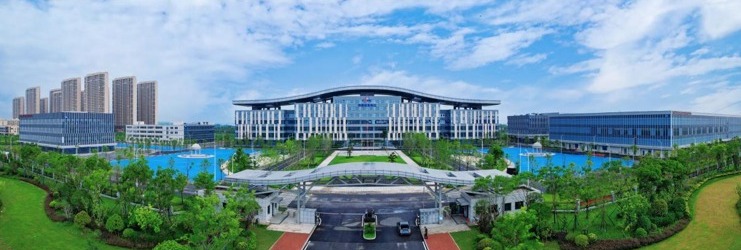
As home to China’s first commercial aerospace industrial base, namely the Wuhan National Aerospace Industry Base, Wuhan city, capital of central China’s Hubei province, is making significant progress in the exploration of capabilities and application scenarios of the commercial aerospace industry.
Recently, a Kauizhou-1A (KZ-1A) carrier rocket produced in the Wuhan National Aerospace Industry Base successfully launched five satellites, the A to E satellites belonging to the Head-3 micro-satellite constellation, into their planned orbits from the Xichang Satellite Launch Center in southwest China’s Sichuan province.
The Kuaizhou-series rockets are solid-propellant launch vehicles independently developed by the Kuaizhou rocket industrial park within the Wuhan National Aerospace Industry Base. The first batch of the Kuaizhou-1A rockets rolled off the production line at the industrial park in 2021.
So far, the Kuaizhou series rockets have been successfully launched over 20 times, sending more than 40 satellites into their planned orbits.
Initiated in 2017, the Wuhan National Aerospace Industry Base has achieved an annual production capacity of up to 50 rockets and has built the backbone of an industry chain encompassing satellites, rockets, cloud platforms and aerospace materials.
In November 2014, China’s State Council issued guidelines on innovating investment and financing mechanisms of key areas to encourage social investment, inspiring private enterprises to participate in civil space infrastructure construction. The document ushered in new opportunities for China’s commercial aerospace industry.
At the time, Wuhan-based China Space Sanjiang Group Co., Ltd., a subsidiary of the China Aerospace Science and Industry Corporation Limited (CASIC), envisioned potential in the commercial aerospace industry and was poised to step into it.
“As a transportation hub linking nine provinces, Wuhan has rather developed land and water transport. Development of the aerospace industry here not only enjoys the advantage of convenient transportation of aerospace products, but can boost the growth of upstream and downstream links of the entire industrial chain across the country,” said an executive of the CASIC.
In 2017, the construction of the Wuhan National Aerospace Industry Base kicked off in Shuangliu subdistrict of Wuhan’s Xinzhou district under a partnership between the CASIC and the Hubei Provincial People’s Government.
Thanks to tireless efforts of relevant parties, a demonstration zone featuring the integration of the aerospace industry and city development, with an area of 8 square kilometers, took shape in 2022.
In the satellite industrial park of the Wuhan National Aerospace Industry Base, one can enter China’s first intelligent satellite production line after donning white work clothes and cap and going through dust removal.
Inside the satellite production line, dozens of components for satellite manufacturing are neatly placed in a 10-meter-tall component warehouse.
The entire production process, from components delivery to assembly, final assembly and testing, is highly automated.
The production line has realized flexible and intelligent satellite manufacturing, according to Liu Feng, deputy director of the Wuhan intelligent manufacturing center of the CASIC’s Space Engineering Department.
It can meet the needs for the development and production of single satellite as well as mass production of customized satellites, Liu said.
With a deep understanding of the development of the aerospace industrial chain, the Wuhan National Aerospace Industry Base has consistently improved the business environment for the growth of aerospace manufacturing, services and supporting industries.
It has attracted 17 industrial projects spanning such industries as commercial aerospace, new materials, and data application, and completed cumulative investments of nearly 20 billion yuan ($2.76 billion).
“We earn our main revenues by providing satellite launch services, and additional income by offering customized peripheral services to companies, enhancing the overall profitability of commercial rockets,” said Liu Xin, deputy general manager of CASIC Rocket Technology Company, a holding subsidiary of the China Space Sanjiang Group Co., Ltd.
The company has established brand partnerships with over 10 companies, according to Liu.
In addition to satellites and rockets, the Wuhan National Aerospace Industry Base has also continuously explored more application scenarios for space technologies along the long industry chain to expand the development models of the commercial aerospace industry.
At the telemetry, command and control center of a holding subsidiary of the China Space Sanjiang Group Co., Ltd., real-time data on the location, door status, internal temperature and humidity as well as other information about the containers carried by the China-Europe freight trains are displayed on large screens.
This application scenario represents an emerging commercial aerospace development model based on the use of remote sensing satellites, satellite internet and aerospace technologies in areas like environmental monitoring, smart transportation, and emergency communications, according to Pi Benjie, an executive of the telemetry, command and control center.
“In 2020, we successfully launched two communications satellites. After networking them into a constellation, we can eliminate communication blind spots in areas where ground networks can’t reach, like oceans, polar regions, forests and deserts,” explained Pi.
In an effort to strengthen, complement and expand the commercial aerospace industrial chain, local authorities have accelerated efforts to promote communication and attract more enterprises through diverse means.
The government of Xinzhou district has reportedly signed over 10 billion yuan worth of agreements with many renowned Chinese enterprises to jointly create different commercial aerospace application scenarios.





