


By Han Xin, People’s Daily
Along the Bohai Sea coast, Tianjin Port stands as a dynamic hub where the value of port-driven development continues to expand.
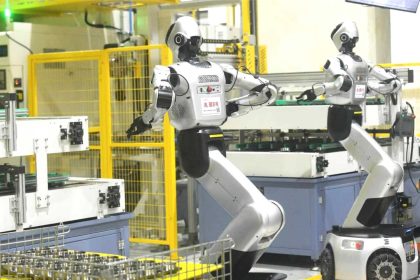
Within the port, towering gantry cranes and docked vessels form a bustling scene. Smart control systems work in tandem with AI-powered transport robots to keep operations running smoothly, handling over 1.5 million tons of cargo everyday.
Just a few dozen kilometers away in Binhai New Area, trading companies leverage direct shipping routes to Latin America, establishing a rapidly maturing supply chain for imported fruits. During the first five months of this year alone, Tianjin Port recorded imports of fruits and seafood from Latin America worth 8.1 billion yuan ($1.13 billion).
In Tianjin’s Heping district, a steady flow of cross-border trade financing is helping inject fresh vitality into international shipping. The growing logistics simultaneously drives with modern service sector enterprises now comprising 98% of district businesses.
Tianjin Port offers a vivid snapshot of the broader growth seen across China‘s port economy. According to the Port Economic Development Report of Chinese Seaport Cities 2024 released by the Transport Planning and Research Institute under the Ministry of Transport, the total value-added output of China’s coastal ports reached 6.7 trillion yuan in 2024, a year-on-year increase of 360.6 billion yuan.
“The port economy of seaport cities centers on the port itself, using the city as a platform. It encompasses a wide range of port-related industrial activities, integrating ports, industries, and urban development into a unified, open economic system,” said Liu Zhanshan, deputy director of the Transport Planning and Research Institute.
Ports’ economic impact is quantifiable: each 10,000 tons of cargo handled at coastal ports generates roughly 1.94 million yuan in GDP. Additionally, every 100 million yuan invested in port construction creates nearly 10,000 jobs. By the end of 2024, China had 2,971 berths capable of accommodating vessels of 10,000 tons or more, 1.4 times the number from a decade ago.
On May 15, China’s largest vessel powered by solar energy and liquefied natural gas , the Yuanhai Kou, was officially delivered at Nansha Port in Guangzhou, south China’s Guangdong province. The ship transported nearly 4,000 China-manufactured vehicles to multiple European destinations.
Today, shipping vehicles from Guangzhou has become the preferred solution for many automakers. In 2004, Guangzhou Port handled just 15,000 vehicles. By 2024, the number had soared to over 1.4 million, a near 100-fold increase over two decades. As southern China’s largest automotive export terminal, the port reflects the rapid rise of the country’s new energy vehicle industry.
While the composition of port cargo continues to evolve, the drive toward industrial upgrading remains constant. The report shows that in 2024, port-driven economic activity accounted for 15%, 22%, and 8% of the output in the primary, secondary, and tertiary sectors, respectively. Ports are playing a particularly strong role in supporting agriculture and manufacturing sectors.
“Within the secondary sector, port-driven growth has been especially notable in strategic emerging industries such as computer and communication equipment and chemical products. These industries accounted for 15.9% and 12.7% of incremental growth in the secondary sector, respectively,” Liu explained. “This shows ports are playing a key role in helping surrounding industries upgrade and transform.”
The evolution of China’s port economy also reflects the increasingly symbiotic relationship between ports and cities.
In Rizhao, east China’s Shandong province, summer breezes now sweep across Hailong Bay, a site once dominated by coal yards. As China’s first “port-to-city restoration” project, Hailong Bay has undergone a dramatic transformation: the coal operations were relocated, 1,882 meters of ecological shoreline restored, and 460,000 square meters of new beach area created. The port is now a scenic zone, attracting a steady stream of tourists, said a local official.
By leveraging a “port-industry synergy model,” Rizhao Port has built an integrated supply chain spanning grain logistics, storage, and feed processing. The port serves as a key logistics node for multiple provinces including Shandong, Henan, Shaanxi, and Sichuan, attracting major players such as COFCO and China Grain Reserves Group. Currently, over 85% of Rizhao’s output value of industrial enterprises above the designated size comes from port-related industries.
Ports drive urban growth, and in turn, cities fuel the development of ports. The report highlights how port economies are becoming increasingly significant drivers of urban development. In Tianjin, for instance, 147 container shipping routes link Tianjin Port to over 500 terminals around the world, and the city’s marine economy has surpassed 400 billion yuan. In Yantai, Shandong province, a comprehensive supply chain service park is under construction, set to upgrade the traditional port area into a modern port service hub that better integrates with city development.
Across China, a growing number of modern, globally competitive ports are emerging as vital pillars in the country’s journey toward high-quality development.