




By Zhang Wen, People’s Daily
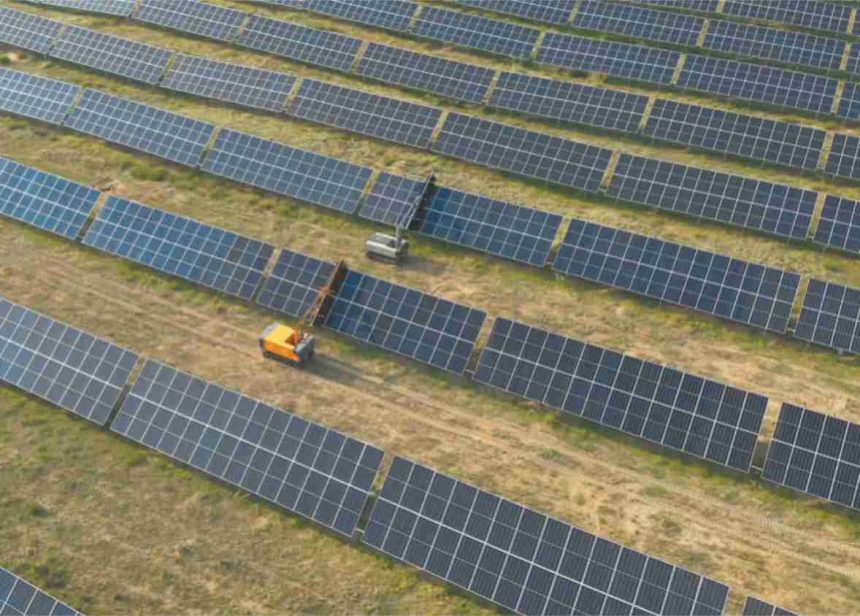
The vast blue “ocean” before me is where I work. More than 10 million photovoltaic panels stretch across this area, forming a sprawling “blue sea” that covers 12,000 hectares, an area equivalent to more than 16,000 international standard football pitches.Located southeast of Yinchuan, capital of northwest China’s Ningxia Hui autonomous region, this area lies on the edge of the Mu Us Desert. For years, it was a barren expanse of Gobi wasteland.Since 2022, this Gobi wasteland has been transformed. Rows of photovoltaic panels have taken root here, gradually blanketing the landscape. At the end of February this year, a photovoltaic power base with a total installed capacity of 6 million kilowatts was completed. Each year, the base converts the Gobi’s intense sunlight into about 10.8 billion kilowatt-hours of clean electricity, enough to meet the annual power needs of 7.2 million households. I have also made this place my home.You may wonder who I am. I am the base’s smart inspection drone, its “little caretaker.” Here is my “inspection log.”At the start of a new day, as soon as my hatch opens, I begin my inspection duties.My home, the drone hangar, is a metal cabin more than one meter high, located beside the photovoltaic panel arrays. Every day, following instructions preset by engineers, I take off, inspect along a fixed route, return, and land back in the hangar on schedule. I then recharge automatically, using electricity generated by the base’s own photovoltaic panels.

I fly at an altitude of around 35 meters, the optimal height calculated by engineers for inspections. With the help of 5G networks and the BeiDou Navigation Satellite System, I fly steadily along my designated flight path. My dual high-definition cameras capture every detail of the photovoltaic panels below. Equipped with visible-light cameras and an infrared gimbal camera, my imaging system can accurately identify 12 types of faults, including hot spots, microcracks, and diode failures.Each inspection flight takes about 50 minutes. After completing a mission, I return to the hangar to recharge before heading out again. I make at least eight “trips” a day, completing the workload that once took human inspectors more than half a month. After each inspection, I automatically generate a report, helping engineers keep track of the base’s condition in a timely manner.I detect a photovoltaic panel with partial contamination. Upon closer inspection, I find a large patch of bird droppings on the panel. The contamination has affected power generation, causing a sharp rise in the panel’s local temperature — a hot spot. I immediately use the intelligent system to generate a report with images and text and send it to the engineers.The engineers work at the centralized control center in downtown Yinchuan, more than 50 kilometers away. There, wall-sized screens display real-time data on power generation and equipment status for each photovoltaic array. After receiving my report, the engineers simply operate a tablet and dispatch an unmanned cleaning robot to the affected panel.Standing about three meters tall, the cleaning robot is equipped with a long mechanical arm fitted with a cleaning brush. Like me, it operates automatically with the help of 5G networks and the BeiDou Navigation Satellite System. It moves to the photovoltaic panels and, with a sweep of its arm, cleans them thoroughly. Its crawler-type chassis allows it to move easily across the rocky terrain of the Gobi.The base is expanding its use of unmanned equipment. In the future, around 20 smart inspection drones like me will operate here. The base’s major innovations in unmanned operation and maintenance have reached internationally leading levels.When construction of the base began in 2022, the surrounding area was still a barren Gobi landscape. During inspections, sandstorms would often leave my high-definition cameras “blinded,” making it difficult to see the ground clearly. As the base was built, the large photovoltaic panels helped block strong winds and reduced the frequency of dust storms.The panels also shielded the ground from intense sunlight, increasing soil moisture and allowing grass to grow across the Gobi. The barren land gradually turned green. People were delighted by the change and began planting various plants, including honeysuckle, astragalus adsurgens, and bush clover.To make better use of precious rainfall, engineers installed rainwater collectors and drainage pipes on the photovoltaic panels, directing water evenly onto the soil beneath them and accelerating vegetation growth. In some areas of the base, vegetation coverage has exceeded 30 percent.The area where the photovoltaic base is located contains several deep coal mines and has been designated as a coal mining subsidence zone. To better monitor ground subsidence, engineers drilled holes and installed more than 100 geological sensors about one meter underground.
Once cracks, displacement, or other changes occur on the surface, the sensors send out graded warnings. This not only allows engineers to adjust photovoltaic panel layouts in affected areas in a timely manner, but also accurately identify subsidence locations to support ecological restoration.
Isn’t this land full of technological wonders?