



By Rana Tahir Shahbaz
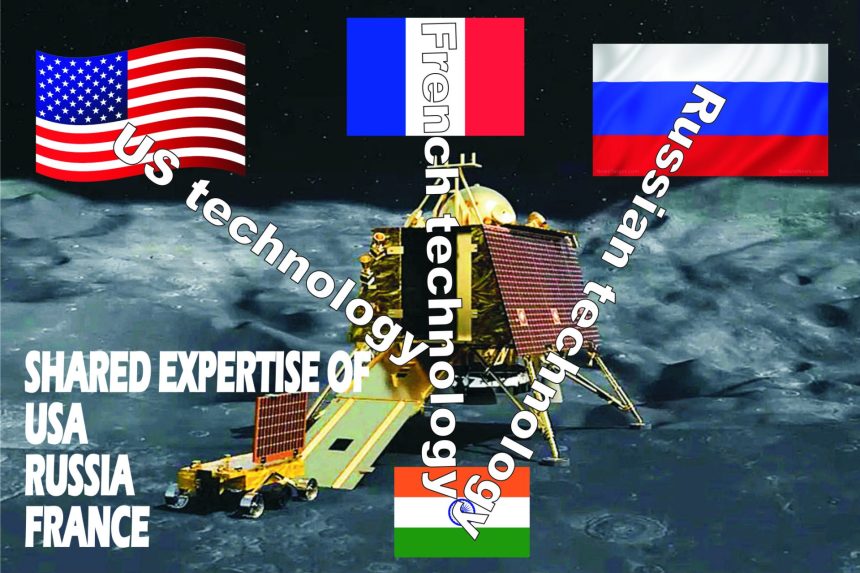
In recent years, space exploration has captured the attention of nations around the world. India’s foray into lunar exploration has been particularly noteworthy, with its Chandrayaan missions making significant strides in uncovering the mysteries of the moon. However, a closer look reveals that these accomplishments are the result of a complex web of international collaboration, with technologies and support from countries like the United States, France, and Russia playing a pivotal role. While India’s achievements should indeed be celebrated, it’s important to acknowledge the significant contributions made by its global partners.
Shared Expertise: The American Connection
India’s Chandrayaan missions have benefited immensely from the collaboration with American space agencies and institutions. The Indian Space Research Organisation (ISRO) has leveraged American expertise in various areas, including satellite communication, space technology, and mission planning. For instance, instruments aboard the Chandrayaan-1 mission, like the Moon Impact Probe (MIP), were designed and developed with assistance from NASA and other American organizations. The Miniature Synthetic Aperture Radar (Mini-SAR) on board was a product of collaboration between ISRO and the Johns Hopkins University Applied Physics Laboratory.
French Touch: Scientific Contributions
France, too, has played a significant role in India’s lunar exploration efforts. The payloads and instruments carried by the Chandrayaan missions often have French origins, highlighting the close partnership between ISRO and the French space agency, CNES. The Moon Impact Probe on Chandrayaan-1, for instance, contained a mass spectrometer developed by CNES. The IR spectrometer on the Chandrayaan-2 orbiter was jointly developed by ISRO and CNES. This underscores the importance of international collaboration in advancing scientific research and technology development.
Russian Collaboration: Launch Capabilities
Russia has been a longtime partner of India in space exploration, providing crucial launch services for its missions. The Indian lunar missions, including Chandrayaan-1 and Chandrayaan-2, were launched using Russian rockets. The cooperation between ISRO and the Russian space agency, Roscosmos, has played a vital role in India’s space endeavors. It highlights the global nature of space exploration, where nations pool their resources and expertise to achieve ambitious goals.
Balancing National Pride and International Collaboration
While celebrating its achievements, India has, at times, been criticized for downplaying the contributions of its international partners. The vibrant Indian media has sometimes projected these achievements as solely the nation’s own, omitting the essential role played by other countries. Such portrayal can lead to misunderstandings and perpetuate the idea that space exploration is a solitary endeavor. It’s essential to strike a balance between acknowledging a nation’s accomplishments and recognizing the collaborative nature of scientific progress.
Conclusion is that India’s strides in lunar exploration are undoubtedly commendable and reflect its growing prowess in space technology and research. However, it’s crucial to recognize that these achievements are the result of a complex international collaboration involving American, French, and Russian expertise and support. The contributions of these countries have been instrumental in the success of India’s Chandrayaan missions. As the global community continues to push the boundaries of space exploration, cooperation among nations will remain the cornerstone of progress. By acknowledging and celebrating these collaborations, we can embrace the true spirit of scientific advancement and unity.