




By Li Kaixuan, People’s Daily
The new building of the Sanxingdui Museum in southwest China’s Sichuan province officially opened to the public on July 27. Nearly 600 relics unearthed from the renowned Sanxingdui Ruins debuted to the public.
A total of more than 1,500 pieces or sets of relics, including pottery, bronze, jade and gold wares are showcased in the new building, which has an exhibition area of 22,000 square meters.
The Sanxingdui Ruins is the largest ruins of the pre-Qin period (pre-221 BC) featuring the longest duration and the most relics unearthed in southwest China. It is dubbed as one of the greatest archaeological findings in the 20th century. Its core area, the Sanxingdui Ancient City, covers an area of about 3.6 square kilometers, and went into prime in mid- and late-Shang Dynasty (1600-1046 BC) more than 3,000 years ago.
Over recent years, a number of advanced technologies in multiple disciplines have been employed in archaeological excavations at the Sanxingdui Ruins site, which innovated the research models of major archaeological projects and built open platforms for interdisciplinary cooperation.
For instance, from the black ashes uncovered from the sacrificial pits at the site, experts revealed textile techniques over 3,000 years ago; with the artificial intelligence technology, a replica of a bronze altar was made by bronze ware fragments unearthed in different sacrificial pits.
Relics are in a relatively stable state when they are buried underground. The drastic environmental change after they are unearthed may bring devastating damages to them if protection measures are not taken in a timely manner, such as discoloring and carbonization of organic matters.
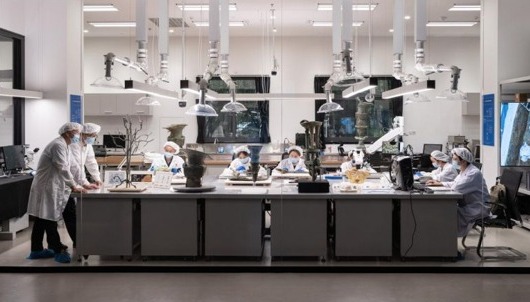
The 2021 excavation of the Sanxingdui Ruins site just amazed the public with its tech-ish transparent archaeological cabins and archaeologists in “protective suits.” The enclosed cabins were equipped with temperature and humidity controllers, and able to shield relics from dust, bacteria and other polluting factors, thus offering reliable in-situ protection. There were also a laboratory for relics emergency protection and temporary warehouses beside the cabins.
Unearthing relics is a challenging task. Archaeologists must sample the soil and adhesions on relics and then test pH values, soluble salt, and moisture content, so as to offer a basis for unearthing and preservation.
To not damage large bronze wares when extracting them from the Sanxingdui Ruins, archaeologists for the first time made 3D-printed silica gel protective cases that perfectly fitted the bronze wares.
Besides, real-time kinematic technology was employed in the excavations at the Sanxingdui Ruins site to record the longitudes and latitudes of soil samples and unearthed relics, as well as their ages and materials. A QR code was generated for each relic as its unique “identity card.”
To piece together bronze ware fragments unearthed in different sacrificial pits, the relics preservation team of the Sanxingdui Ruins collaborated with a digital lab under Chinese tech giant Tencent, obtained the fragments’ geometrical features with artificial intelligence technology, and verified the possibilities of different combinations. This enabled researchers to restore the original appearance of relics in the virtual space without even touching physical items.
Due to insufficient sci-tech capability, studies on many relics unearthed remained stagnant in the past. In the 1980s, a large batch of bronze wares, gold wares and jade wares were discovered at the Sanxingdui Ruins site, which astonished the world. Researchers found ashes on bronze wares and considered them residues of silk, but there was no technology then able to prove this point.
The puzzle was not solved until recent years. Thanks to a fibroin detection technology developed by the China National Silk Museum and other institutions based on immunology, silk residues were discovered in sacrificial pits at the Sanxingdui Ruins site in 2021.
With ultra-depth microscopes, micro Fourier transform infrared spectroscopy and other advanced analysis technologies, researchers restudied some bronze wares unearthed some 30 years ago and confirmed the existence of silk on them.
The finding proved that ancient residents during that period of history had already developed mature textile techniques and skills, and offered physical materials for the studies of textile history of Sichuan province, said Zhou Yang, a researcher with the China National Silk Museum.
Technology is like a microscope that enables researchers to see more details on relics and thus obtain information that was once difficult to get.
The aging of relics is irreversible, no matter what materials they are made of. Recording the information of relics through digital means would give them a “new life.” With digital technology, researchers and visitors from all over the world can obtain the information of relics anytime and anywhere. As cultural relics turn from a material resource to a digital one, they are contributing more energy to mutual learning among civilizations and science popularization and education.