

By Liu Shiyao, Li Junqiang, People’s Daily
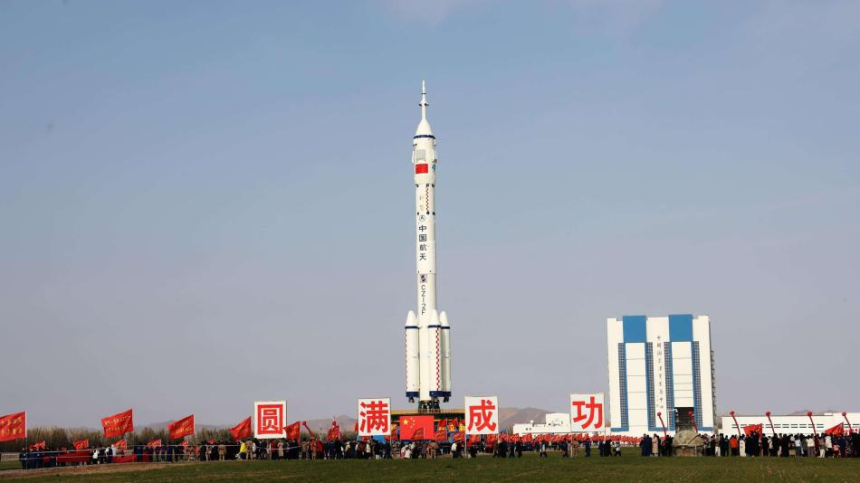
At 11:44 p.m. Beijing time on Oct. 31, the Shenzhou-21 manned spacecraft, aboard a Long March-2F carrier rocket, lifted off from the Jiuquan Satellite Launch Center in northwest China, embarking on a journey to China’s space station.

This marked the 37th flight mission of China’s manned space program and the sixth manned flight mission since the space station entered the application and development phase.
According to Zhang Jingbo, a spokesperson for the China Manned Space Agency, the main objectives of the mission are to complete an in-orbit rotation with the Shenzhou-20 crew, stay in the space station for about six months, and carry out space science and application tasks.
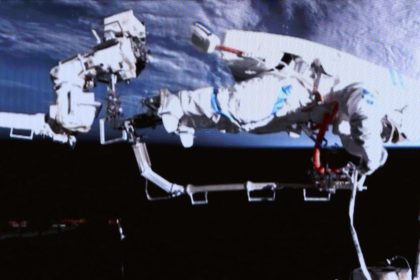
The astronauts will perform extravehicular activities, manage cargo transfers in and out of the modules, install space debris protection devices, and mount and retrieve external payloads and facilities. They will also engage in science education and public outreach activities, as well as conduct space-based experiments to further enhance the comprehensive benefits of the space station’s applications.
During their stay, the Shenzhou-21 crew will undertake 27 new scientific and application projects. These projects will focus on key scientific issues in areas such as space life science and biotechnology, space medicine, space materials science, microgravity fluid physics and combustion, and new spacecraft technologies.
Notably, the mission will carry out China’s first in-orbit scientific experiment involving rodent mammals. Four mice, two male and two females, have traveled with the spacecraft and will be raised in orbit. The experiment will explore how microgravity and confined space conditions affect behavioral patterns. After returning to Earth, further studies will be conducted to explore how multiple organs and tissues of mice respond and adapt to the stress of the space environment.
The spacecraft also carries experimental payloads related to space applications, including in-situ electrochemical and optical studies of lithium-ion batteries and an on-orbit intelligent computing platform. These projects are expected to provide a scientific foundation for future research and strengthen the station’s long-term application capabilities.
Since its inception, China’s manned space program has adhered to the principles of peaceful use, equality and mutual benefit, and common development. China continues to promote international cooperation by inviting foreign astronauts to participate in missions to its space station, contributing to the progress of space technology and benefiting humanity as a whole.
Following the signing of a cooperation agreement between China and Pakistan in February this year, the selection of Pakistani astronauts for participation in China’s space missions has officially begun. The preliminary selection process is currently under way in Pakistan, while the secondary and final selections will take place in China.
Upon completion, two Pakistani astronauts will train alongside their Chinese counterparts. One of them will be selected to participate in a short-duration spaceflight mission as a payload specialist and conduct scientific experiments for Pakistan.
Zhang reaffirmed that China is holding firm to its goal of landing astronauts on the moon by 2030. He noted that the country’s manned lunar exploration program is progressing smoothly.
Since the beginning of this year, China has completed several key tests, including the second-stage propulsion system test and the captive firing test for the Long March-10 rocket, the zero-altitude escape test for the Mengzhou spacecraft, and the comprehensive landing and takeoff verification test for the Lanyue lander.
Upcoming tests will include integrated testing of the lander, thermal and maximum dynamic pressure escape tests of the Mengzhou spacecraft, and low-altitude and technology verification flights of the Long March-10 rocket.
Since the approval of the space station application and development project and the manned lunar exploration program, China has actively adopted a commercial competition model to encourage the participation of private enterprises in spacecraft development and manufacturing. This approach has been applied to projects such as the low-cost cargo transport system for the space station, the crewed lunar rover, and lunar remote-sensing satellites. Contracts for these projects have been signed, and development work is under way. The share of commercial participation in China’s manned space program has increased substantially, accelerating technological progress and yielding increasingly significant results.
Looking ahead, China will continue to expand commercial participation in future projects, including the development of lunar scientific probe platforms and crater-detection platform, to further stimulate innovation and vitality in the country’s commercial space sector.