

By using this site, you agree to the Privacy Policy and Terms of Use.
Accept
China ObserverChina Observer
Notification
Latest News
Yiwu home to more than 10,000 foreign-funded business entities
March 29, 2026
China planning human research program at space station
March 28, 2026
China’s narrative of economic resilience, technological advancement takes center stage at Boao Forum
March 28, 2026
The Devastating Impact of Wars on Climate Change
March 26, 2026
MSM Unify and Walsh College UAE Release Whitepaper on Middle East’s Rising Role in Global Student Mobility
March 25, 2026
Aa
  • Home
  • Pakistan
  • China
  • Sports
  • World
  • Business
  • Technology
  • Entertainment
  • Tourism
  • Videos
  • Health
  • More
    • Articles
    • Currency Rates
    • Gold Rates
    • Daily Horoscope
Reading: Resurrecting ancient art: Digital technology reawakens murals of Kizil Caves in Xinjiang
Share
Aa
China ObserverChina Observer
  • Home
  • Pakistan
  • China
  • Sports
  • World
  • Business
  • Technology
  • Entertainment
  • Tourism
  • Videos
  • Health
  • More
Search
  • Home
  • Pakistan
  • China
  • Sports
  • World
  • Business
  • Technology
  • Entertainment
  • Tourism
  • Videos
  • Health
  • More
    • Articles
    • Currency Rates
    • Gold Rates
    • Daily Horoscope
Have an existing account? Sign In
Follow US
China Observer > Blog > China > Resurrecting ancient art: Digital technology reawakens murals of Kizil Caves in Xinjiang
China

Resurrecting ancient art: Digital technology reawakens murals of Kizil Caves in Xinjiang

July 25, 2025 4 Min Read
Updated 25/07/25 at 9:56 PM
Share
4 Min Read
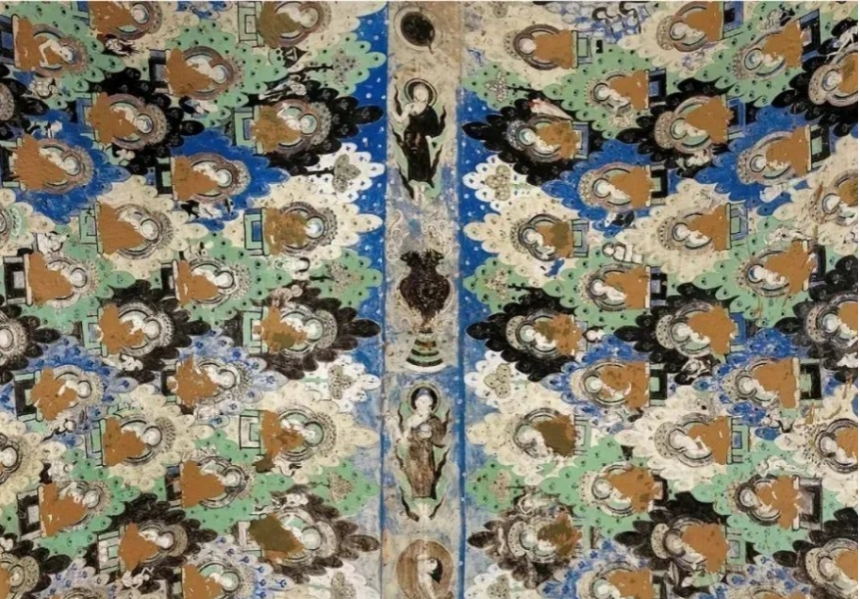
Photo shows the diamond motifs on the mural in Cave 178 at Kizil Thousand-Buddha Caves in Baicheng county, Aksu prefecture of northwest China's Xinjiang Uygur autonomous region. (File photo)

By Li Yanan, Dong Yingxue, People’s Daily

Within the Kizil Thousand-Buddha Caves in Baicheng county, Aksu prefecture of Xinjiang Uygur autonomous region, visitors are greeted by a refreshing coolness – a welcome respite from the arid expanse of northwest China. Here, among the country’s earliest large-scale grotto groups, cave walls shimmer with rows of jewel-toned diamond patterns. Each geometric frame encapsulates a story, with blues and greens from millennia-old murals unfolding in solemn procession across stone canvases.

Yet time has been unkind. As China‘s oldest surviving Buddhist cave complex, Kizil confronts relentless preservation challenges. Centuries of aging, smoke damage, and human intervention have compromised its artistic legacy. “Restoration is painstaking,” said Yang Jie, a staff member at the Kizil Grottoes research institute. “A single four-to-five-square-meter mural can demand over two months of meticulous work.”

Of Kizil’s 349 caves, 107 contain murals spanning nearly 4,000 square meters, only a fraction of their original glory. In the early 20th century, foreign expeditions removed significant portions. According to Zhao Li, a researcher at the institute, around 500 square meters of murals from 59 caves were stripped away.

From 2002 to 2016, Zhao collected 487 high-resolution images of these scattered fragments from over 20 international museums and brought them back to China for digital restoration. This meticulous effort required extensive research to determine each mural’s original location. She digitally cropped and reassembled the pieces like a massive jigsaw puzzle, culminating in 2020 with the most comprehensive catalog of displaced Kizil artworks – a 1,200-plate compendium mapping each artwork to their ancestral caves.

Where soot obscures murals, advanced technologies now illuminate. A project jointly launched by the China Cultural Heritage Information and Consulting Center, the Digital Culture Laboratory under Tencent’s Sustainable Social Value organization, and the Tencent Research Institute, is pioneering the use of terahertz imaging, X-ray analysis, and large language models to identify,  reconstruct and digitally restore damaged artworks

In Cave 161, layers of grime cloak artistic narratives. A research team from the School of Art and Archaeology of Zhejiang University employed terahertz time-domain spectroscopy to non-invasively penetrate the darkened surfaces, revealing pigment layers beneath and effectively seeing through centuries of residue without damaging the murals.


“We’ve identified one figure, two concentric circles on the dome, and diamond motifs, all classic Kuqa artistry,” said Zhang Hui, professor with Zhejiang University, gesturing toward the blackened ceiling. Next, the team will digitally reconstruct these findings using advanced analytical techniques.

Meanwhile, Cave 38’s fragmentary murals defy conventional restoration. Here, artificial intelligence offers a breakthrough: The Digital Xinjiang Group utilizes image recognition to hypothesize and reconstruct missing sections – a technological leap accelerating preservation.

At the foot of the Mingwutag Mountain, poplars planted decades ago by researchers stand sentinel beside the caves. Today, as these silent witnesses guard Xinjiang’s cultural legacy, technological innovation breathes new vitalityinto ancient pigments, ensuring their stories endure for generations.

You Might Also Like

Yiwu home to more than 10,000 foreign-funded business entities

China planning human research program at space station

China’s narrative of economic resilience, technological advancement takes center stage at Boao Forum

Chinese smart technologies shine at 2026 Mobile World Congress

A day in the life of China’s economy

admin July 25, 2025
Share this Article
Facebook Twitter Whatsapp Whatsapp LinkedIn Email Print
Leave a comment

Leave a Reply Cancel reply

You must be logged in to post a comment.

Follow US

Find US on Social Medias
Facebook Like
Twitter Follow
Instagram Follow
Youtube Subscribe
China

Yiwu home to more than 10,000 foreign-funded business entities

ChinaTechnology

China planning human research program at space station

China

China’s narrative of economic resilience, technological advancement takes center stage at Boao Forum

Articles

The Devastating Impact of Wars on Climate Change

World

MSM Unify and Walsh College UAE Release Whitepaper on Middle East’s Rising Role in Global Student Mobility

You Might Also Like

China

Yiwu home to more than 10,000 foreign-funded business entities

March 29, 2026
ChinaTechnology

China planning human research program at space station

March 28, 2026
China

China’s narrative of economic resilience, technological advancement takes center stage at Boao Forum

March 28, 2026
China

Chinese smart technologies shine at 2026 Mobile World Congress

March 16, 2026
logo-chinaoberver-tranparent-small

About US

We influence 20 million users and is the number one business and technology news network on the planet.
  • Contact
  • Blog
  • Complaint
  • Advertise
Menu
  • Contact
  • Blog
  • Complaint
  • Advertise

Market Performers

Subscribe US

Weather Widgets for Websites

©China observer. All Rights Reserved.

Removed from reading list

Undo
Welcome Back!

Sign in to your account

Lost your password?