




By Tian Xianjin, You Yi, Song Zhaojun, People’s Daily
From cranberries grown in northeast China’s Heilongjiang province to caviar produced in Sichuan province in the southwest, and from Australian red claw crayfish bred in southwest China’s Chongqing to king prawn cultivated in northwest China’s Gansu province, an increasing number of high-end ingredients originally from the West are now evolving into new specialties of Chinese counties.
These former imports are not only capturing local appetites, but also becoming full-fledged industries that are revitalizing regional economies and shaping new agricultural identities.
French foie gras finds a foothold in Anhui
At Anhui Renjun Poultry Farming Co., Ltd., the air is thick with the honking of geese – hundreds of them clustered inside bustling workshops.
“Every part of the Landes goose is valuable, but the liver is especially prized as a gourmet ingredient in French cuisine,” said Zhu Renjun, the company’s manager.
Native to the Landes region in southwestern France, the Landes goose now thrives in Huoqiu county, east China’s Anhui province. Home to over 140 foie gras producers, Huoqiu produces over 5 million geese annually and more than 5,000 tons of foie gras.
Huoqiu has a long tradition of goose farming, particularly the local Wanxi white goose. With the growing demand for foie gras, local farmers introduced the Landes goose for breeding, and the industry expanded rapidly. Today, foie gras has become a regional hallmark.
Zhu is now focused on expanding the market share of Huoqiu’s foie gras. “Right now, we mainly sell to hotels and online consumers. To reach a broader customer base and boost market presence, we need to break into brick-and-mortar supermarket chains,” he said.
To meet that goal, the company is upgrading its production lines. “Supermarkets demand strict quality assurance. We’re planning to install more surveillance cameras and digitize our operations for real-time monitoring. Cold storage will also need a major upgrade,” Zhu explained. “The total investment will likely run into several million yuan (1 million yuan is approximately $139,400.70), but it’s well worth for access to a much larger market.”
Caviar from the mountains of Sichuan
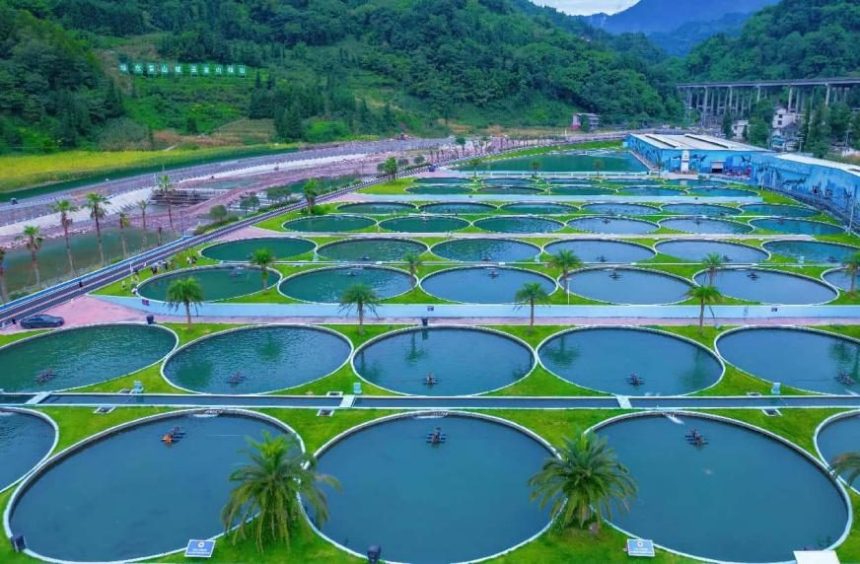
Nestled at the foot of snow-capped Erlang Mountain, more than 100 circular fish ponds glint in the sunlight – each home to sturgeons bred in Ya’an, Sichuan province. Spring-fed streams and clean, cold water make the area ideal for cultivating this ancient fish.
“Sturgeons thrive in water temperatures between 12 and 20 degrees Celsius. Ya’an offers abundant cold-water resources with excellent water quality and high oxygen content, making it perfect for caviar farming,” said Li Jun, chairman of Sichuan Runzhao Fisheries Co., Ltd.
After learning sturgeon farming techniques, Li established his aquaculture base in a modern agricultural park of Tianquan county in Ya’an in 2012. But it takes patience: a sturgeon requires at least eight years to mature from fry to an egg-bearing adult, and harvesting its roe involves 17 meticulous steps – all completed within 15 minutes.
To acquire processing expertise, Li invited foreign specialists for hands-on training. Local experts from research institutes and universities also lent their support.
Over a decade later, Ya’an’s caviar industry has carved out a solid reputation. Exports now reach more than 30 countries and regions, with strong brand recognition abroad.
Li still vividly recalls the early setbacks, when foreign buyers turned away from his product. But through relentless quality improvements, in-person outreach, technical certifications, site visits, and even blind taste tests, his company gradually won over European customers. So far, the company has registered caviar trademarks in 17 countries and regions.
King prawns in China’s northwest
In Greenhouse No. 4 of Fengsen New Agriculture Technology Co., Ltd. in Yanuan township, Linze county, Gansu province, deputy general manager Ma Guibin inspects rows of aquaculture tanks. In a few days, a new batch of king prawn larvae will arrive from the hatchery and begin their months-long journey to market size.
Popular for their delicate texture, mild flavor, and high market appeal, king prawns have traditionally been farmed along China’s coastal regions, where cultivation techniques are developed. However, they can only survive minutes out of water, and even with cold chain logistics, they typically remain viable for no more than five hours. This made it difficult for consumers in China’s western regions to enjoy them fresh – until recently.
Linze county sits in the heart of the Hexi Corridor, part of the ancient Silk Road and stretching over a distance of nearly 1,000 kilometers in Gansu. Yanuan township offers favorable conditions for prawn farming: low-lying terrain, ample groundwater, and extensive saline-alkali land unsuitable for crops but ideal for aquaculture.
In 2022, thanks to local investment incentives, Ma and his partners launched the first phase of a land-based, recirculating aquaculture system. Last year, the company introduced digital technology to further boost efficiency.
Today, the company runs eight greenhouse facilities and produces 60 tons of king prawns annually, along with another 10 tons of high-value aquatic species. The venture generates four million yuan in economic benefits.
Building on that success, Yanuan township has recently launched a fishery-tourism complex that combines aquaculture, tourism, and ecological sustainability. Visitors now flock to the facility not only to learn about the prawn-farming process, but also to enjoy the taste of prawns harvested just minutes before.