



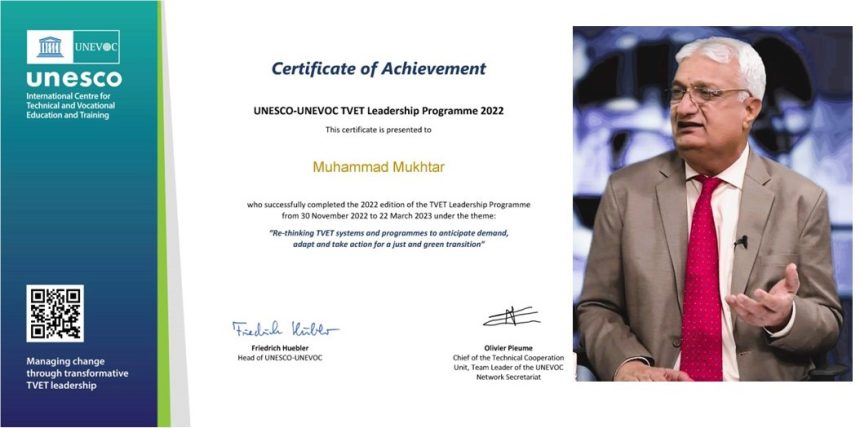
Academic institutions across the globe can play a significant role in saving environments and controlling impending harmful climatic changes. This was stated by Professor Dr. Muhammad Mukhtar, Vice Chancellor of National Skills University Islamabad, who is the recipient of the certificate of achievementfrom the UNESCO/UNEVOCon “Re-thinking TVET system and Programmes to anticipate demand, adapt and take action for a just and green transition.” The said academic leaders’ training was designed after UNESCO/UNEVOC concerns stated as “Catastrophic trends caused by climate change are harming people and ecosystems around the world. Shifts in temperatures and weather patterns have impacted people’s lives, jobs, and long-term access to finite resources. The degree of planetary heating is causing more damage as sea levels rise, biodiversity loss worsens, and ecosystem ceases functioning.”
We and our youth must work on mitigating the deterioration of environments and implement strategies supporting green transition reflected in the form of lesser release of carbon compounds that promote global warming and the ecosystem of the place we live deterioration.
Vice Chancellor NSU will offer a course on bringing green transition in skills education. In this course, he will share promising practices for academia that he learned during his five-month extended UNESCO/UNEVOC leadership certificate focused on making environments healthy. This course will be mainly for academic leaders, policy advocates, and government officials engaged in programs relevant to the environment. According to Prof. Mukhtar, over the past three years, the NSU campus has seen major transformations, including the conversion of deserted places to a hustling, bustling campus full of students and employees preparing youth for job-ready skills incorporating climate education.