




Archaeologists from Shaanxi Province in northwest China have uncovered a significant building site dating back to the Spring and Autumn period, more than 2,000 years ago, according to the Shaanxi Academy of Archaeology.
The site was located on the eastern section of the Yongcheng ruins, an ancient Qin state capital now situated in the city of Baoji, covering an area of 50 square kilometers.
Between June and December 2022, the Shaanxi Academy of Archaeology, the Institute of Archaeology of Baoji City, and two local museums jointly conducted an excavation project at the site. The excavation revealed the foundations of a large-scale building, extending both east-west and north-south.
Various artifacts were unearthed, including mud models for chariots, horses, antlers, horns, and other materials used for making bone tools. Additionally, remains such as ash pits, stoves from the Eastern Zhou Dynasty (770 BC-256 BC), ash pits and tombs from the Han Dynasty (202 BC-220 AD), as well as ruins of houses, streets, and wells from the Tang (618-907) to the Ming (1368-1644) and Qing (1644-1911) dynasties, were discovered.
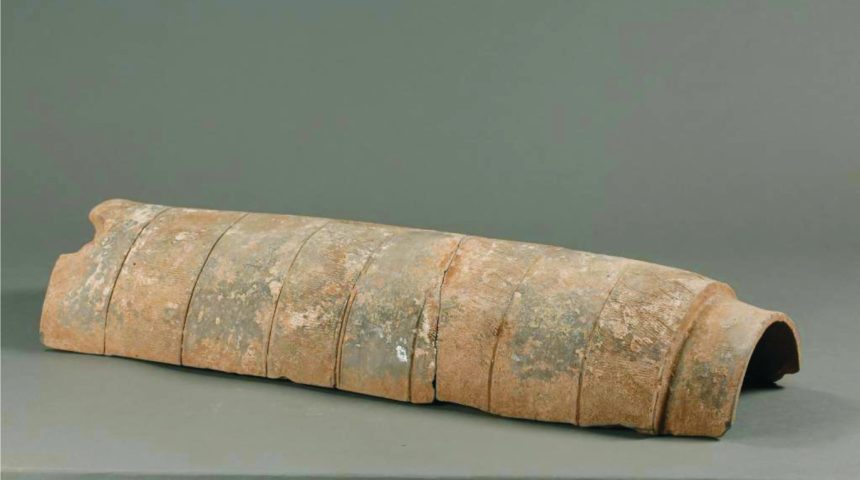
The artifacts primarily consist of building materials from the Spring and Autumn period, specifically argillaceous grey pottery. These materials include trough-shaped slab tiles, tubular tiles, semicircular tiles, among others.