


By Zhang Cheng, People’s Daily
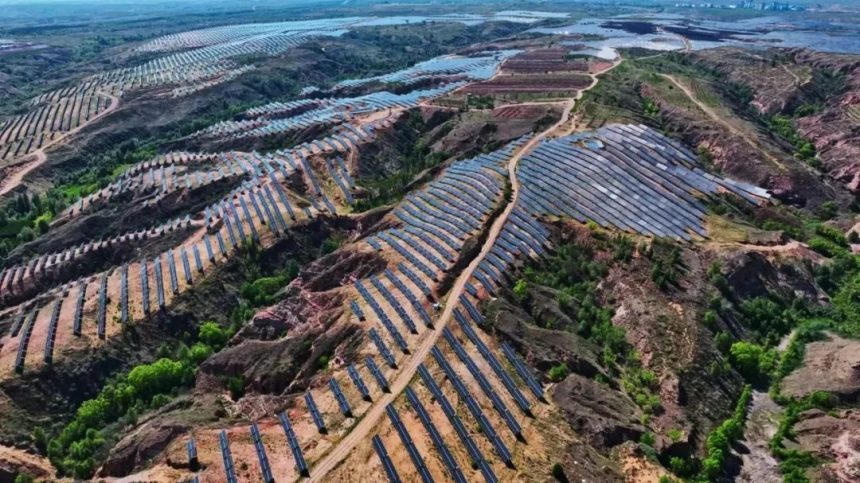
On the sun-drenched plateaus of Ejin Horo banner, Ordos, north China’s Inner Mongolia autonomous region, the glare bouncing off more than a million silver-blue photovoltaic panels is dazzling. The panels stretch across 42,000 mu (2,800 hectares) of terrain once ravaged by coal mining. Today, the view is unexpectedly softened by the emergence of fresh vegetation and rows of fruit trees.
Mines occupy 87 percent of Ejin Horo banner’s total area. With proven coal reserves of 56 billion tons and more than 3 billion tons already extracted, the region currently produces around 210 million tons of coal annually.
While coal continues to underpin the local economy, the environmental consequences of mining are stark: over 700,000 mu of subsidence zones have formed, with an additional 30,000 mu being added each year. These lands cannot be allowed to deteriorate indefinitely. A transition toward sustainable development is no longer optional; it is essential.
The imperative of transformation prompts a critical question: should the region pursue a wholly new direction, or should it build upon its existing industrial foundations? Ejin Horo banner chose the latter. By leveraging its well-established coal chemical industry, abundant wind and solar resources, and extensive tracts of subsidence-affected land, the region is advancing a proactive agenda for sustainable development.
Rather than abandoning its industrial base, the region is upgrading it through technological innovation to extend and deepen the industrial chain.
At the Ordos coal-to-liquid (CTL) branch of China Energy Investment Corporation, the world’s first million-ton direct CTL facility converts coal into refined products like naphtha, diesel, and gasoline. Besides, Inner Mongolia Huineng Coal Chemical Co., Ltd. processes 5.5 million tons of coal into liquefied natural gas each year. The former “dig-and-sell” model is being supplanted by a complex value chain of coal-based chemical industry.
At the heart of China’s energy transformation lies the objective of building a clean, low-carbon, safe, and efficient energy system.
In Ordos Mengsu Economic Development Zone, solar panels and large wind turbines power a zero-carbon industrial park. Within the park, production lines energized by green electricity employ robotic arms to assemble battery cells. From photovoltaic modules to energy storage batteries, from hydrogen fuel cells to new energy heavy trucks, an integrated industrial ecosystem encompassing wind, solar, thermal, hydrogen and storage is steadily taking shape.
This interconnection between green energy and green production fosters the development of emerging sectors, contributing to a more advanced and efficient economic structure.
Ultimately, the overarching aim of this green transition is not solely industrial upgrading, but also to deliver shared prosperity.
In recent years, Ejin Horo banner has carried out relevant initiatives to promote ecological restoration with preliminary ecological balance achieved.
To date, 47 green mines have been established. Of the 17 open-pit coal mines undergoing reclamation, 96.85 percent have been restored, and 94.51 percent of the land has been returned to productive use. Some former subsidence zones have been repurposed into solar farms, where crops like medick and mulberry grow beneath solar panels. The surrounding areas now support apple trees, sea buckthorns, and apricot orchards, simultaneously rehabilitating the environment and generating economic returns.
Relocated villagers are increasingly able to return to their hometowns and work in the photovoltaic industry. Through coordinated efforts in ecological restoration, mining redevelopment, and solar sector growth, these previously abandoned mines are being transformed into valuable assets, unlocking comprehensive benefits.
As the local economy transitions from black to green, the industrial footprint is shifting from subterranean extraction to surface-based innovation. Former subsidence zones are being reimagined as productive and scenic landscapes. A comprehensive blueprint for high-quality green development is steadily unfolding across this once coal-dependent region.