



By Liu Qinghua, Luo Xufu
The Sanxingdui Ruins, an archaeological site in Guanghan, southwest China’s Sichuan province, is revered as one of the greatest archaeological findings of the 20th century. Every new discovery at the site is so sensational that it triggers an “archaeological fever” of the whole Chinese society.
Sanxing village is where the Sanxingdui Ruins locates. It was renamed from Zhongxing commune in 1980 when archaeologists started excavation of the Sanxingdui site.
At the end of 2021, the village was home to 6,242 residents, with nearly 5,000 of them living within a three-square-kilometer area surrounding the core protection zone of the Sanxingdui Ruins.
How should the cultural heritage of the Sanxingdui Ruins be leveraged in an effective and rational manner to harmonize the preservation of this invaluable archaeological site with the development of the surrounding rural communities?
At the end of 2021, Sanxing village repurposed an abandoned water park, building it into an archaeological exploration base themed with the Sanxingdui culture. It also invited professional teams to develop educational tours that delve into the rich archaeological legacy of the site.
The archaeological exploration base locates in the Sanxingdui ancient city, 200 meters away from the excavation cabin and 1.5 kilometers from the Sanxingdui Museum.
To enrich the educational tours at the archaeological exploration base with resources from the Sanxingdui Ruins, an expert team comprised of young archaeologists pioneered an innovative public archaeology program, which offers participants unique opportunities to immerse themselves in the role of an archaeologist for a day.
Most members of the expert team are graduates with a master’s degree in public archaeology from Peking University. Boasting rich experience in this realm, they have organized Peking University’s archaeology summer camps for Chinese middle school students and established archaeology societies and alliances.
The archaeological exploration base features three major experiential scenarios: a simulated archaeological site, a workshop, and an ancient Shu village, corresponding to the three core elements of the Sanxingdui Ruins: archaeological remains, craft technologies, and social life.
At the simulated archaeological site, students listen to instructors explaining the significant building ruins, ash pits, and the No. 2 sacrificial pit of the Sanxingdui site. After learning operation procedures, the students then pick up archaeological tools and follow the correct methods to excavate pre-buried replicas of bronze human heads and ivory artifacts.
They can create stunning replicas of bronze wares, experiencing the entire process of crafting, including mold making, pattern casting, pouring and finishing.
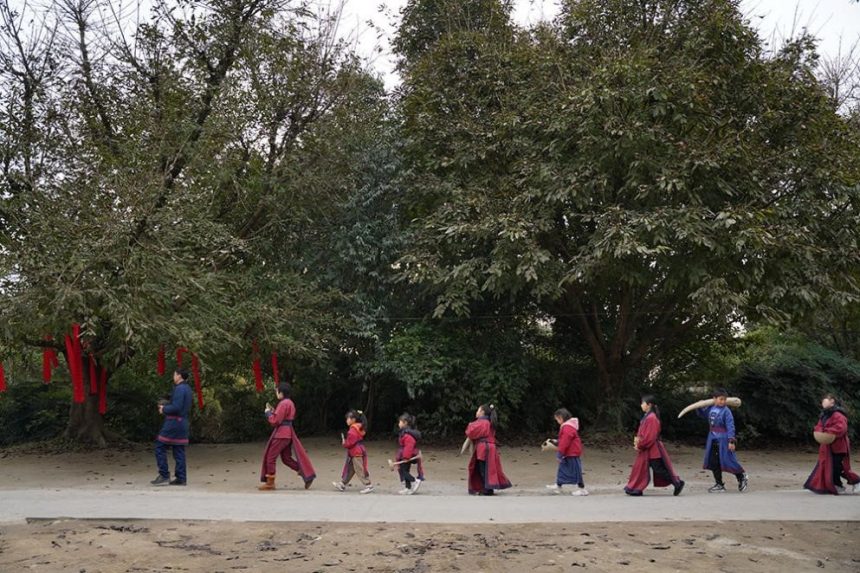
Students participating in the program can also experience the daily rhythms of life of the ancient Shu people, immersing themselves in activities such as foraging for food, processing grains, and spinning and weaving textiles, just as the Shu people did centuries ago.
Despite a simplified archaeological excavation process, it can convey concepts such as science-based excavation, legal excavation, and settlement archaeology.
Besides, the archaeological exploration base also engages in public welfare initiatives. It hosts free lectures for primary and secondary school students at least once a month, familiarizing them with the Sanxingdui civilization and the rich heritage of the ancient Shu culture.
Furthermore, the base collaborates with Sanxing village to organize community forums to enhance local residents’ understanding of the significance and value of the Sanxingdui cultural legacy and the importance of preserving this archaeological treasure.
The base’s prosperous development has also provided more employment opportunities for villagers while catalyzing the growth of local cultural and creative industries and the hospitality sector.
Educational tours centered around archaeology are becoming increasingly popular in the thriving cultural tourism sector. The attempts made by the archaeological exploration base have not only boosted rural development but also provided novel approaches for the innovative integration of culture and tourism.
Cultural legacy propels development of rural communities surrounding Sanxingdui Ruins
Leave a comment