


By Wang Yunna, People’s Daily
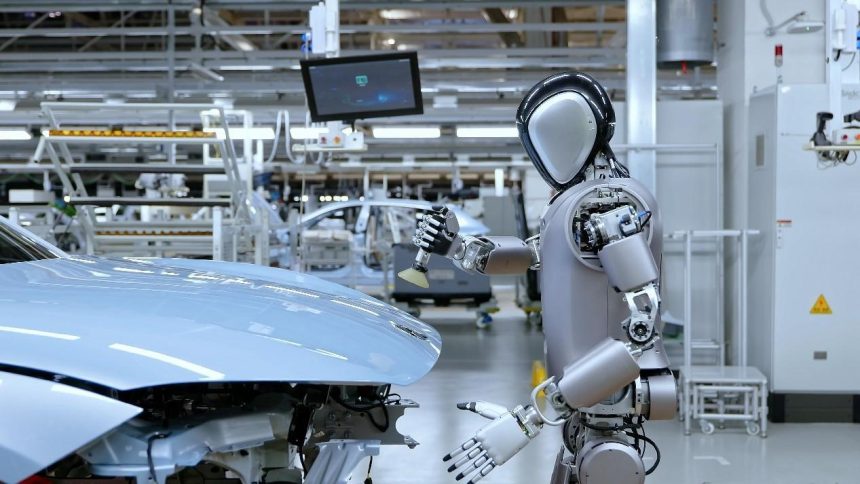
Recently, industrial humanoid robots developed by UBTECH Robotics Corp, a Chinese robot manufacturer based in Shenzhen, south China’s Guangdong province, were introduced to the assembly workshop of a factory of Chinese electric carmaker NIO in Hefei, east China’s Anhui province. They were put to work alongside humans to inspect the quality of automobiles.
Making small steps, a humanoid robot came to the left side of a car and soon completed the quality inspection of the front and rear door locks. Pausing the movement, it extended its arm into the car body, rotated its wrist 180 degrees, and pulled down the seatbelt with its five fingers, completing the safety belt functionality check. The inspection results were uploaded to the factory’s intelligent manufacturing management system as the robot performed its functions.
“Humanoid robots are now being used in actual car production settings, moving beyond experimental labs. By collecting data from the assembly line and understanding the company’s production needs, they have undergone self-iteration and upgrades for formal deployment,” said Jiao Jichao, vice president of UBTECH Robotics and executive dean of UBTECH Research Institute.
Industrial robots such as industrial manipulators and welding and painting robots are becoming increasingly common in production workshops. What makes humanoid robots different?
Humanoid robots are more intelligent than traditional industrial robots, which are limited to executing tasks with predetermined processes and often struggle to accomplish complex activities such as flexible assembly.
“Our company specializes in tasks that traditional industrial robots find difficult to accomplish,” said Jiao.
Actions like walking, stopping, turning, and visual detection may seem simple, but they pose significant technical challenges.
The movements of humanoid robots, much like those of humans, are largely dependent on joints. When UBTECH Robotics teams initially developed humanoid robots, their biggest concern was the search for the right robot joints.
“At that time, we were unable to find them in the Chinese market, and the imported ones didn’t meet our requirements,” Jiao said.
Servo drives, acting as the joint actuators of robots, play a vital role in determining robots’ motion capabilities. A high-power servo drive used in humanoid robots consists of 50 to 100 different parts, while a low-power one has 40 to 80 parts.
Thanks to continuous technological breakthroughs, UBTECH Robotics has managed to develop and commercialize a diverse range of servo drives, ranging from compact, low-torque models to powerful, high-torque variants. Over 90 percent of these components are produced independently in China, up from the previous 40 percent.
For instance, harmonic rotary servo drives are characterized by their high torque density, small size, light weight, and fast response, enabling robots to have more agile and stable arms and legs for heavy-duty tasks like carrying and sorting, Jiao explained.
“Leveraging the flexible disassembly of robots, we created modular end effectors such as ‘hands’ and ‘feet.’ For example, we designed various types of ‘hands’ for robots, including human-like five-fingered hands and two-fingered grippers. Using different connection methods, we can easily swap out these end effectors as needed,” said Jiao.
In addition to the developed and dexterous “limbs,” humanoid robots also require an intelligent and adaptable “brain.” Chinese professionals in big data and artificial intelligence are working to train humanoid robots on how to plan intricate models and improve strategies using algorithms, specifically for industrial manufacturing scenarios.
For example, semantic visual navigation technology is developed to enhance robots’ perception of their surroundings and scenes by extracting high-level semantic information and building spatial topological relationships.
“Through semantic navigation, humanoid robots are capable of autonomously scheduling tasks and performing diverse operations in different workshops,” Jiao said.
Different car makers have different demands for humanoid robots, so on-site training in factories is crucial. “Carmakers provide verification and testing scenarios for humanoid robots, which allows for data collection, algorithm iteration, and performance improvement,” said Jiao.
According to him, UBTECH Robotics has collaborated with automakers such as Dongfeng Liuzhou Motor, FAW-Volkswagen Automobile Co., Ltd Qingdao Branch, and Geely to update and iterate algorithms based on real manufacturing scenarios, thereby further enhancing robot performance.
It is expected that the first batch of humanoid robots will be delivered and put into operation in car manufacturing workshops within this year.
It takes more than 7,000 parts to build a humanoid robot. In recent years, the humanoid robot industry in Guangdong province has seen major achievements in recent years, with breakthroughs in key technologies and ongoing improvements in supply chains. As of August 2023, Guangdong was home to 39 humanoid robot companies.
In the first half of 2024, the Department of Industry and Information Technology of Guangdong Province announced an action plan to cultivate future intelligent equipment industry clusters. The plan aims to turn Guangdong into a global innovation hub for future intelligent equipment industries such as humanoid robots, aerospace equipment, deep-sea equipment, and underground equipment by 2035.
Chinese humanoid robots enter factory for on-site training
Leave a comment