


By using this site, you agree to the Privacy Policy and Terms of Use.
Accept
China ObserverChina Observer
Notification
Latest News
The Millennium Education Celebrates Excellence & Legacy at Prestigious Service Awards
April 6, 2026
From Awareness to Action: Building an Inclusive Future for Autism in Pakistan
April 3, 2026
Yiwu home to more than 10,000 foreign-funded business entities
March 29, 2026
China planning human research program at space station
March 28, 2026
China’s narrative of economic resilience, technological advancement takes center stage at Boao Forum
March 28, 2026
Aa
  • Home
  • Pakistan
  • China
  • Sports
  • World
  • Business
  • Technology
  • Entertainment
  • Tourism
  • Videos
  • Health
  • More
    • Articles
    • Currency Rates
    • Gold Rates
    • Daily Horoscope
Reading: China’s telescope makes new finding on super massive first generation star
Share
Aa
China ObserverChina Observer
  • Home
  • Pakistan
  • China
  • Sports
  • World
  • Business
  • Technology
  • Entertainment
  • Tourism
  • Videos
  • Health
  • More
Search
  • Home
  • Pakistan
  • China
  • Sports
  • World
  • Business
  • Technology
  • Entertainment
  • Tourism
  • Videos
  • Health
  • More
    • Articles
    • Currency Rates
    • Gold Rates
    • Daily Horoscope
Have an existing account? Sign In
Follow US
China Observer > Blog > China > China’s telescope makes new finding on super massive first generation star
ChinaTop Stories

China’s telescope makes new finding on super massive first generation star

June 8, 2023 5 Min Read
Updated 08/06/23 at 2:01 PM
Share
5 Min Read
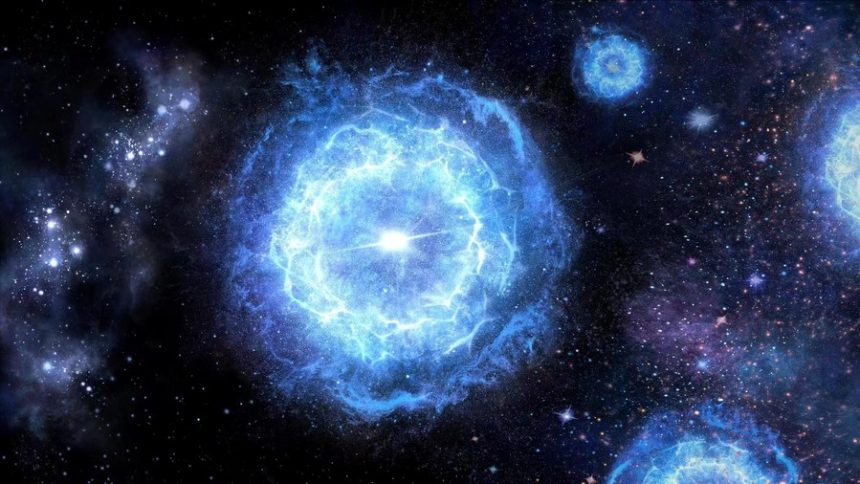
This image provided by the National Astronomical Observatories of China (NAOC) shows the first generation stars end up as a special type of supernovae, called pair-instability supernovae (PISN). (NAOC/Handout via Xinhua)

BEIJING — An international research team have discovered the oldest known star in the Galactic halo. Their findings indicate that it was born in the gas cloud left by a first generation star with a mass up to 260 times that of our Sun. This discovery has improved mankind’s understanding of the first stars and the evolution of the Milky Way and the universe.

The new study led by Chinese astronomers at the National Astronomical Observatories of China (NAOC) under the Chinese Academy of Sciences (CAS) was published online in Nature on Wednesday.

Zhao Gang, leader of the research project, said that the first stars illuminated the universe during the cosmic dawn and put an end to the cosmic “dark ages” that followed the Big Bang. However, the distribution of their mass is one of the great unsolved mysteries of the cosmos.

Numerical simulations of the formation of the first stars estimate that the mass of the first stars could reach up to several hundred solar masses. Among them, the first stars with masses between 140 and 260 solar masses ended up as a special type of supernovae, called pair-instability supernovae (PISN), which would imprint a unique chemical signature in the atmosphere of the next generation of stars, said Zhao.

However, no direct evidence of such type of supernovae had been previously found.

Based on the survey by the Large Sky Area Multi-Object Fiber Spectroscopic Telescope (LAMOST) in China and the follow up observation by the Subaru telescope in Japan, scientists identified a chemically peculiar star, named LAMOST J1010+2358. Its special chemical characteristics are consistent with the theory of PISN. Scientists confirmed that this star was formed in the gas cloud dominated by the yields of a PISN with 260 solar masses.

“Our discovery is the first clear direct evidence of the existence of a PISN from a very massive first generation star in the early universe,” said Xing Qianfan, a key member of the study from NAOC.

“This paper presents what is, to my knowledge, the first definitive association of a Galactic halo star with an abundance pattern originating from a PISN,” said Timothy Beers, a professor with University of Notre Dame in the United States.

Wang Xiaofeng, a professor with Tsinghua University, said that the next generation stars carry the elemental imprints formed by the evolution and death of the previous generation stars. “It’s like we can trace the characteristics of a child’s father by examining the child’s DNA.”

This discovery proves that the mass of the first generation stars can reach up to several hundred solar masses, and will have a profound impact on the research of the origin of elements, star formation in the early universe, and the chemical evolution of galaxies, said Zhao.

“Understanding the properties of the first generation stars is crucial for us to understand the formation of stars, galaxies and large-scale structure of the universe,” said Han Zhanwen, an academician of CAS.

“I think that this discovery, with many findings expected to come in the future, might shed light on the still unknown mechanism of very massive black hole formation in the early universe,” said Toshitaka Kajino, a professor with the Beihang University.

Witnessing successful collaborations over the years between China’s LAMOST and Japan’s Subaru telescope, he said “we expect that many more important discoveries will be made by Asian astronomers, and enrich our understanding on when, how and where the atomic nuclei in the world and ourselves were synthesized and played the key roles in the evolution of the universe.”
You Might Also Like

Yiwu home to more than 10,000 foreign-funded business entities

China planning human research program at space station

China’s narrative of economic resilience, technological advancement takes center stage at Boao Forum

Chinese smart technologies shine at 2026 Mobile World Congress

A day in the life of China’s economy

admin June 8, 2023
Share this Article
Facebook Twitter Whatsapp Whatsapp LinkedIn Email Print
Leave a comment

Leave a Reply Cancel reply

You must be logged in to post a comment.

Follow US

Find US on Social Medias
Facebook Like
Twitter Follow
Instagram Follow
Youtube Subscribe
Corporate

The Millennium Education Celebrates Excellence & Legacy at Prestigious Service Awards

Corporate

From Awareness to Action: Building an Inclusive Future for Autism in Pakistan

China

Yiwu home to more than 10,000 foreign-funded business entities

ChinaTechnology

China planning human research program at space station

China

China’s narrative of economic resilience, technological advancement takes center stage at Boao Forum

You Might Also Like

China

Yiwu home to more than 10,000 foreign-funded business entities

March 29, 2026
ChinaTechnology

China planning human research program at space station

March 28, 2026
China

China’s narrative of economic resilience, technological advancement takes center stage at Boao Forum

March 28, 2026
China

Chinese smart technologies shine at 2026 Mobile World Congress

March 16, 2026
logo-chinaoberver-tranparent-small

About US

We influence 20 million users and is the number one business and technology news network on the planet.
  • Contact
  • Blog
  • Complaint
  • Advertise
Menu
  • Contact
  • Blog
  • Complaint
  • Advertise

Market Performers

Subscribe US

Weather Widgets for Websites

©China observer. All Rights Reserved.

Removed from reading list

Undo
Welcome Back!

Sign in to your account

Lost your password?