




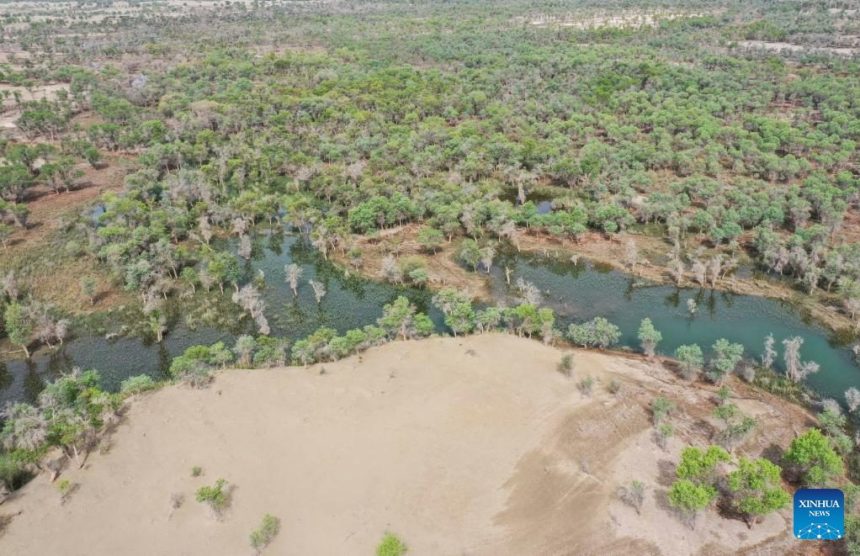
Once known as the “sea of death,” the Taklimakan Desert, the world’s second-largest shifting sand desert, has become a driving force for green development in northwest China’s Xinjiang Uygur Autonomous Region.
In recent years, photovoltaic (PV) stations have been constructed, and large plantations of vegetation such as roses and cistanche have emerged on the outskirts of this vast desert, equivalent in size to Malaysia.
This transformation has not only attracted tourism but also positioned the desert as a flourishing center of sustainable development.
GREEN INITIATIVES IN THE DESERT
Under the sun’s rays, rows of PV panels that generate electricity resemble a shimmering blue ocean.
Tian Juxiong, head of a power station in Lop County, Hotan Prefecture, regularly inspects these power generation systems and monitors their daily operations on the control center’s screen.
“The southern part of the Taklimakan Desert benefits from low precipitation and ample sunshine, resulting in up to 1,600 hours of electricity generation each year,” Tian said.
Operated by the State Power Investment Corporation, this station boasts a total installed capacity of 200 megawatts, producing 360 million kWh of electricity annually.
The station can meet the residential electricity needs of the 25.9 million residents of Xinjiang for around 10 days. Every year, it saves approximately 110,000 tonnes of standard coal and reduces 330,000 tonnes of carbon dioxide and 1,300 tonnes of nitrogen dioxide.
The project is also equipped with an energy storage system with a capacity of 80,000 kWh.
“In rainy conditions when the station cannot generate electricity, the storage facility acts as a power bank, providing energy for approximately two hours,” Tian said.
According to Yu Zhongping, a researcher with State Grid’s Xinjiang branch, most PV and wind power stations in southern Xinjiang are equipped with storage systems to ensure a stable supply of renewable energy.
In Kuqa City, located on the northwestern edge of the Taklimakan, a green hydrogen project is set to commence operations, with an expected production capacity of 20,000 tonnes upon completion.
Solar power replaces fossil fuels in generating hydrogen, said Cao Jie, vice manager of Sinopec Tahe Refining and Chemical Company.
According to a document released by the National Development and Reform Commission, China aims to accelerate the construction of large-scale wind and solar power bases in desert regions, develop hydropower infrastructure, and explore and utilize biomass, geothermal, and ocean energy during the 14th Five-Year Plan period (2021-2025).
By May, the total installed capacity for renewable energy in southern Xinjiang had surpassed 8,400 megawatts, and an additional 8,259 megawatts of new energy facilities are currently under construction, according to Ding Biwei, who is responsible for grid connection of new energy at State Grid’s Xinjiang branch.
“As power grids are gradually being interconnected to encircle the Tarim Basin, the electricity generated from new energy sources not only injects green vitality into southern Xinjiang but also contributes to achieving carbon peak and carbon neutrality,” Ding said.
BLOSSOMING CASH CROPS, WINDBREAKS
Zorigul Yakhup and many other farmers in Oytograk Township, Yutian County, Hotan, find themselves immersed in a bustling atmosphere as they diligently pluck roses of various breeds amidst the sprawling 667-hectare base of Yutian Guimi Bio-technology Co., Ltd.
“Every May, when the roses bloom, I come here to pick them. I can pick 40 or 50 kg a day,” said Zorigul Yakhup.