




People’s Daily
China and Vietnam are connected by mountains and rivers. They enjoy cultural proximity, cherish the same ideals, and have a shared future ahead of them.
In recent years, the two countries have brought out the full potential in their geographical proximity and complementarity of industries, and accelerated synergizing the Belt and Road Initiative (BRI) and the Two Corridors and One Economic Circle strategy, in a bid to better serve their respective national development and benefit the two peoples.
To the west of Kong Chro District, Gia Lai Province in south-central Vietnam, there stand dozens of huge wind turbines with their blades slowly rotating, providing steady electricity for local production and life.
These belong to a wind power project designed and constructed by China Energy Engineering Corporation (CEEC), which includes two wind farms. So far, all 64 wind turbines of the project have been erected with grid-connected power generation capacity, some of which have been put into use.
According to Lin Lingli, deputy general manager of the new energy division of Guangdong Electric Power Design Institute of CEEC, the project uses internationally advanced onshore wind turbines with large capacity and high towers, which have a large power generation capacity and occupy less land. Compared with coal-fired power plants of similar size, the wind power project can reduce carbon dioxide emissions by about 897,000 tons annually.
Driven by a series of policies and measures, a number of Chinese enterprises helped develop Vietnam’s renewable energy power generation, contributing to the country’s energy transition and development. Wind farms invested in or constructed by Chinese enterprises have provided Chinese solutions to alleviating power shortages in Vietnam, offering many families with green electricity.
Long Jiang Industrial Park in south Vietnam’s Tien Giang Province enjoys prominent geographical advantages. It’s only 50 kilometers away from Tan Son Nhat International Airport in Ho Chi Minh City and also 50 kilometers away from the container terminal of the Saigon Port. A hectic scene could be seen within the industrial park as all kinds of vehicles were running to and fro.
The comprehensive industrial park was invested and built by a Chinese company, and is among the first batch of the overseas economic and trade cooperation zones at the national level accredited by China’s Ministry of Commerce. Enterprises in the industrial park are mainly engaged in textile and light industry, machinery and electronics, as well as construction materials and chemicals.
The industrial park has received strong support from both Chinese and Vietnamese governments since it was established in 2007, offering constant impetus to China-Vietnam economic and trade cooperation and development.
Up to now, the industrial park has developed over 85 percent of its total area, introducing 53 companies, including 41 Chinese-funded enterprises to invest in the park. Among them, 48 have started production.
According to statistics, the industrial output value of the park accounts for over 35 percent of the annual industrial output value of Tien Giang Province, and over 45 percent of the province’s foreign trade volume.
The industrial park has created more than 30,000 jobs for Tien Giang Province and neighboring provinces, significantly improving the life quality of local people.
Deputy general director of the industrial park Tang Zhenyu said that expanding employment is one of the most direct and sustainable ways to improve the life quality of local people.
“We will step up efforts to attract outstanding companies in various fields to the park, providing more job opportunities for young people in Vietnam and making them the main force driving local economic development,” Tang said.
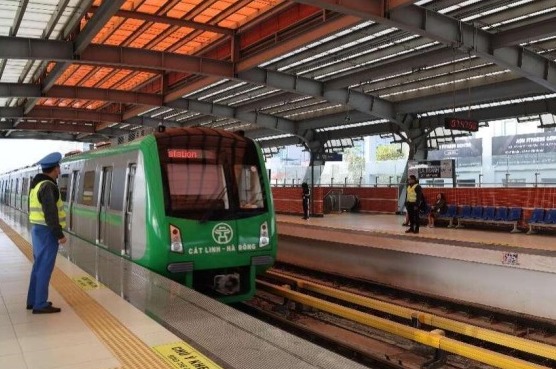
Early in the morning of Dec. 7, many students were seen in the carriages of a train on the Cat Linh-Ha Dong metro line in Hanoi. These students, on their way to school, told People’s Daily that taking the light rail is safer than taking a motorcycle and faster than taking a bus, so they don’t have to worry about being late for class.
The Cat Linh-Ha Dong metro line, which was built by China Railway Sixth Group Co., Ltd., is Vietnam’s first urban light rail. It is a signature project synergizing the BRI and the Two Corridors and One Economic Circle strategy. With a total investment of $868 million, the project started construction in October 2011.
The Cat Linh-Ha Dong metro line is one of the main lines in Hanoi’s urban rail transit network. It plays a crucial role in alleviating traffic pressure in downtown Hanoi and promoting local economic development.
Besides, the line has become a new landmark of Hanoi attracting many young people and tourists to take photos and enjoy the convenient way of traveling.
According to statistics from Hanoi Metro Company, the Cat Linh-Ha Dong metro line has carried a total of nearly 20 million passengers since it started operation in November 2021.
The Chinese company, while advancing the line project, has cultivated Vietnam’s first batch of professionals in light rail driving, operation, and maintenance. This has laid a solid talent foundation for the development of urban rail transit in Vietnam.
“China maintains a positive and open attitude toward participating in Vietnam’s infrastructure construction. Accelerating the development of transportation infrastructure, especially railway and highway connectivity, is a focus of synergizing the BRI and the Two Corridors and One Economic Circle strategy,” said Xiong Bo, the Chinese Ambassador to Vietnam.
China, Vietnam deepen practical cooperation, benefit two peoples
Leave a comment