



By Liu Shiyao, Hu Runxin, People’s Daily
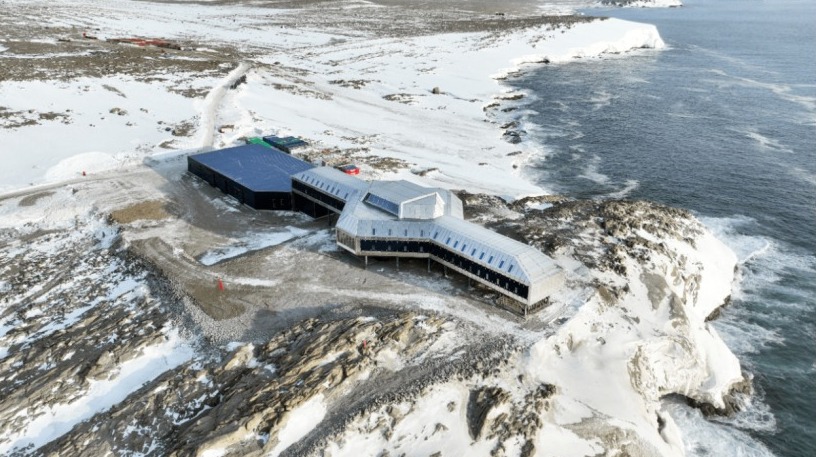
China’s Qinling Station started operation on Inexpressible Island in the Terra Nova Bay of Antarctica on Feb. 7.
Chinese President Xi Jinping sent a congratulatory letter on the completion of the building of the Qinling Station and its operation in Antarctica. He said the completion of the building of the Qinling Station will provide a strong guarantee for scientists in China and around the world to continue to explore the mysteries of nature and bravely ascend the peak of science.
Antarctica has immense value for scientific research. It is hailed as the golden key to unlock the Earth’s mysteries and a natural science laboratory.
Because of its distinctive geographical conditions and natural environment, changes in Antarctica will have incalculable impacts on the global climate and environment.
The Qinling Station is China’s fifth research station in Antarctica, after the Great Wall, Zhongshan, Kunlun, and Taishan Stations. It is also China’s third Antarctic research base to be operational throughout the year.
This year marks the 40th anniversary of China’s polar expedition. Over the past 40 years, China has launched five stations and two research vessels for Antarctic research, entering an era of three-dimensional development across sea, land and air.
The Great Wall Station is located on King George Island, the Zhongshan Station in the Larsemann Hills, the Kunlun Station and Taishan Station in Antarctica’s inland region, and the Qinling Station in the Ross Sea area. Their geographic differences exactly bring greater value to scientific research.
The region where the Great Wall Station is located is suitable for subantarctic ecological monitoring and research. The Zhongshan Station is an ideal place to observe and study the evolution of the Antarctic ice sheet and the interactions between the ice shelf and the ocean. It is also an excellent location for research in aerophysics, geology, geophysics and other disciplines.
The Kunlun and Taishan stations in Antarctica’s inland enable frontier research in ice core science, atmospheric science and astronomical science.
The Ross Sea region features interactions between the lithosphere, cryosphere, biosphere and atmosphere – different layers of the Earth system. This helps researchers investigate important scientific questions like how changes in Antarctica affect the whole world.
Over the past 40 years, China has become a driving force in Antarctic scientific exploration, achieving many breakthroughs in fields like glaciology, space science, bio-ecology, and climate change.
Countless “firsts” have marked the fruitful achievements of China’s Antarctic expeditions.
The first Chinese Antarctic expedition team conducted the first multidisciplinary field scientific survey near the Great Wall Station.
During the 19th Chinese Antarctic expedition, China tracked and monitored changes in the thickness of Antarctic sea ice for the first time in the world.
The 21st expedition team entered the area of the Dome Argus (Dome A), the peak of Antarctica’s inland icecap, and carried out substantive scientific investigations, for the first time in the history of Antarctic research.
In recent years, China has conducted continuous observations of the atmosphere, ocean, sea ice, glaciers, soil, bio-ecology and other elements of Antarctica. This has made important contributions to the international community’s understanding of the polar regions, especially the interaction between global climate change and Antarctica.
Over the past 40 years, China has always been an active contributor to environmental protection in Antarctica.
In early September 1990, the Great Wall Station temporarily halted the use of all vehicles and required staff to walk on foot, in order to ensure a good environment for seals around the station during their pregnancy and following childbirth.
At the 31st Antarctic Treaty Consultative Meeting in 2008, the Antarctic Specially Protected Area around Mount Harding in the middle of the Grove Mountains proposed by China was approved. As the first Antarctic Specially Protected Area independently proposed by China, it has made positive contributions to environmental protection in the region.
China’s first independently built polar icebreaker, the Xuelong 2, is a well-deserved “green” vessel. From the control of exhaust emissions, sewage and waste discharge, to real-time regulation of air conditioning and heating, and even the use of paints, all are in strict compliance with environmental requirements.
Environmental protection was also integrated throughout the construction process of the Qinling Station. Through integrated design, domestic modular customization and pre-assembly were implemented to save energy, water and materials.
In addition, the station reduced the number of temporary facilities and construction personnel on site to minimize the scope of construction activities, aligning with the goal of building an environmentally sustainable research station.
Over the past 40 years, China has become an important participant in the international governance of Antarctica.
In 1983, China acceded to the Antarctic Treaty. In October 1985, China became a consultative party to the Antarctic Treaty, obtaining decision-making status in international polar affairs.
In 2017, China successfully hosted the 40th Antarctic Treaty Consultative Meeting and the 20th Meeting of the Committee for Environmental Protection, where it led the proposal of an international initiative on green expeditions, which was widely recognized by the international community.
In 2023, China and several other countries jointly submitted a proposal to promote international cooperation on aerial surveys of the Antarctic ice cap and improve the accuracy of global sea level rise projections.
Since 2012, China has submitted over 80 proposals individually or jointly to relevant polar international organizations, comprehensively participating in the formulation of rules and regulations related to polar environmental protection and resource conservation.
China contributes to Antarctic studies, protection over past 40 years
Leave a comment