


By Li Xinping, People’s Daily
The year 2026 marks the opening year of the 15th Five-Year Plan period (2026-2030).
China targets an economic growth of 4.5-5 percent this year and will strive for better in practice, according to the country’s government work report.
Main targets for development this year also include: a surveyed urban unemployment rate around 5.5 percent; over 12 million new urban jobs; an increase in consumer price index of around 2 percent; growth in personal income in step with economic growth; a basic equilibrium in the balance of payments; grain output of around 700 million tons; and a drop of around 3.8 percent in carbon dioxide emissions per unit of GDP.
These core indicators collectively signal a clear national priority: the unwavering pursuit of high-quality development. This strategy focuses on achieving substantive qualitative improvements alongside reasonable quantitative growth.
The targets embody a balance of “change” and “continuity,” reflecting a policy methodology that emphasizes progress while ensuring stability. Despite external uncertainties, China remains focused on managing its domestic affairs effectively, leveraging the certainty derived from high-quality development to navigate external challenges.
Setting the economic growth target at around 4.5-5 percent demonstrates a pragmatic approach. This realistic assessment acknowledges current economic headwinds while providing necessary flexibility for structural adjustments, risk mitigation, and reforms.
Furthermore, the target also aligns with the long-range objectives through the year 2035 and reflects the requirement of laying a solid foundation and making comprehensive efforts during the 15th Five-Year Plan period, balancing both present needs and long-term goals.
By committing to striving for better in practice, China demonstrates a resolve for action, dedication, and tenacity in overcoming difficulties. This consistent approach embodies the historical initiative of the Communist Party of China — the courage to face severe tests head-on and the determination to surmount challenges, mitigate risks, and tackle difficulties.
A closer look at the three major indicators — prices, employment, and the balance of payments — offers further insight. Together with economic growth, these indicators are often referred to as the “four pillars” of macroeconomic performance. This year, the targets for employment, prices, and international payments remain unchanged from last year. This demonstrates that, on the basis of maintaining stability and safeguarding the fundamentals, China will continue consolidating and strengthening the momentum of economic recovery and growth.
Regarding income, the report states that personal incomes rise in step with economic growth. This goal may sound simple, but behind it lies a policy orientation that places people’s well-being above all else. Measures such as improving policies for free preschool education and increasing minimum basic old-age benefits for rural and non-working urban residents by 20 yuan ($2.9) highlight a stronger commitment to delivering tangible benefits for the people.
Another point worth noting is the grain output target. The government work report proposes a grain output of around 700 million metric tons. While this figure appears unchanged from last year, it carries deeper significance.
It represents both a firm commitment to the bottom line that “China’s food supply remains firmly in its own hands” and a solid step toward the goal of reaching around 725 trillion metric tons in overall grain production capacity during the 15th Five-Year Plan period. Achieving stability at the 700 million metric ton level for two consecutive years demonstrates strategic patience, providing a solid platform for reaching even higher production levels.
Finally, the target to reduce carbon dioxide emissions per unit of GDP by about 3.8% balances the needs of economic and social development, green and low-carbon transition, and national energy security. This measured reduction supports the orderly achievement of China’s goal to peak carbon emissions before 2030.
Recent years have seen China refine its climate approach, shifting from a system focused primarily on controlling total energy consumption to a “dual control” mechanism targeting both the total volume and intensity of carbon emissions. This evolution represents a move from regulating energy inputs to managing carbon outputs, and from indirect carbon control towards more targeted carbon governance. Consequently, the orientation toward green development is clearer, market-based incentives are stronger, and alignment with global climate governance efforts is closer.
This year’s government work report continues to prioritize people’s well-being. Initiatives range from enhanced fiscal support for public services and plans to boost urban and rural incomes, to increasing the proportion of government investment allocated to livelihood projects. These efforts underscore the government’s commitment to delivering concrete improvements that enhance citizens’ sense of fulfillment.
From the 1st Five-Year Plan to the 14th Five-Year Plan, China’s original aspiration and mission of seeking happiness for the Chinese people and rejuvenation for the Chinese nation has remained unchanged. The country’s major undertakings are always rooted in the need and concerns of the people.
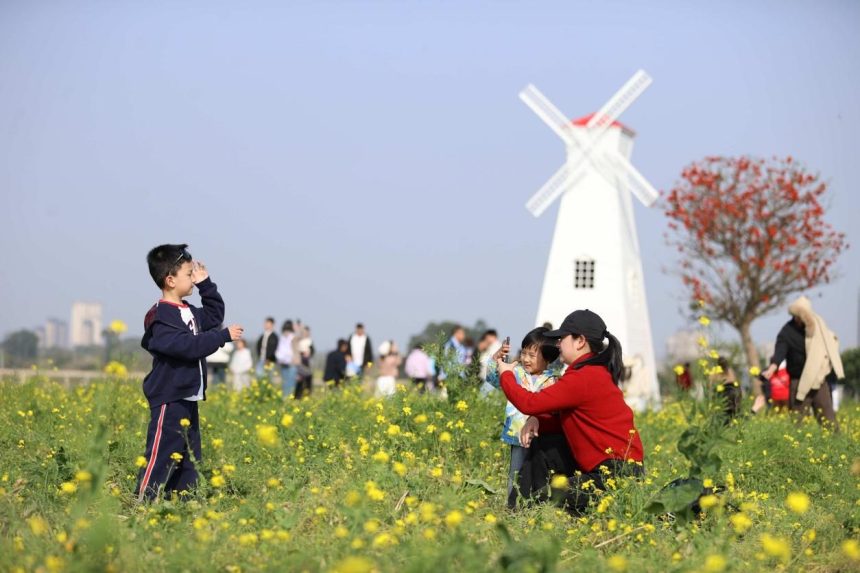
Chinese modernization is not an abstract concept; it is manifested in rising incomes, improved surroundings, growing hope among the people, and the warmth of policies that touch every aspect of people’s lives.
Looking forward, China’s development targets form a coherent progression: annual objectives feed into Five-Year Plans, which in turn advance the long-range vision for 2035. This interlocking strategic framework ensures the national blueprint is implemented consistently. By steadfastly focusing on managing its own affairs effectively and making solid, incremental progress, China advances steadily towards its goals.