

BEIJING, Feb. 15 (Xinhua) — The 40-day Spring Festival travel rush, a mass migration marking the celebration of the Chinese New Year, officially ended on Wednesday, with more than 1.5 billion trips made by rail, highway, water and civil aviation.
The travel season, also known as “chunyun,” kicked off on Jan. 7 and saw many Chinese people traveling to reunite with their families for the Chinese Lunar New Year, which fell on Jan. 22 this year.
On Tuesday, Beijing Fengtai Railway Station, Asia’s largest passenger railway hub, was still buzzing with passengers dragging and carrying luggage as they poured from trains under the guidance of station staff.
“This year, the number of passengers has obviously increased during the travel rush, and our workload has become heavier. But seeing the normal flow of people in cities and stations and the happy smiles on their faces, we feel that all our efforts are worth it,” said Ling Chengcheng with Beijing Major Railway Station Areas Administration.
“China’s railways, roads, waterways and civil aviation have maintained stable operation, with sufficient transport capacity, orderly services, strong emergency support and a stable security situation,” said Zhou Min, a Ministry of Transport official.
EXTENDED TRAVEL RUSH
Though it was predictable that this year’s holiday travel would be very busy following an optimized COVID-19 response, the flood of sightseers that swarmed into Lijiang, a famed tourist city in southwest China’s Yunnan Province, still astonished Wang Yingbo, who runs two bed-and-breakfasts (B&Bs) there.
“We saw some solo travelers coming around Jan. 10, which gave us some confidence about the upcoming holiday season,” said Wang. “Yet it didn’t occur to me that the number of tourists would suddenly soar within a week and that all 29 rooms of our two B&Bs would soon be booked up.”
Wang’s B&Bs have been almost always full since then, especially during the week-long holiday. He estimates the net income at about 400,000 yuan (about 58,665 U.S. dollars) for the three weeks around the Chinese New Year. “I expected a boom in tourism this Spring Festival, but I never thought it would be so crazy!”
Pent-up demand for consumption even “extended” this year’s travel rush, with many incoming travelers arriving much earlier than expected, while many left much later than anticipated.
According to Mou Xuemei, general manager of a travel agency in Lijiang, tourists began to increase in mid-January, about a week earlier than in previous years.
“Usually the number of tourists would wane on the sixth day of the first lunar month (usually the last day of the week-long holiday), but this year the drop in tourist levels was delayed for another week,” Mou noted.
“No one expected such a quick recovery and so we were not well prepared. But everyone is greatly motivated and many are now adding manpower,” said Zhang Yu, who also runs a travel agency.
During the holiday, Yunnan alone recorded over 45.1 million tourist arrivals, up 244.7 percent year on year. Together they generated a total tourism revenue of 38.4 billion yuan, an increase of 249.4 percent from a year ago. Both these figures were about 30 percent higher than the pre-epidemic level in 2019.
CONSUMPTION BOOM
What the tour operators in Yunnan have witnessed is just one reflection of a vigorous, flourishing Chinese economy on the fast track of recovery.
Eager travelers packed train stations, airports, eateries, tourist attractions and homestays, unleashing a stunning consumption revival.
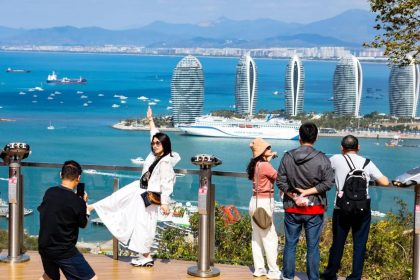
According to the online tourism platform TravelGo, tourist destinations like Xishuangbanna, Sanya and Xiamen in the country’s south, and the Changbai Mountains in northeastern Jilin Province, were among the most popular spots during the holiday.
After three years of relying on video chat, Wang Lin, 28, spent “the best Spring Festival ever” this year, reuniting with her parents on a trip to Sanya.
“Face-to-face chat and home-cooked meals, such things can never be replaced,” said Wang Lin, who was wowed by the large-scale flow of people at the airport and scenic spots.
During the Spring Festival holiday, Sanya civil aviation authority recorded a new high of 3,024 flights in seven days, an increase of 5.8 percent over the same period in 2019.
“Many are on family tours to savor the lovely sunshine and splendid sea views here. Everyone wears a big smile from the bottom of their hearts,” Wang Lin added.
Congested shopping malls, traffic jams and long queues for dinner are scenes that used to annoy Tao Kangjia, a courier for Meituan Waimai, a major food delivery platform in China. However, Tao was delighted to see the return of such scenes during the Spring Festival this year.
“Some stores went out of business over the past two years due to the epidemic, but this year, most of them remained open to serve the large number of customers,” Tao said.
Tao worked in one of the most prosperous areas in Nanjing, capital of east China’s Jiangsu Province. He worked about eight hours a day in the holiday season, earning over 10,000 yuan in a month.
The hurly-burly of the revived holiday experience was felt in many parts of the country.
Data from ride-hailing company DiDi shows that from Jan. 7 to Feb. 14, DiDi’s ride-hailing and taxi orders continued to increase and had recovered to more than 90 percent of the number recorded in 2019. Beijing, Shanghai and Guangdong Province saw orders restored to more than 90 percent of the 2019 level, while second-tier and third-tier cities, including Dalian and Yancheng, also witnessed obvious increases in ride-hailing orders.