

By Chang Biluo, Wang Zhe, Li Xinping, People’s Daily
Noise pollution from sources like construction, traffic, and daily neighborhood activities is a pervasive challenge of modern life, directly impacting public well-being. In recent years, cities across China are increasingly harnessing advanced technologies to innovate noise management and improve the effectiveness of pollution control measures.
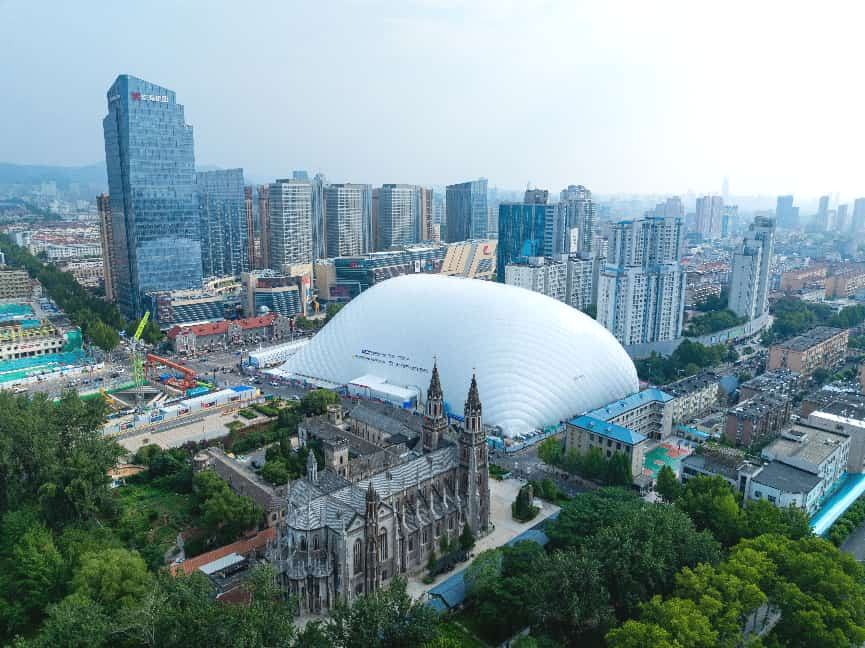
In Licheng district, Jinan, east China’s Shandong province, a massive “white cushion” structure at the “Honglou 1905” urban renewal project has recently drawn attention.
“This device is an air-supported dome used to enclose foundation pit construction,” explained project manager Wang Luren. “It stands about 50 meters high, spans over 100 meters in width, and covers an area roughly equivalent to two and a half football fields.”
The main purpose of this structure is to reduce noise and dust, Wang stated. Located in a bustling commercial area surrounded by residential communities and schools, the project faces strict environmental requirements.
Measurements confirm its effectiveness: noise levels inside the dome reach about 80 decibels, while outside they drop to around 65 decibels — well within regulatory limits. Nearby residents report barely hearing the machinery.
This technologically advanced structure features a fully enclosed design that effectively contains noise. Integrated spraying systems and large mist cannons prevent dust escape. Furthermore, the dome’s membrane, constructed from specialized new materials, blocks ultraviolet radiation and offers high thermal reflectivity and heat dissipation, ensuring a comfortable internal working environment.
This construction model is now being promoted in municipal engineering and historical district renovations, offering a new “quiet mode” solution for urban development.
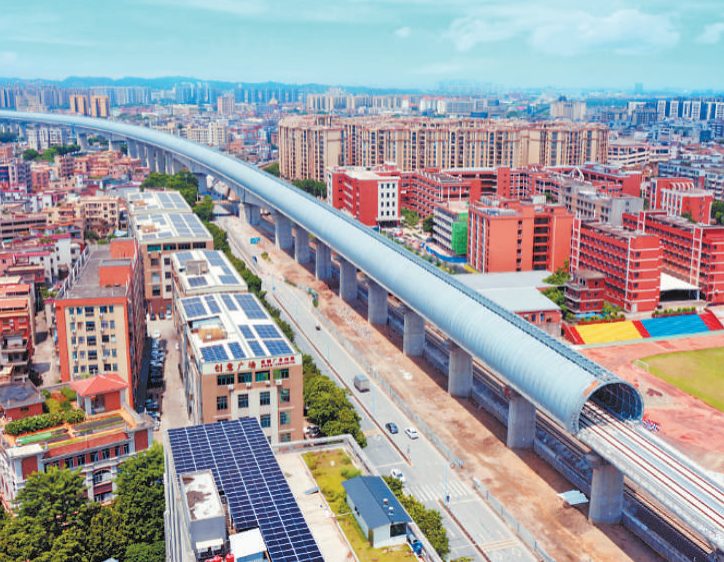
High-speed rail, a cornerstone of China’s transportation network, presents unique noise challenges, especially near residential areas. A novel approach emerged with the December 2025 opening of the Guangzhou-Zhanjiang high-speed railway: a fully enclosed sound barrier on a major bridge section, likened to giving trains “noise-canceling headphones.”
“Inspired by noise-canceling headphones, we adopted active noise control and built a fully enclosed sound barrier,” said Huang Chun, project manager from China Railway Electrification Engineering Group.
Unlike conventional roadside barriers, this design forms a sealed “soundproof tunnel” over the railway bridge, significantly reducing both noise frequency and decibel levels.
The location necessitated this innovation: the bridge is located in Nanhai district, Foshan, Guangdong province, just about 10 meters from the nearest residential buildings and around 40 meters from a middle school. Without noise mitigation, passing trains would disrupt daily life.
Stretching 2.5 kilometers in length, the barrier measures 11.8 meters wide and nearly 9 meters high. It uses innovative metal sound-absorbing panels composed of high-strength aluminum alloy, acoustic materials, and cavity structures.
“Sound is essentially energy,” Huang explained. “We guide noise through the perforations into sound-absorbing materials, where friction and internal resistance convert it into heat, thereby reducing noise.”
Tests show that high-frequency noise from passing trains is repeatedly reflected and attenuated within the enclosure, achieving a stable noise reduction of around 20 decibels.
Everyday noise from moving vehicles, home renovations, electric vehicle charging and other sources has become a persistent challenge for community governance.
To tackle noise pollution, Liangjiang New Area of southwest China’s Chongqing municipality is leveraging technology for smarter governance. Some residential compounds have adopted noise-reducing pavement, which uses finer asphalt aggregates to cut down traffic noise more effectively than traditional road surfaces.
Other neighborhoods have installed soundproof enclosures for new energy vehicle ultra-fast chargers, while newly deployed charging equipment adopts advanced liquid-cooling technology to minimize noise.
Since 2023, China’s Ministry of Ecology and Environment has promoted the development of “quiet communities” nationwide. As of early 2026, more than 3,200 such communities have been established.