



By using this site, you agree to the Privacy Policy and Terms of Use.
Accept
China ObserverChina Observer
Notification
Latest News
Yiwu home to more than 10,000 foreign-funded business entities
March 29, 2026
China planning human research program at space station
March 28, 2026
China’s narrative of economic resilience, technological advancement takes center stage at Boao Forum
March 28, 2026
The Devastating Impact of Wars on Climate Change
March 26, 2026
MSM Unify and Walsh College UAE Release Whitepaper on Middle East’s Rising Role in Global Student Mobility
March 25, 2026
Aa
  • Home
  • Pakistan
  • China
  • Sports
  • World
  • Business
  • Technology
  • Entertainment
  • Tourism
  • Videos
  • Health
  • More
    • Articles
    • Currency Rates
    • Gold Rates
    • Daily Horoscope
Reading: Shanghai’s 6G hub: Where innovation takes shape for future
Share
Aa
China ObserverChina Observer
  • Home
  • Pakistan
  • China
  • Sports
  • World
  • Business
  • Technology
  • Entertainment
  • Tourism
  • Videos
  • Health
  • More
Search
  • Home
  • Pakistan
  • China
  • Sports
  • World
  • Business
  • Technology
  • Entertainment
  • Tourism
  • Videos
  • Health
  • More
    • Articles
    • Currency Rates
    • Gold Rates
    • Daily Horoscope
Have an existing account? Sign In
Follow US
China Observer > Blog > China > Shanghai’s 6G hub: Where innovation takes shape for future
China

Shanghai’s 6G hub: Where innovation takes shape for future

February 19, 2026 5 Min Read
Updated 19/02/26 at 11:34 AM
Share
5 Min Read
By Wang Yinxin, People's Daily At the Shanghai 6G AI-Valley Future Industry Park in the Songjiang district, Zhao Xi, chairman of GKXN, one of the first companies to settle in the park, ordered a cup of coffee prepared by a robotic barista. "Once our project launched, ordering coffee won't require a touchscreen; a mere thought transmitted via a wearable device will suffice," Zhao explained. His company specializes in 6G immersive communication, developing technology that bridges human consciousness with the digital world through wearables. An employee of GKXN wears a headset equipped with brain-computer interface technologies. (Photo/Pan Jie) 6G represents one of the defining directions of future industry. In 2025, Shanghai rolled out a plan for cultivating 6G future industry, aiming to become one of China's first cities with full 6G commercial deployment by 2030. Building on its industrial and locational strengths, Songjiang district has been designated as the core zone for building a 6G future industry cluster, giving birth to the 6G AI-Valley. "If 5G accelerated information flow by clearing 'blood vessels', 6G constructs a 'nervous system' -- laying the digital foundation for tomorrow's industries," said Jin Jun, chairman of the 6G AI-Valley. "Our vision is to integrate satellites in orbit, ground stations, and handheld terminals into a seamless network, fostering an ecosystem for future innovation." Achieving integrated space-air-ground connectivity depends fundamentally on the control and operation of 6G and satellite networks. Within the 6G AI-Valley, Ying Chenghan, founder of a tech firm, and his team refined a "black box" -- a satellite-borne controller and operating system. Described as the satellite's "brain" and "central nervous system," this technology addresses a critical industry challenge. Nearby, Zhao was organizing his company's daily testing and development tasks. The incubation space provides resident companies with six shared workstations and two independent offices, enabling engineers to carry out routine research and preliminary testing on site. On Zhao's desk, a pair of AI glasses stood out. They were co-developed by GKXN and its "neighbor" in the same building -- Waterfall Artificial Intelligence Technology Co., Ltd. (Waterfall). The collaboration began at a networking event organized by the park, where Waterfall's founder Wang Jiasheng and Zhao first connected. While Waterfall was seeking to differentiate its AI glasses with advanced functionality, GKXN was looking for suitable terminals to deploy its 6G and brain-computer interface technologies. The match was ideal. With the park's support, Waterfall moved into the incubation space, becoming GKXN's next-door neighbor. After several months of joint effort, a prototype of AI glasses began to take shape, equipped with brain-computer interface technology capable of sensing early signs of Alzheimer's disease in elderly users. To enable high-speed connectivity, embedded 6G chip modules were essential. Another park-based company, specializing in such modules, joined the collaboration. "With 6G integration, data from the glasses can instantly alert hospitals and families, enabling timely intervention," Wang noted. Pre-deployment testing is critical for 6G systems. On the top floor of a building in the park sits the Shanghai satellite internet test and verification platform. Inside the test rooms, instruments and meters are neatly arranged, while an antenna on the roof maintains a live link to satellite signals. "We develop downstairs, verify upstairs, pilot in the park, and manufacture locally," Ying said. Equipment tested on the top floor is later integrated into satellites, launched into orbit, and linked to ground terminals -- forming a unified space-air-ground network. "The ultimate purpose of future industries is to serve real needs and improve people's lives," Jin said. As 6G matures, applications like integrated emergency response systems, adaptive autonomous driving, and ultra-low-latency remote surgery will transition from concept to reality. So far, the 6G AI-Valley has gathered over 50 relevant enterprises. A collaborative ecosystem spanning nearly the entire 6G future industry chain is rapidly taking shape -- all within the same building.

By Wang Yinxin, People’s Daily

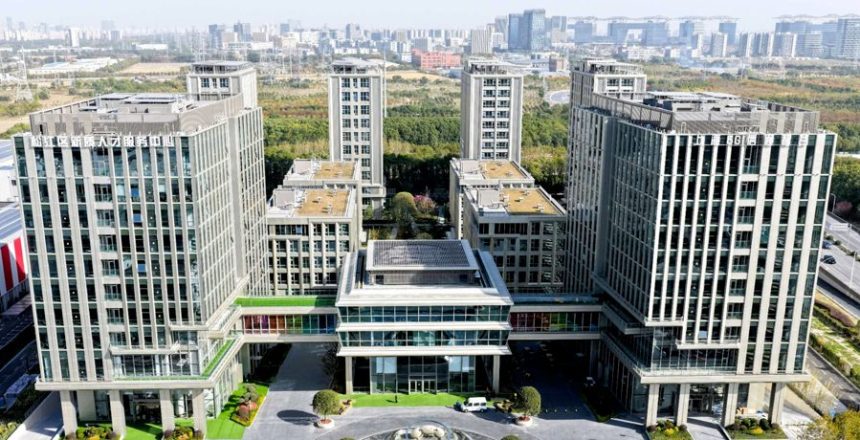
At the Shanghai 6G AI-Valley Future Industry Park in the Songjiang district, Zhao Xi, chairman of GKXN, one of the first companies to settle in the park, ordered a cup of coffee prepared by a robotic barista.

“Once our project launched, ordering coffee won’t require a touchscreen; a mere thought transmitted via a wearable device will suffice,” Zhao explained. His company specializes in 6G immersive communication, developing technology that bridges human consciousness with the digital world through wearables.

An employee of GKXN wears a headset equipped with brain-computer interface technologies. (Photo/Pan Jie)

6G represents one of the defining directions of future industry. In 2025, Shanghai rolled out a plan for cultivating 6G future industry, aiming to become one of China’s first cities with full 6G commercial deployment by 2030.

Building on its industrial and locational strengths, Songjiang district has been designated as the core zone for building a 6G future industry cluster, giving birth to the 6G AI-Valley.

“If 5G accelerated information flow by clearing ‘blood vessels’, 6G constructs a ‘nervous system’ — laying the digital foundation for tomorrow’s industries,” said Jin Jun, chairman of the 6G AI-Valley. “Our vision is to integrate satellites in orbit, ground stations, and handheld terminals into a seamless network, fostering an ecosystem for future innovation.”

Achieving integrated space-air-ground connectivity depends fundamentally on the control and operation of 6G and satellite networks. Within the 6G AI-Valley, Ying Chenghan, founder of a tech firm, and his team refined a “black box” — a satellite-borne controller and operating system. Described as the satellite’s “brain” and “central nervous system,” this technology addresses a critical industry challenge.

Nearby, Zhao was organizing his company’s daily testing and development tasks. The incubation space provides resident companies with six shared workstations and two independent offices, enabling engineers to carry out routine research and preliminary testing on site.

On Zhao’s desk, a pair of AI glasses stood out. They were co-developed by GKXN and its “neighbor” in the same building — Waterfall Artificial Intelligence Technology Co., Ltd. (Waterfall). The collaboration began at a networking event organized by the park, where Waterfall’s founder Wang Jiasheng and Zhao first connected.

While Waterfall was seeking to differentiate its AI glasses with advanced functionality, GKXN was looking for suitable terminals to deploy its 6G and brain-computer interface technologies.

The match was ideal. With the park’s support, Waterfall moved into the incubation space, becoming GKXN’s next-door neighbor. After several months of joint effort, a prototype of AI glasses began to take shape, equipped with brain-computer interface technology capable of sensing early signs of Alzheimer’s disease in elderly users.

To enable high-speed connectivity, embedded 6G chip modules were essential. Another park-based company, specializing in such modules, joined the collaboration. “With 6G integration, data from the glasses can instantly alert hospitals and families, enabling timely intervention,” Wang noted.

Pre-deployment testing is critical for 6G systems. On the top floor of a building in the park sits the Shanghai satellite internet test and verification platform. Inside the test rooms, instruments and meters are neatly arranged, while an antenna on the roof maintains a live link to satellite signals.

“We develop downstairs, verify upstairs, pilot in the park, and manufacture locally,” Ying said. Equipment tested on the top floor is later integrated into satellites, launched into orbit, and linked to ground terminals — forming a unified space-air-ground network.

“The ultimate purpose of future industries is to serve real needs and improve people’s lives,” Jin said. As 6G matures, applications like integrated emergency response systems, adaptive autonomous driving, and ultra-low-latency remote surgery will transition from concept to reality.

So far, the 6G AI-Valley has gathered over 50 relevant enterprises. A collaborative ecosystem spanning nearly the entire 6G future industry chain is rapidly taking shape — all within the same building.

You Might Also Like

Yiwu home to more than 10,000 foreign-funded business entities

China planning human research program at space station

China’s narrative of economic resilience, technological advancement takes center stage at Boao Forum

Chinese smart technologies shine at 2026 Mobile World Congress

A day in the life of China’s economy

admin February 19, 2026
Share this Article
Facebook Twitter Whatsapp Whatsapp LinkedIn Email Print
Leave a comment

Leave a Reply Cancel reply

You must be logged in to post a comment.

Follow US

Find US on Social Medias
Facebook Like
Twitter Follow
Instagram Follow
Youtube Subscribe
China

Yiwu home to more than 10,000 foreign-funded business entities

ChinaTechnology

China planning human research program at space station

China

China’s narrative of economic resilience, technological advancement takes center stage at Boao Forum

Articles

The Devastating Impact of Wars on Climate Change

World

MSM Unify and Walsh College UAE Release Whitepaper on Middle East’s Rising Role in Global Student Mobility

You Might Also Like

China

Yiwu home to more than 10,000 foreign-funded business entities

March 29, 2026
ChinaTechnology

China planning human research program at space station

March 28, 2026
China

China’s narrative of economic resilience, technological advancement takes center stage at Boao Forum

March 28, 2026
China

Chinese smart technologies shine at 2026 Mobile World Congress

March 16, 2026
logo-chinaoberver-tranparent-small

About US

We influence 20 million users and is the number one business and technology news network on the planet.
  • Contact
  • Blog
  • Complaint
  • Advertise
Menu
  • Contact
  • Blog
  • Complaint
  • Advertise

Market Performers

Subscribe US

Weather Widgets for Websites

©China observer. All Rights Reserved.

Removed from reading list

Undo
Welcome Back!

Sign in to your account

Lost your password?