



By Wang Hao, People’s Daily
The Yellow River, China’s second-longest river, transports more sediment than any major river in the world. Centuries of silt accumulation have diminished reservoir capacity and elevated its riverbed, creating a “suspended river” that historically threatened downstream regions with flooding.
Since 2002, China has conducted 31 coordinated water-sediment regulation initiatives to ensure the river’s long-term stability. Through multi-reservoir management, over 3.5 billion tons of sediment have been flushed seaward, significantly mitigating the suspended river phenomenon while enhancing flood control and sediment transport capacity.
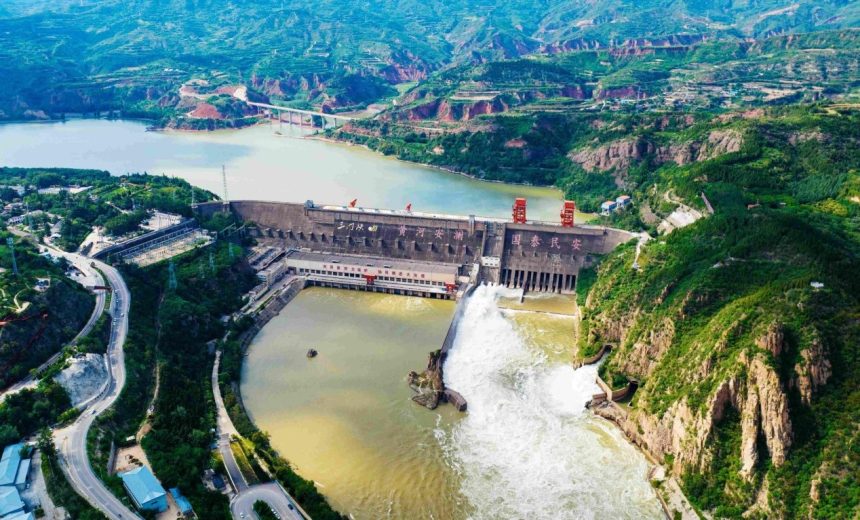
Central to this system is the Xiaolangdi Reservoir – functioning as both the “control tap” for the middle-lower Yellow River and the “power source” for sediment regulation. At 9 a.m. on Sept. 8, inside a digital twin control center of the Xiaolangdi Multipurpose Dam Project Management Center in central China’s Henan province, massive data streams pulsed on monitoring screens.
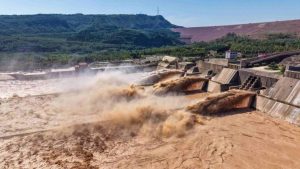
“Following a dispatch order to “adjust outflow to 2,500 m³/s,” Engineer Li Xiandong executed operational commands. As sediment-discharge gates lifted, torrents surged downstream, initiating the annual regulation cycle.
“This flow rate releases an Olympic-sized swimming pool’s volume per second – triple the normal discharge,” Li explained. “The powerful current acts like hydraulic brushes, scouring sediment seaward.” Li’s expertise lies in precisely timing gate combinations to optimize this scouring effect. During this year’s operation, 24 gate adjustments following six major commands enabled Xiaolangdi to flush 8.87 million tons of sediment.
Through meticulous water management, a multi-reservoir coordination system now operates across more than 1,000 river kilometers, integrating Xiaolangdi with Sanmenxia and Wanjiazhai reservoirs. This precision engineering has dramatically increased sediment discharge efficiency, alleviating sedimentation burdens throughout the system.
During pre-flood season operations (June 28, 8:00 AM), Xiaolangdi’s outflow peaked at 4,820 m³/s. Concurrently, drones equipped with edge-analysis terminals and dual-spectrum cameras launched automated inspections. “These devices transmit real-time imagery, autonomously identify structural defects, and generate inspection reports,” noted Wang Pengfei, deputy director of the hydraulic engineering department of a company under the Xiaolangdi Multipurpose Dam Project Management Center.
With digital twin technology, an intelligent “mirror” of Xiaolangdi has come to life. More than 2,943 monitoring devices capture precise structural data, while satellites provide full coverage of the 300-square-kilometer reservoir area and 1,300 kilometers of shoreline. In the virtual space, 12 hydrological and engineering models run continuous simulations.
From the dam and reservoir to the river channel and water flow, everything is mapped into the digital twin platform, where virtual and physical systems interact. This enables advanced simulations for sediment flushing, reservoir dispatching, and engineering safety – all tested and refined before real-world implementation.
From Xiaolangdi to the Yellow River section in Jinan and Dongping Lake, the digital twin yellow river project is steadily advancing. More than 550 million data entries have been integrated, bringing the Yellow River into the digital realm.
“We have developed a scientific paradigm of three interconnected models – a prototype Yellow River, a model Yellow River, and a digital twin Yellow River,” said Cao Yongtao, director of the sediment research department at the Yellow River Institute of Hydraulic Research. “The three systems verify and complement each other, improving forecasting accuracy and refining dispatch plans.”
Through “micro-Yellow River” experiments and cross-validation among the three systems, the forecast error for flood peak enhancement has been reduced to within 10 percent.
As torrents of water roared downstream during this year’s pre-flood season operation, Lou Guangyan and her team from ecology and environment division the Yellow River institute of water resources protection worked along the river’s monitoring sections, studying the relationship between changes in sediment discharge and aquatic life.
The Yellow River Protection Law, which took effect on April 1, 2023, stipulates in Article 62 that water and sediment regulation shall minimize impacts on aquatic organisms and their habitats.
From 2023 to 2025, Lou’s team has set up 12 monitoring cross-sections between Xiaolangdi and the river mouth, collecting more than 1,300 samples to assess ecological impacts. “In the long run, water and sediment regulation helps stabilize the river’s morphology, improve aquatic habitats, and support biodiversity. Rare species such as the ungeo fish have reappeared,” Lou said.
Data show that since 2008, the structure of plankton communities in the lower Yellow River has remained stable, while the number of fish species in Henan and Shandong provinces has increased by nearly 50. During each operation, water is also released to the Yellow River delta wetland, providing essential support for its restoration and biodiversity enhancement.
The water and sediment regulation of the Yellow River embodies China’s ancient wisdom of water governance combined with modern technological innovation. After more than two decades of practice, this integrated approach has laid a solid foundation for ensuring the river’s long-term stability, while offering valuable experience and insights for the ecological management of major rivers around the world.