



By using this site, you agree to the Privacy Policy and Terms of Use.
Accept
China ObserverChina Observer
Notification
Latest News
Pakistan launches alliance to protect crypto users
November 10, 2026
China-Pakistan Information Corridor launched to strengthen media ties
October 28, 2026
Yasukuni Shrine visits and offerings tear away Japan’s “country for peace” mask
October 27, 2026
To reduce global poverty, the world should partner with China, not exclude it: Insights from a Fellow of British Academy of Social Sciences
October 27, 2026
China issues first policy document dedicated to technology-driven commerce
October 27, 2026
Aa
  • Home
  • Pakistan
  • China
  • Sports
  • World
  • Business
  • Technology
  • Entertainment
  • Tourism
  • Videos
  • Health
  • More
    • Articles
    • Currency Rates
    • Gold Rates
    • Daily Horoscope
Reading: Technology unlocks new possibilities for people with disabilities in China
Share
Aa
China ObserverChina Observer
  • Home
  • Pakistan
  • China
  • Sports
  • World
  • Business
  • Technology
  • Entertainment
  • Tourism
  • Videos
  • Health
  • More
Search
  • Home
  • Pakistan
  • China
  • Sports
  • World
  • Business
  • Technology
  • Entertainment
  • Tourism
  • Videos
  • Health
  • More
    • Articles
    • Currency Rates
    • Gold Rates
    • Daily Horoscope
Have an existing account? Sign In
Follow US
China Observer > Blog > China > Technology unlocks new possibilities for people with disabilities in China
ChinaTechnology

Technology unlocks new possibilities for people with disabilities in China

October 28, 2025 4 Min Read
Updated 28/10/25 at 11:10 AM
Share
4 Min Read
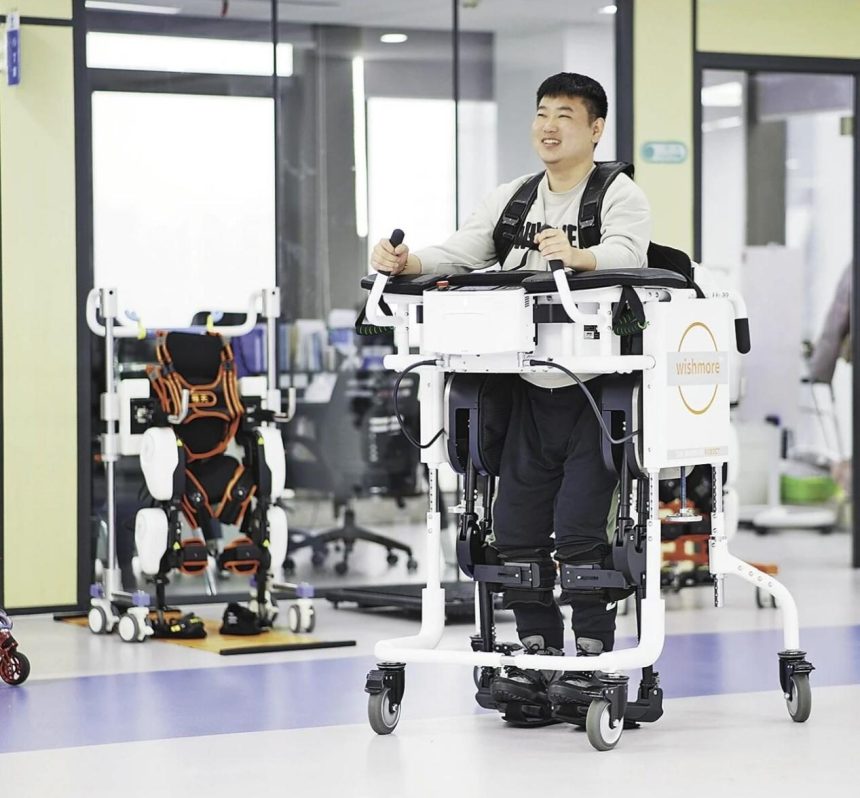
Nie joins rehabilitation training with an exoskeleton robot. (Photo/Wang Yang)

By Dou Hao, People’s Daily

“Tighten the straps, hold the handles, push and up!” At the rehabilitation center of startup RoboCT located in Hangzhou, east China’s Zhejiang province, Mr. Wang, wheelchair-bound for more than a decade, slowly rose with the aid of an exoskeleton robot, drawing applause across the room.

Engineer Nie Peng, who also uses a wheelchair, shared the moment. A former auto mechanic, Nie sustained a spinal cord injury over ten years ago that left him paralyzed from the waist down. “When I realized I’d spend the rest of my life in a wheelchair, my world collapsed,” he recalled. Prolonged immobility led to muscle atrophy and complications such as infections and blood clots.

Physically disabled and emotionally withdrawn, Nie shut himself indoors like many paraplegic patients. “I was either sitting or lying down, and my health kept deteriorating,” he said.

RoboCT, founded in 2017 in AI Town at Hangzhou Future Sci-Tech City, develops and applies exoskeleton technologies. “An exoskeleton is not just an iron frame strapped to the body, but a wearable robotic system that integrates advanced information technology and mobile computing,” explained founder Wang Tian.

The device used by Mr. Wang employs leg-mounted force sensors to detect movement intention and then assists with powered motions that mimic a natural gait.

Nie’s daily routine includes working with colleagues to optimize exoskeleton comfort. He joined RoboCT the year it was founded after learning the company was recruiting testers. “I didn’t know what an exoskeleton was back then, but staying at home wasn’t an option. If my efforts could give other patients hope, it would be worth it,” he said.

He later joined the research and development team of RoboCT and vividly remembers his first assisted steps – tears streaming down his face. “Standing again gave me hope for life,” he said.

Today, Nie trains with the exoskeleton for at least an hour a day. offers design feedback, and, having taught himself mechanical and electronic skills, now maintains system data and manages equipment.

The team has shifted from hydraulic to electric drives, downsized battery packs, and refined strap design to improve usability. The latest model integrates a brain–computer interface that captures neural signals and, together with leg sensors, more precisely interprets user intent.

At the company’s rehabilitation center, people with disabilities can try or rent the equipment. Children with cerebral palsy use exoskeletons to correct gait, and seniors with limited mobility climb stairs with portable models. To date, RoboCT’s devices have been deployed in over 700 rehabilitation and eldercare institutions, serving more than 650,000 patients.

Nie said the Chinese society has become more inclusive and friendly to people with disabilities in recent years. “In Hangzhou, accessibility has improved greatly. On the metro, staff set up ramps to help us board safely. I love this city not just for its skyline and convenience, but because it genuinely supports vulnerable groups,” he said.

Recently, Nie tested the latest prototype using the brain-computer interface. As the technology matures, exoskeletons may soon move in sync with users’ thoughts. “From being unable to stand, to walking again, and to earning a living, I’ve grown more confident with each step,” he said. Looking ahead, he has a simple wish that exoskeletons made of flexible materials will be as light and easy to wear as clothing, enabling patients to walk freely.

“Ten years ago, I never dared to dream of standing again. Now, I can’t wait to see what the future holds,” said Nie.

You Might Also Like

China-Pakistan Information Corridor launched to strengthen media ties

To reduce global poverty, the world should partner with China, not exclude it: Insights from a Fellow of British Academy of Social Sciences

China issues first policy document dedicated to technology-driven commerce

Grassland city in N China’s Inner Mongolia transforms into an AI computing hub

A conversation with Liu Cixin: From The Three-Body Problem to the future of humanity

Top Categories

admin October 28, 2025
Share this Article
Facebook Twitter Whatsapp Whatsapp LinkedIn Email Print
Leave a comment

Leave a Reply Cancel reply

You must be logged in to post a comment.

Follow US

Find US on Social Medias
Facebook Like
Twitter Follow
Instagram Follow
Youtube Subscribe
Corporate

Pakistan launches alliance to protect crypto users

China

China-Pakistan Information Corridor launched to strengthen media ties

Articles

Yasukuni Shrine visits and offerings tear away Japan’s “country for peace” mask

China

To reduce global poverty, the world should partner with China, not exclude it: Insights from a Fellow of British Academy of Social Sciences

BusinessTechnology

China issues first policy document dedicated to technology-driven commerce

About Us

We influence 20 million users and is the number one business and technology news network on the planet.

You Might Also Like

China

China-Pakistan Information Corridor launched to strengthen media ties

October 28, 2026
China

To reduce global poverty, the world should partner with China, not exclude it: Insights from a Fellow of British Academy of Social Sciences

October 27, 2026
BusinessTechnology

China issues first policy document dedicated to technology-driven commerce

October 27, 2026
Technology

Grassland city in N China’s Inner Mongolia transforms into an AI computing hub

October 27, 2026
logo-chinaoberver-tranparent-small

About US

We influence 20 million users and is the number one business and technology news network on the planet.
  • Contact
  • Blog
  • Complaint
  • Advertise
Menu
  • Contact
  • Blog
  • Complaint
  • Advertise

Market Performers

Subscribe US

Weather Widgets for Websites

©China observer. All Rights Reserved.

Removed from reading list

Undo
Welcome Back!

Sign in to your account

Lost your password?



