

By using this site, you agree to the Privacy Policy and Terms of Use.
Accept
China ObserverChina Observer
Notification
Latest News
Pakistan launches alliance to protect crypto users
November 10, 2026
China-Pakistan Information Corridor launched to strengthen media ties
October 28, 2026
Yasukuni Shrine visits and offerings tear away Japan’s “country for peace” mask
October 27, 2026
To reduce global poverty, the world should partner with China, not exclude it: Insights from a Fellow of British Academy of Social Sciences
October 27, 2026
China issues first policy document dedicated to technology-driven commerce
October 27, 2026
Aa
  • Home
  • Pakistan
  • China
  • Sports
  • World
  • Business
  • Technology
  • Entertainment
  • Tourism
  • Videos
  • Health
  • More
    • Articles
    • Currency Rates
    • Gold Rates
    • Daily Horoscope
Reading: China scales up urban recycling in drive for ‘zero-waste’ cities
Share
Aa
China ObserverChina Observer
  • Home
  • Pakistan
  • China
  • Sports
  • World
  • Business
  • Technology
  • Entertainment
  • Tourism
  • Videos
  • Health
  • More
Search
  • Home
  • Pakistan
  • China
  • Sports
  • World
  • Business
  • Technology
  • Entertainment
  • Tourism
  • Videos
  • Health
  • More
    • Articles
    • Currency Rates
    • Gold Rates
    • Daily Horoscope
Have an existing account? Sign In
Follow US
China Observer > Blog > China > China scales up urban recycling in drive for ‘zero-waste’ cities
China

China scales up urban recycling in drive for ‘zero-waste’ cities

October 28, 2025 4 Min Read
Updated 28/10/25 at 10:57 AM
Share
4 Min Read
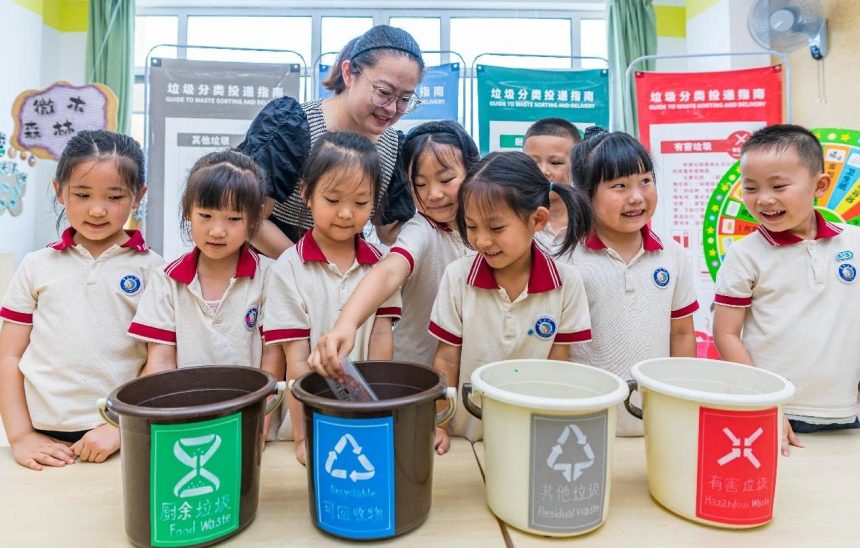
Kindergarten students learn waste sorting, Zhangjiakou, north China's Hebei province. (Photo/Zhang Litao)

By Wu Weizheng, People’s Daily

In Tianjin Port Free Trade Zone, north China’s Tianjin municipality, the first 20 smart recycling stations built by a subsidiary of China Resources Recycling Group Co., Ltd., have recently entered operation.

These multifunctional “smart cabins” combine resource recovery, community services, and emergency power supply, improving front-end urban waste collection and supporting the development of zero-waste cities.

Across China, localities are actively piloting distinctive models to turn waste into value and expand recycling.

The term “zero waste” does not mean that solid waste will cease to be generated, nor can it be eliminated entirely. Rather, it represents a governance approach centered on continuous source reduction and the systematic promotion of recycling and reuse – an essential pathway for advancing green development.

Turning waste into value requires removing bottlenecks across the recycling chain and converting materials into productive assets. As the adage suggests, waste is simply a resource in the wrong place. The practical question is how to realize resource circulation at scale.

One way is technological innovation. For instance, Moon-Tech, an environmental protection technology firm based in Yantai, east China’s Shandong province, has developed a technology that captures 97 percent of carbon dioxide in exhaust gas, and the resulting high-purity carbon dioxide extracted can be applied in food processing and other industries.

By converting waste into resources and consumption into added value, such innovations enhance resource efficiency and create new growth opportunities for enterprises.

Another approach is scenario-based innovation. At a new energy company in southwest China’s Chongqing municipality, retired power batteries undergo health testing, dismantling, and remanufacturing to become standardized battery packs. These packs are then applied in telecommunications base stations, smart streetlights, and other scenarios. Materials that are obsolete in one application can become valuable assets in another.

From technology to application scenarios, prioritizing efficient resource use and anchoring innovation enables idle or underutilized resources to be redeployed for greater value and broader public benefit.

Policy and regulatory frameworks are also critical to stimulating market vitality and transitioning recycling from being primarily government-driven to market-driven. In Shenzhen, south China’s Guangdong province, guidelines for the construction of recycling stations encourage companies to upgrade or build high-standard sorting centers and transfer stations, ensuring recyclables are properly collected and efficiently processed.

Policy instruments not only provide safeguards for implementation but also help shape public behaviors. Shanghai, for example, has issued a regulation on zero-waste city development that promotes wider public participation in zero-waste lifestyles. As a result, the city’s household waste-sorting compliance rate has remained above 95 percent, with an overall recycling rate of 43 percent. Well-designed policies can foster a culture of sustainability and support low-carbon living.

Effective green development further depends on coordinated governance. Ecological and environmental challenges do not conform to administrative boundaries. In construction waste management, for example, strict controls in one locality alongside law enforcement in another can lead to cross-regional dumping. Sustained progress from municipal zero-waste pilots to inter-regional collaboration requires systemic thinking and stronger coordination among government departments, regions, and policies.

By intensifying technological innovation, strengthening policy design and enforcement, and enhancing cross-regional coordination, the journey of building zero-waste cities can be transformed into a process that cultivates and expands green productivity while improving people’s sense of gain and fulfillment.

You Might Also Like

China-Pakistan Information Corridor launched to strengthen media ties

To reduce global poverty, the world should partner with China, not exclude it: Insights from a Fellow of British Academy of Social Sciences

A conversation with Liu Cixin: From The Three-Body Problem to the future of humanity

BeiDou Navigation Satellite System drives economic growth and social development

UnionPay connects the world through seamless digital payments

Top Categories

admin October 28, 2025
Share this Article
Facebook Twitter Whatsapp Whatsapp LinkedIn Email Print
Leave a comment

Leave a Reply Cancel reply

You must be logged in to post a comment.

Follow US

Find US on Social Medias
Facebook Like
Twitter Follow
Instagram Follow
Youtube Subscribe
Corporate

Pakistan launches alliance to protect crypto users

China

China-Pakistan Information Corridor launched to strengthen media ties

Articles

Yasukuni Shrine visits and offerings tear away Japan’s “country for peace” mask

China

To reduce global poverty, the world should partner with China, not exclude it: Insights from a Fellow of British Academy of Social Sciences

BusinessTechnology

China issues first policy document dedicated to technology-driven commerce

About Us

We influence 20 million users and is the number one business and technology news network on the planet.

You Might Also Like

China

China-Pakistan Information Corridor launched to strengthen media ties

October 28, 2026
China

To reduce global poverty, the world should partner with China, not exclude it: Insights from a Fellow of British Academy of Social Sciences

October 27, 2026
China

A conversation with Liu Cixin: From The Three-Body Problem to the future of humanity

October 27, 2026
ChinaTechnology

BeiDou Navigation Satellite System drives economic growth and social development

October 27, 2026
logo-chinaoberver-tranparent-small

About US

We influence 20 million users and is the number one business and technology news network on the planet.
  • Contact
  • Blog
  • Complaint
  • Advertise
Menu
  • Contact
  • Blog
  • Complaint
  • Advertise

Market Performers

Subscribe US

Weather Widgets for Websites

©China observer. All Rights Reserved.

Removed from reading list

Undo
Welcome Back!

Sign in to your account

Lost your password?