


By Wang Haonan, People’s Daily
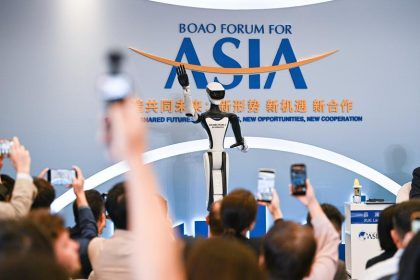
The 2025 World Robot Conference opened in Beijing on August 18, bringing together more than 200 global robotics companies and unveiling over 100 new products. Just days later, the city hosted another event: the 2025 World Humanoid Robot Games, the first of its kind globally, which kicked off on August 14, drawing 280 teams from 16 countries and regions.
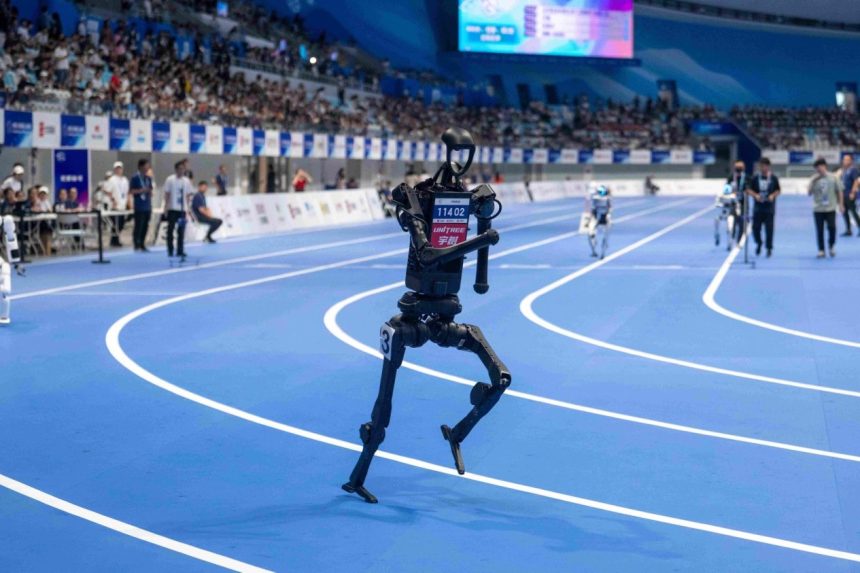
At the games, Chinese tech firm Unitree Robotics’s G1 humanoid robot completed the 100-meter obstacle race in 33.71 seconds, while its H1 robot won the 1,500-meter race in 394.40 seconds. Although these results fall short of professional human athletes, Unitree founder Wang Xingxing expressed confidence in the trajectory of progress: “Robots will soon outperform humans.”
Today, humanoid robots extend beyond racing tracks to precision factory tasks. Yet a pressing question persists: how close are they to seamless integration into everyday life?
According to Jia Baoxiong, a researcher at the embodied robotics center of the Beijing Institute for General Artificial Intelligence, humanoid robots have already demonstrated remarkable abilities in specialized tasks such as sprinting and dancing.
But to transition into everyday life, breakthroughs are required in several areas: enhanced autonomy in open environments, greater precision and stability in movement and manipulation, and above all, safe and reliable interaction with humans, Jia added.
“We are seeing continuous breakthroughs in hardware performance, leaps in AI-driven decision-making, and stronger foundations in datasets and virtual simulation,” said Xu Xiaolan, president of the Chinese Institute of Electronics, at the World Robot Conference. Humanoid robots are now at a critical stage, moving from laboratory experimentation toward industrial application, Xu added.
Still, obstacles remain. Why do some robots stray from their lanes in a race or misfire in a boxing match? The explanation often lies in human involvement: many robots are still remotely controlled by humans, making performance dependent on operator skill and vulnerable to electromagnetic interference.
To encourage intelligence and autonomy, the 2025 World Humanoid Robot Games introduced innovative scoring. Few spectators realized that Tiangong Ultra, developed by the Beijing Humanoid Robot Innovation Center, and crowned champion of the 100-meter dash, was not actually the first to cross the finish line. But as the only competitor to complete the race using a fully autonomous navigation system without human control, its recorded time was multiplied by a 0.8 coefficient, giving it the highest overall ranking.
Smarter robots will gradually emerge through incremental breakthroughs, said Xiong Youjun, general manager of the Beijing Humanoid Robot Innovation Center. “Step by step, they will grow in capability until they can truly serve and assist us,” he added.
For now, hardware refinement remains essential, but according to Wang, the larger bottleneck lies in embodied intelligence itself, which has yet to reach maturity. This, he argued, is the key factor holding back large-scale adoption of humanoid robots in daily life.
In Jia’s view, humanoid robots are already delivering value in performance and entertainment, and when combined with wheeled platforms, they can be deployed for sorting and logistics in warehouses, supermarkets, and pharmacies. But moving them into households will require not just technical breakthroughs, but also solutions to ethical and cost concerns.
Price remains a critical challenge. Training embodied AI models requires vast amounts of real-world trajectory data. “High-quality data is scarce and expensive, driving up development expenses,” noted Xiong.
Ethical considerations are equally pressing. “How can we protect our privacy once humanoid robots enter homes? How should we coexist with them?” Such questions sparked vigorous debate at the 2025 World Robot Conference.
Despite challenges, the industry’s outlook is robust. According to the International Federation of Robotics, the global humanoid robot market is projected to grow at a compound annual rate of 71 percent from 2021 to 2030. The Chinese Institute of Electronics predicts that the nation’s humanoid robot market will reach 870 billion yuan (about $122 billion) by 2030.
Humanoid robots continue to evolve at a remarkable speed. The day they “run” into households and integrate into everyday life may not be as far away as it seems.