

By Xu Peiyu
What defines a “luxury car”? Is it the price tag and brand prestige, or the advanced technologies and driving experience it delivers?
In China today, more and more consumers are embracing the new possibilities brought by electrification and smart technologies. Many now associate luxury less with logos and leather, and more with intelligent functions and comfort-oriented design. With continuous technological upgrades and rapid innovation, Chinese auto brands are steadily moving up the value chain and reshaping the meaning of “luxury vehicles.”
Not long ago, features such as air suspension were the exclusive preserve of imported high-end cars. Today, they are standard on many Chinese models.
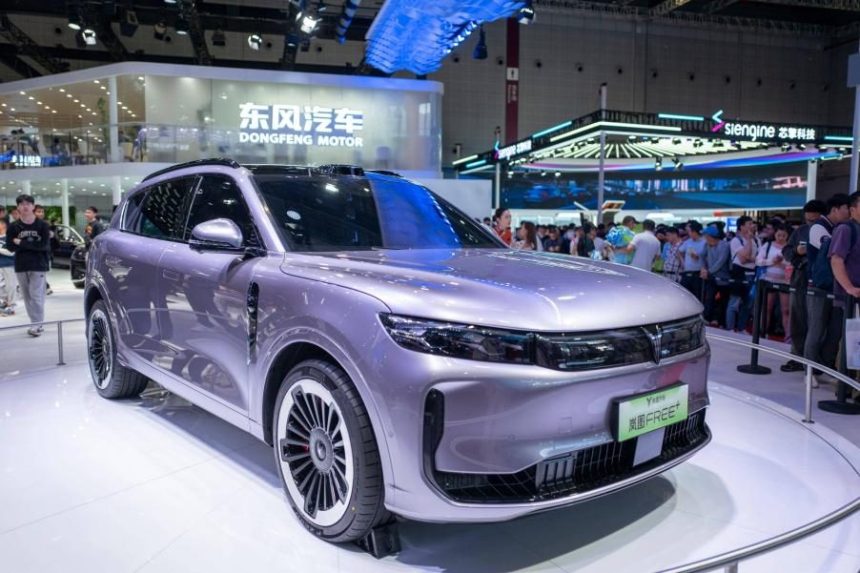
“When I was considering an upgrade, I first looked at traditional fuel-powered models. Then I test-drove the Voyah FREE 318 and was immediately impressed by the smoothness and acceleration of the electric vehicle (EV),” said Mr. Zhang from east China’s Shandong province.
“What really stood out was its air suspension with a height adjustment range of 100 millimeters, which comes in four modes. It can lower the ground clearance to 113 millimeters to make entry easier for children and the elderly, or raise it to 213 millimeters to handle rough terrain.”
Air suspension is just one example. Once-premium features such as zero-gravity seats, multi-screen interaction, and automatic parking have become widely available in Chinese vehicles. As a result, even models priced under 300,000 yuan ($42,071) now deliver experiences once associated only with luxury cars.
Beijing resident Mr. Liu said that he once viewed price as the only criterion for a luxury car. “For me, the definition of ‘luxury’ has changed. A car that offers intelligent driving, a comfortable ride, and richer entertainment functions can be considered luxurious, even if it costs less than 300,000 yuan.”
For young consumers, technology matters most. Ms. Lin, a Gen-Zer consumer, recently purchased a G6 SUV from Chinese EV maker Xpeng. “This car feels cutting-edge. Its voice interaction works across all driving scenarios, while many traditional luxury models still rely on wired connections just to use CarPlay,” she said.
The redefinition of luxury cars has been driven by technological breakthroughs in China’s auto industry. Take air suspension: in the past, overseas suppliers charged steep prices, but Chinese automakers partnered with local component makers to develop air springs and electronic control systems independently. The localization of these technologies has driven costs down, lowering the entry price for vehicles equipped with air suspension from around 500,000 yuan to just 200,000 yuan.
As Chinese new energy vehicle brands expand their focus on intelligent functions and high-end configurations, the traditional markers of luxury – price and brand heritage – are giving way to new standards based on functionality and user experience.
While sub-300,000 yuan models offer more premium features than ever before, Chinese brands are also strengthening their presence in the upper tiers of the market.
Chinese EV manufacturer NIO has built a loyal customer base with refined design, attentive service, and innovative battery-swapping system. Li Auto has resonated with families by positioning its vehicles as “mobile homes,” capturing the hearts of high-end users who prioritize family-oriented experiences.
AITO, an electric vehicle marque of Chinese vehicle manufacturer Seres Group, has carved out a niche with its “tech-driven luxury” brand identity, with its M9 model alone surpassing 200,000 units in sales. Meanwhile, Chinese auto giant BYD’s Yangwang brand emphasizes “extreme performance,” with its U8, capable of maneuvers such as “tank turns” and emergency floating, remaining a top seller among million-yuan luxury vehicles since its launch in September 2023.
Industry analysts noted that Chinese automakers are seizing opportunities in what were once bastions of traditional luxury brands. Some emphasize premium services, others appeal to family-oriented scenarios, while still others differentiate through advanced technologies, creating a dynamic and diversified competitive landscape.
According to the China Association of Automobile Manufacturers, in the first half of this year, Chinese passenger vehicle sales reached 9.27 million units, up 25 percent year on year, accounting for 68.5 percent of total passenger vehicle sales – an increase of 6.6 percentage points from the same period last year.
Chinese new energy brands have demonstrated a clear advantage in the high-end market. According to vehicle insurance registration data for the first half of 2025, Chinese brands already made up over 80 percent of the market for new energy passenger vehicles priced above 300,000 yuan.
At the same time, Chinese brands such as Voyah have begun sharing their core technologies, including electric drive systems and hybrid solutions, with joint-venture partners. Traditional international luxury automakers like BMW, Audi, and Mercedes-Benz are also exploring cooperation with Chinese companies such as Huawei and Momenta on intelligent driving systems.
Experts emphasized that the rise of Chinese automakers up the value chain has not only reshaped consumer perceptions, but also accelerated the global transformation of the auto industry toward electrification and intelligent mobility.