



By Sun Haitian, People’s Daily
During the summer vacation, the China (Hainan) Museum of the South China Sea in Qionghai, south China’s Hainan province, welcomed record crowds, with daily visitor numbers nearly 50 percent higher than usual.
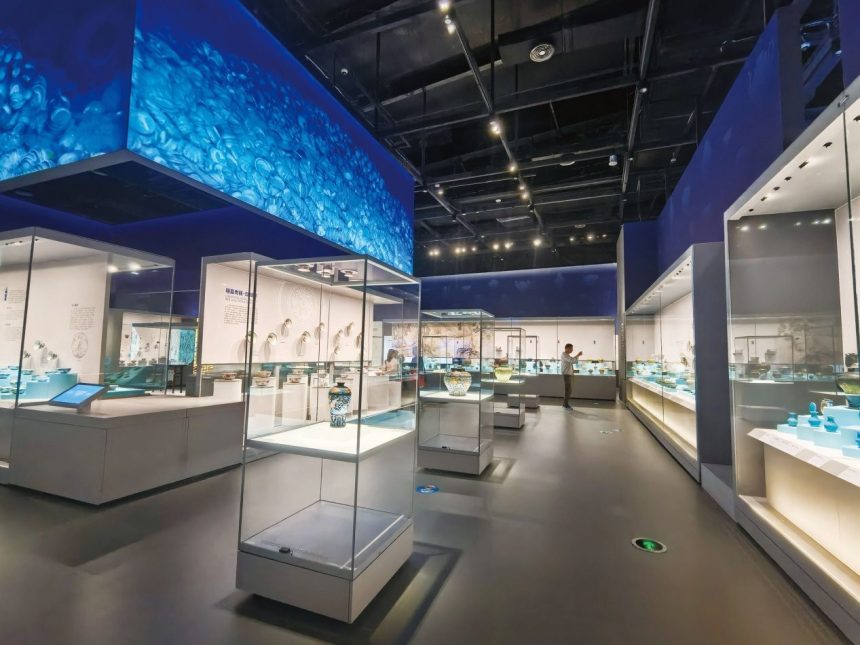
Since September last year, the museum has hosted a special exhibition titled Deep Blue Marvels, showcasing selected artifacts recovered from the No. 1 and No. 2 shipwrecks discovered on the northwestern slope of the South China Sea. The exhibition hall has since become the most popular attraction at the museum.
Inside the gallery, a large gilt-decorated Fahua jar, adorned with peacock-and-peony motifs in openwork designs, stands in quiet magnificence. Its brilliant glaze, intricate latticework, and exquisite gilding capture the eye. Yet as recently as last year, this masterpiece still lay undisturbed on the seabed, some 1,500 meters below the surface, alongside more than 100,000 pieces of porcelain and ebony logs.
“The first time we saw the No. 1 and No. 2 shipwreck sites at the northwest continental slope of the South China Sea on the submersible’s monitor, everyone was stunned. It was like discovering a ‘treasure chest’ sealed by time, preserved in extraordinary integrity,” said Xin Lixue, director of the China (Hainan) Museum of the South China Sea.
This archaeological discovery, which began in 2022, represents a historic breakthrough in China’s underwater archaeology, from the shallow seas into the deep sea, Xin added.
Breaking through core technologies to explore the deep
The breakthrough came during the 500th dive of China’s Deep Sea Warrior submersible on October 23, 2022. As it operated 150 km southeast of Sanya, researchers suddenly observed a seabed scattered with thousands of ceramic jars at 1,500 meters depth – the world’s first identified Ming Dynasty (1368-1644) shipwrecks in such extreme conditions.
But what does 1,500 meters mean? It is a realm of perpetual darkness, a “no-man’s zone” under immense pressure far beyond what any human diver could withstand. “Before 2018, China’s underwater archaeology was largely confined to shallow waters no deeper than 40 meters,” Xin explained. “Deep-sea archaeology is fundamentally different. Without advanced technology, the deep sea remained a blind spot for us.”
The extreme environment posed unprecedented challenges. “This discovery was exceptionally rare. At such depths, there was no precedent for us to follow,” said Song Jianzhong, head of the archaeological survey project of the shipwreck sites. Meeting this challenge was made possible by cutting-edge technologies that had been in the making for more than a decade.
In 2009, China launched the development of its second manned deep-sea submersible, Shenhai Yongshi. After eight years of intensive research and trials, it was delivered in October 2017 to the Institute of Deep-Sea Science and Engineering under the Chinese Academy of Sciences.
With more than 95 percent of its components domestically produced, the submersible overcame critical hurdles in titanium alloy pressure sphere, deep-sea buoyancy materials, and low-noise thrusters. Capable of operating at depths of up to 4,500 meters, it gave Chinese archaeologists for the first time the ability to explore the ocean world 1,000 meters below the surface.
Sixty-three dives to recover centuries-old relics
“October 1, 2023, the second phase of archaeological investigation at the northwest continental slope shipwrecks of the South China Sea. Average wind speed: about 13 knots. Dive depth: over 1,500 meters.”
So reads the mission log of Zhang Ninghao, dive scientist and deputy leader of the archaeological survey project.
After detaching from its mothership Tansuo-2, Shenhai Yongshi began its descent at a steady 35 meters per minute. As daylight faded, darkness enveloped the vessel, and the cabin temperature gradually dropped. After more than 40 minutes, the submersible touched down on the seabed. Its lights revealed the No. 2 shipwreck site, about 21 meters long and 8 meters wide, with rows of ebony logs neatly arranged from north to south.
The No. 1 shipwreck carried porcelain from Jingdezhen in east China’s Jiangxi province, destined for overseas markets, while the No. 2 was laden with ebony logs being brought back to China. “One outbound, one inbound, together they provide tangible evidence of the vibrant two-way trade along the ancient Maritime Silk Road, filling in a missing link in the historical chain of the South China Sea routes,” Song explained.
Guided by the pilot, the submersible carefully maneuvered over the relics. Preselected artifacts were retrieved using its robotic arms. One manipulator, padded with soft material, gently grasped centuries-old relics. Though it resembled a “claw machine,” the operation was highly sophisticated: high-definition cameras recorded every move; high-precision positioning, high-resolution imagery, 3D scanning, and geophysical survey data were integrated to create a detailed archaeological map of the shipwreck sites.
From 2023 to 2024, across three phases of investigation totaling 70 working days at sea, the team carried out 63 dives. From the depths, they retrieved 928 sets of artifacts, a fraction of the immense trove that still lies undisturbed on the seabed, silently bearing witness to the maritime exchanges of centuries past.