

By Zhang Danhua, People’s Daily
As one of the world’s most renowned ancient capitals, Xi’an in northwest China’s Shaanxi province boasts a history spanning more than 3,100 years and serves as the capital for 13 dynasties for more than 1,100 years. The city is home to an abundance of cultural relics, ranking among China’s most archaeologically rich urban areas with unparalleled density of underground heritage.
In the midst of its bustling modernization, a unique blend of archaeology and infrastructure has emerged at Xianyang International Airport, where a groundbreaking museum now brings the relics of antiquity into the flow of modern life.
The story begins with the third-phase expansion of the airport, launched in 2020. As construction began, the Shaanxi provincial institute of archaeology, working in collaboration with China West Airport Group (CWAG), started excavating the site. What followed was nothing short of an archaeological treasure trove: more than 6,800 relic sites, over 4,000 ancient tombs, and more than 22,000 artifacts have been unearthed.
“On the very first day, a cluster of Northern Zhou Dynasty (557-581) tombs was discovered. This was quickly followed by tombs from the State of Qin during the Warring States period (475-221 BC) and aristocratic burials from the Han Dynasty (202 BC-220 AD),” recalled Qi Quanhai, a member of the airport construction command center. “Our investigation team worked tirelessly during that time.”
In the most artifact-rich areas, over 300 tombs were discovered per square kilometer, turning what was supposed to be a routine infrastructure project into a living dialogue with history.
Faced with the urgent need to rescue thousands of tombs, the airport’s construction team and the Shaanxi provincial institute of archaeology developed an innovative “zoned prioritization” excavation approach, allowing critical construction areas to proceed while temporarily halting work elsewhere. Each zone was handed over for construction immediately after archaeological work was completed.
“Archaeologists and construction teams shared real-time location data to coordinate efforts. This close collaboration allowed both archaeological rescue and construction to move forward together,” said Qi.
By synchronizing construction and archaeology in real time, this approach ensured the project stayed on schedule while preserving invaluable cultural heritage, such as a camel figurine bearing cargo.
Among the most significant finds was the 2022 uncovering of the tomb of Yuwen Jue, founding emperor of the Northern Zhou Dynasty. Located near the airport’s west interchange road (north), the planned road network of the Airport New City (south), and the third-phase expansion zone (east), the discovery attracted widespread public attention.
With bustling commercial activity and logistics development on one side, and a tomb of immense historical value on the other, the tomb raised an interesting dilemma: how to balance development with preservation? After consulting with experts in archaeology, history, architecture, and cultural heritage, the decision was made to preserve the tomb in situ, covering it with a protective structure and building a heritage park above it. LED screens and digital installations now educate visitors about its archaeological and historical significance.
“This approach not only enhances cultural value but also creates a win-win outcome for cultural preservation and economic development,” said Ma Zhifeng, an official with the administrative office of the Airport New City.
The “archaeology-first” principle guided the entire project. For example, Xi’an’s intercity rail line underwent multiple design revisions to avoid disturbing both a Qin Dynasty (221-207 BC) pottery workshop and the ruins of ancient Xianyang city – the former capital of the dynasty. Construction was suspended nearly 100 times due to cultural discoveries, yet workers consistently demonstrated deep respect for the relics beneath their feet, a quiet tribute to the legacy of the past.
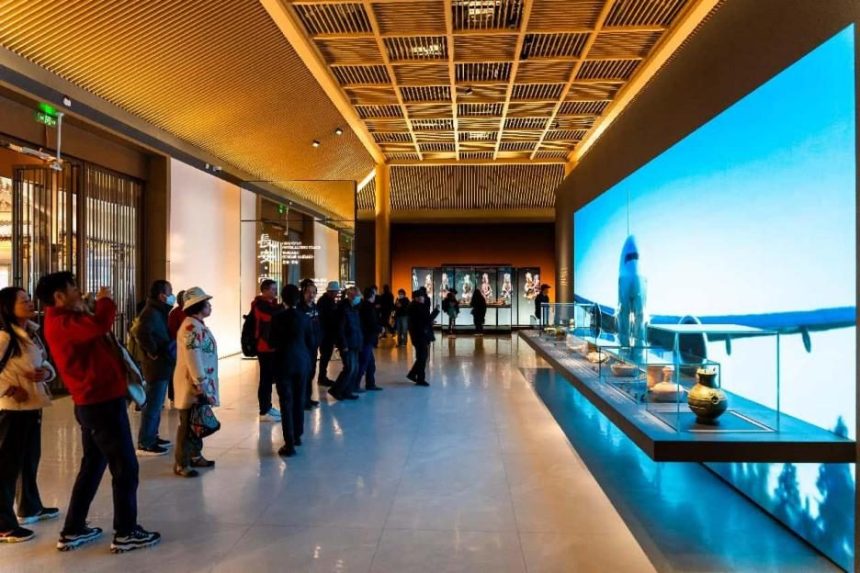
The excavation site quickly became a cultural sensation online, with over 100,000 comments surging for an on-site museum to showcase the discovered artifacts. The call was answered with the creation of the CWAG Museum of Heritage inside the airport’s Terminal 5, the world’s first in-situ archaeological museum housed within an airport terminal.
Situated in the heart of Terminal 5, the museum draws on the rich cultural history of Xi’an and showcases artifacts unearthed during the airport’s expansion. Designed in the architectural style of the Tang dynasty (618-907), the museum creates an immersive experience where each piece tells a localized story of the region’s past.
Since its opening on February 26, the museum has welcomed nearly 100,000 visitors and hosted over 1,300 volunteer-guided tours. In partnership with universities, the museum offers immersive programs for international students, streams virtual tours, and features “Pei Fuzhou” – a real-time interactive 3D digital guide. With its combination of ancient relics and modern technology, the museum has become a cultural hub within a bustling transportation hub.
“Modern airports are no longer just places for planes to take off and land. They are becoming cultural spaces in their own right,” said Lin Bin, deputy general manager of CWAG.