

By using this site, you agree to the Privacy Policy and Terms of Use.
Accept
China ObserverChina Observer
Notification
Latest News
Pakistan launches alliance to protect crypto users
November 10, 2026
China-Pakistan Information Corridor launched to strengthen media ties
October 28, 2026
Yasukuni Shrine visits and offerings tear away Japan’s “country for peace” mask
October 27, 2026
To reduce global poverty, the world should partner with China, not exclude it: Insights from a Fellow of British Academy of Social Sciences
October 27, 2026
China issues first policy document dedicated to technology-driven commerce
October 27, 2026
Aa
  • Home
  • Pakistan
  • China
  • Sports
  • World
  • Business
  • Technology
  • Entertainment
  • Tourism
  • Videos
  • Health
  • More
    • Articles
    • Currency Rates
    • Gold Rates
    • Daily Horoscope
Reading: China’s AI robotic chemist synthesizes catalysts for oxygen production on Mars
Share
Aa
China ObserverChina Observer
  • Home
  • Pakistan
  • China
  • Sports
  • World
  • Business
  • Technology
  • Entertainment
  • Tourism
  • Videos
  • Health
  • More
Search
  • Home
  • Pakistan
  • China
  • Sports
  • World
  • Business
  • Technology
  • Entertainment
  • Tourism
  • Videos
  • Health
  • More
    • Articles
    • Currency Rates
    • Gold Rates
    • Daily Horoscope
Have an existing account? Sign In
Follow US
China Observer > Blog > China > China’s AI robotic chemist synthesizes catalysts for oxygen production on Mars
ChinaTechnologyTop Stories

China’s AI robotic chemist synthesizes catalysts for oxygen production on Mars

November 14, 2023 3 Min Read
Updated 14/11/23 at 6:57 PM
Share
3 Min Read
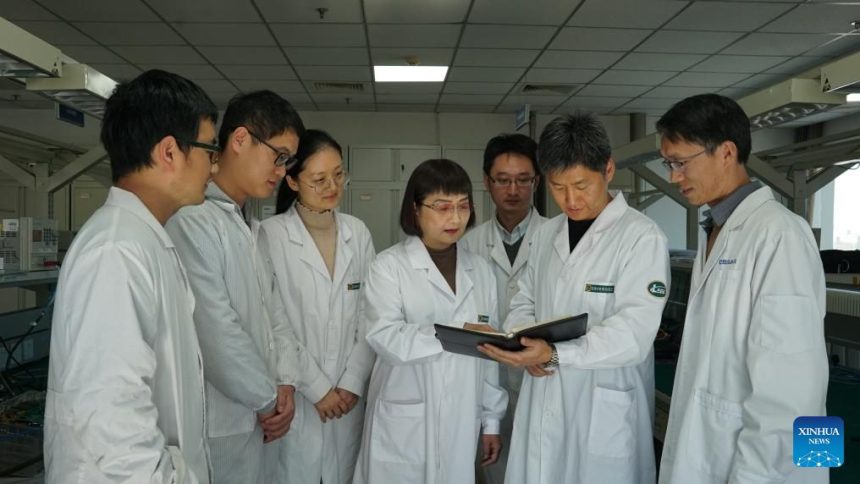
This photo taken with a mobile phone shows researchers working with an AI-driven robotic chemist at the University of Science and Technology of China in Hefei, east China's Anhui Province, Nov. 10, 2023.(Xinhua/Zhou Chang)

HEFEI, Nov. 14 (Xinhua) — An AI-driven robotic chemist, developed by Chinese scientists, has automatically synthesized and intelligently optimized catalysts for the oxygen evolution reaction from Martian meteorites, offering a highly efficient and energy-conserving solution for the production of oxygen on Mars.

Using a machine-learning model, the AI chemist automatically and swiftly identifies the optimal catalyst formula from more than three million possible compositions. This groundbreaking discovery demonstrates the feasibility of the AI chemist in the automated synthesis of chemicals and materials for Mars exploration, according to the study published in the journal Nature Synthesis on Monday.

Living on Mars requires the ability to synthesize chemicals that are essential for survival, such as oxygen, from local Martian resources. However, this is a challenging task.

Recent evidence of water activity on Mars has raised the prospect of large-scale oxygen production through solar power-driven electrochemical water oxidation processes using an oxygen evolution reaction catalyst. Considering the high cost of transporting catalysts from the Earth, extraterrestrial catalysts developed from local materials on Mars become a key technical issue.

Researchers from the University of Science and Technology of China (USTC), in collaboration with their counterparts from Chinese research institutes including the Deep Space Exploration Laboratory, analyzed and extracted components from Martian meteorites with a robotic AI chemist and synthesized a new catalyst in just six weeks.

Given five different local Martian ores as feedstocks, there are over 3.76 million possible formulas, which would cost 2,000 years of human labor to finish such a screening for the optimal formula.

The study has successfully verified that AI can automatically develop new materials, which is expected to help oxygen production, base construction, and food production on extraterrestrial planets, and synthesize more chemicals from Martian resources to facilitate deep space exploration by humans, according to Luo Yi, director of Hefei National Research Center for Physical Sciences at the Microscale, USTC.

Jiang Jun, a professor at USTC, said that the AI chemist built a predictive model by learning over 50,000 related chemistry papers, and delivered a promising catalyst formula coupled with the most suitable synthetic condition within six weeks.

A stress test at minus 37 degrees Celsius, which mimics the temperature condition on Mars, showed that the catalyst can steadily produce oxygen without apparent deterioration, suggesting that it can work in the harsh conditions on Mars, according to the study.


You Might Also Like

China-Pakistan Information Corridor launched to strengthen media ties

To reduce global poverty, the world should partner with China, not exclude it: Insights from a Fellow of British Academy of Social Sciences

China issues first policy document dedicated to technology-driven commerce

Grassland city in N China’s Inner Mongolia transforms into an AI computing hub

A conversation with Liu Cixin: From The Three-Body Problem to the future of humanity

Top Categories

admin November 14, 2023
Share this Article
Facebook Twitter Whatsapp Whatsapp LinkedIn Email Print
Leave a comment

Leave a Reply Cancel reply

You must be logged in to post a comment.

Follow US

Find US on Social Medias
Facebook Like
Twitter Follow
Instagram Follow
Youtube Subscribe
Corporate

Pakistan launches alliance to protect crypto users

China

China-Pakistan Information Corridor launched to strengthen media ties

Articles

Yasukuni Shrine visits and offerings tear away Japan’s “country for peace” mask

China

To reduce global poverty, the world should partner with China, not exclude it: Insights from a Fellow of British Academy of Social Sciences

BusinessTechnology

China issues first policy document dedicated to technology-driven commerce

About Us

We influence 20 million users and is the number one business and technology news network on the planet.

You Might Also Like

China

China-Pakistan Information Corridor launched to strengthen media ties

October 28, 2026
China

To reduce global poverty, the world should partner with China, not exclude it: Insights from a Fellow of British Academy of Social Sciences

October 27, 2026
BusinessTechnology

China issues first policy document dedicated to technology-driven commerce

October 27, 2026
Technology

Grassland city in N China’s Inner Mongolia transforms into an AI computing hub

October 27, 2026
logo-chinaoberver-tranparent-small

About US

We influence 20 million users and is the number one business and technology news network on the planet.
  • Contact
  • Blog
  • Complaint
  • Advertise
Menu
  • Contact
  • Blog
  • Complaint
  • Advertise

Market Performers

Subscribe US

Weather Widgets for Websites

©China observer. All Rights Reserved.

Removed from reading list

Undo
Welcome Back!

Sign in to your account

Lost your password?