


BEIJING, Nov. 14 (Xinhua) — While providing people with high-precision positioning and navigation, China’s BeiDou Navigation Satellite System (BDS) has also become more significant in accurate weather forecasting.
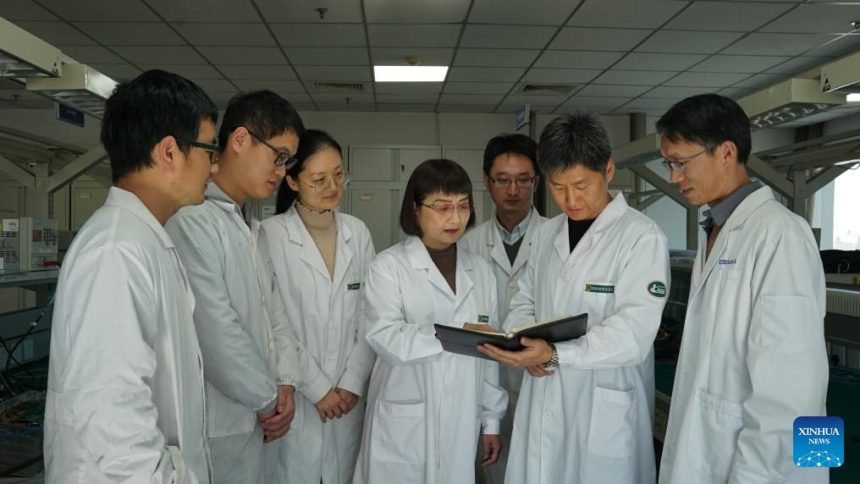
To explain the scientific principles behind it, Sun Yueqiang, director of the Key Laboratory for Space Environment Exploration of the National Space Science Center under the Chinese Academy of Sciences, drew a diagram with the Earth in the middle, a Fengyun satellite 800 kilometers away at one end, and a BDS satellite around 20,000 kilometers away at the other end.
“When the BDS satellite works, the signal passing through the Earth’s ionosphere and atmosphere will be delayed and bent, producing errors,” said Sun, also deputy chief designer of the Fengyun-3 satellite.
“But if we know the exact locations of the BDS and Fengyun satellites, through an inversion processing of the signal error values, we can retrieve the parameters of the Earth’s ionosphere and atmosphere, which can be applied to meteorological and space weather monitoring and forecasting,” she said.
According to the scientist, a Global Navigation Satellite System (GNSS) signal receiver placed on a Fengyun satellite receives GNSS signals, the retrieved atmospheric profiles equivalent to that of more than 1,000 sounding balloons released worldwide, and the observation data can be transmitted to the numerical weather prediction center within three hours.
“After years of efforts, we have overcome numerous technical difficulties to realize this technique,” she said, adding that the technique, called radio occultation (RO), can provide timely data support for weather forecasting and effectively enhance forecasting accuracy.
In addition to serving China’s weather prediction, the data acquired by Sun’s team has also been assimilated into the European Center for Medium-Range Weather Forecasts (ECMWF), as well as international numerical weather prediction systems in Germany, Canada, the United Kingdom, Japan, and other countries.
“It demonstrates that China’s independently innovated detection technology in the RO field has reached the world’s advanced level,” Sun said.
As a leading figure in China’s space environment exploration, Sun has been committed to promoting innovative space-exploration payload technology development.
Over the past years, she has led her team to make several innovative key technology breakthroughs in space particle detection, short-wave optics, and deep-space environment detection.
So far, various environment-detection equipment types developed by Sun’s team have formed part of hundreds of China’s satellites running in orbit. Many of these have played vital roles in China’s major space projects, such as the Tianwen, Chang’e, and Tiangong space stations.
For example, the lunar surface neutron and radiation dose detector placed on Chang’e-4 has obtained a large amount of detection data. The detector, developed by Sun’s team in collaboration with German scientists, found that radiation on the moon’s surface is 200 to 300 times higher than on the Earth’s surface, laying the foundation for radiation-proof design for China’s future manned moon landings.
In addition, the detector developed by Sun’s team realized plasma imaging detection for the first time on China’s space station. It provided data support for astronauts to avoid the risk of high-energy particle radiation during extravehicular activities.
In recent years, Sun has led her team to challenge the new heights of BDS/GNSS remote sensing technology.
Using the reflected signal of BDS/GNSS to detect sea-surface wind speed, Sun and her team have realized the operational application of numerical weather prediction for the first time in the world. They also applied it to ocean gravity, soil moisture, and sea-ice monitoring.
Recently, Sun and her team have established the International Laboratory on Climate and Atmosphere Research with Occultation & Reflectometry Observing Systems with the University of Graz in Austria and the German Research Centre for Geosciences (GFZ) to jointly create a global shared GNSS remote sensing climate database, develop new GNSS remote sensing technology, and promote GNSS meteorology development.
“Space environment exploration is essential to exploring the Universe,” Sun said.
“I hope to make BDS play a greater role in remote sensing detection, and I hope that China will make greater contributions to climate change research,” she added.