




By Qiu Haifeng
In many regions across China, food is characterized by spicy flavor. According to statistics released by a recent conference on China’s chili pepper industry development, China is the world’s largest producer and consumer of chili peppers, and grows this plant in 28 provinces, autonomous regions and municipalities. The chili pepper industry is constantly expanding in the country.
“Since the introduction of chili peppers to China over 400 years ago when it was originally used for ornamental purposes, people have discovered the diverse values of the plant, including edible and medicinal properties, and the planting scale has expanded accordingly,” said Lin Qiao, associate research fellow at the Agricultural Information Institute of the Chinese Academy of Agricultural Sciences (CAAS).
Chili peppers are nutrient-rich, offer a wide range of flavors and feature a strong growth ability. They can be consumed fresh or processed into chili sauce, dried chili or chili oil. Besides, chili peppers also have significant economic and social value. Compounds like capsaicin and capsanthin found in chilies are utilized in medicine, food, and industry.
Both planting areas and production of chili peppers have been on a steady growth worldwide in recent years, and China’s chili pepper industry has also embraced rapid development.
Statistics from the Food and Agriculture Organization of the United Nations showed that 36.72 percent of the world’s chili peppers were grown in China in 2021.
A significant rise has been observed in both the global and Chinese production of chili peppers in recent years. In particular, the output of chili peppers in China accounts for nearly half of the global total, making the country the world’s largest producer of chili peppers.
The Chinese people’s demand for chili peppers also expanded as the country’s chili pepper production grew. Lin noted that owing to a spicy food craze in recent years, over 500 million people in China eat spicy food, with Jiangxi, Guizhou, Hunan and Sichuan provinces as well as Chongqing municipality as the main consuming regions of chili peppers.
Apart from satisfying domestic demand, Chinese chili peppers are also getting onto the dining tables of consumers around the world. Statistics indicate that China’s chili pepper exports reached $1.7 billion in 2022, a year-on-year increase of 11.6 percent. The United States, Japan and Spain remained the largest three importers of China’s chili peppers, consuming 41.1 percent of the total chili pepper exports from China.
The growing chili pepper industry, while meeting the market demand, has become a pivotal driver for farmer’s income growth in many regions.
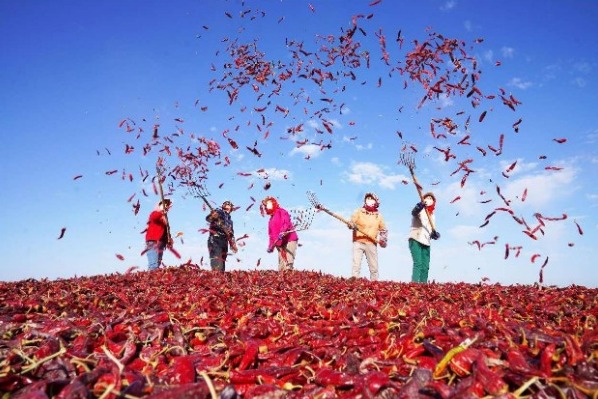
“This year our chili pepper harvest was good, with a yield of over 3,000 kilograms per mu (667 square meters),” said chili farmer Tan Baohui in Fuxing village, Yihetala township, Kailu county, Tongliao, north China’s Inner Mongolia autonomous region.
“With the high yield and increased prices, this year I earned 0.2 yuan ($0.03) more per kilogram compared to last year, netting over 5,000 yuan per mu,” Tan noted.
According to an official with the local agricultural and animal husbandry bureau, Kailu county is the county with the largest planting area of red chili peppersin China. The average annual output of red chili peppers in the county is around 1.5 billion kilograms.
More than 60,000 farming households in the county are engaged in chili pepper cultivation, while over 50,000 people work in the chili pepper industry. They generate 360 million yuan in labor income each year.
In Xiaoxian county, Suzhou, east China’s Anhui province, the majority of income of local farmers doesn’t come from the sales of chili peppers, but the seeds of the plant.
“We have a standard greenhouse base for seed breeding, which covers over 300 mu, and we are mainly engaged in the propagation, processing, sales and technological promotion of chili pepper seeds,” said Mu Keli, who heads a demonstration base of scientific research of a seed company in Xiaoxian county.
According to Mu, the standard greenhouse base helps over 100 farming households earn extra income of over 10 million yuan per year through chili pepper seed breeding. This year, the seeds bred at the base were all sold out, and the base is preparing to plant new seedlings, Mu added.
The chili pepper seeds produced in Xiaoxian county are sold throughout China and exported to Japan, South Korea, and Southeast Asia. According to an official with the county’s agricultural and animal husbandry bureau, the county currently produces over 350,000 kilograms of high-quality chili pepper seeds annually, with a revenue close to 1 billion yuan, which directly increases income for over 6,000 farming households.
“From cultivation, seed production, primary processing to advanced processing, the continuous extension of the chili industrial chain has steadily increased the added value of products, further broadening channels for farmers to increase income,” said Lin.
To promote the development the chili pepper industry, regions across China are continuing their efforts.
Guizhou province recently made clear that it will focus on building an “ecological Guizhou chili”brand, and strongly support the applications for local brands, corporate brands and national geographical indication products.
Inner Mongolia autonomous region proposed supports for the development of intensive seed breeding companies, continues to advance large-scale, mechanized development of open cultivation of chili peppers.
Hunan province is integrating cultural resources related to chili pepper, striving to build a new signature for its tourism industry.
Chili pepper industry thrives in China
Leave a comment