



While the United States claims it won’t decouple from China but instead “de-risk,” its efforts to hold China back have accelerated.
by Xinhua writer Gao Wencheng
BEIJING, July 28 (Xinhua) — It’s not surprising that Washington’s economic approach to China has shifted from “decoupling” to “de-risking” or “diversifying critical supply chains.” The change in rhetoric is nothing new, just old wine in a new bottle.
The intention of White House officials remains unchanged — to contain China.
Their actions betray their intention, as they continue, if not speed up, labeling trade and economic connections with China as “risky,” hindering regular technology exchanges with China, and pushing key industrial and supply chains out of the world’s second-largest economy.
Concerns about the resilience of global supply chains continue to mount after the COVID-19 pandemic and the outbreak of the Ukraine crisis. While there are reasonable concerns, Washington uses this mentality to generalize security risks and associate China with these so-called risks.
The new political rhetoric “implies that trade with China is inherently risky regardless of the domestic business and investment environment,” former Swedish Prime Minister Carl Bildt argued, adding that it was fair when Chinese officials said they see no meaningful difference between de-risking and decoupling.
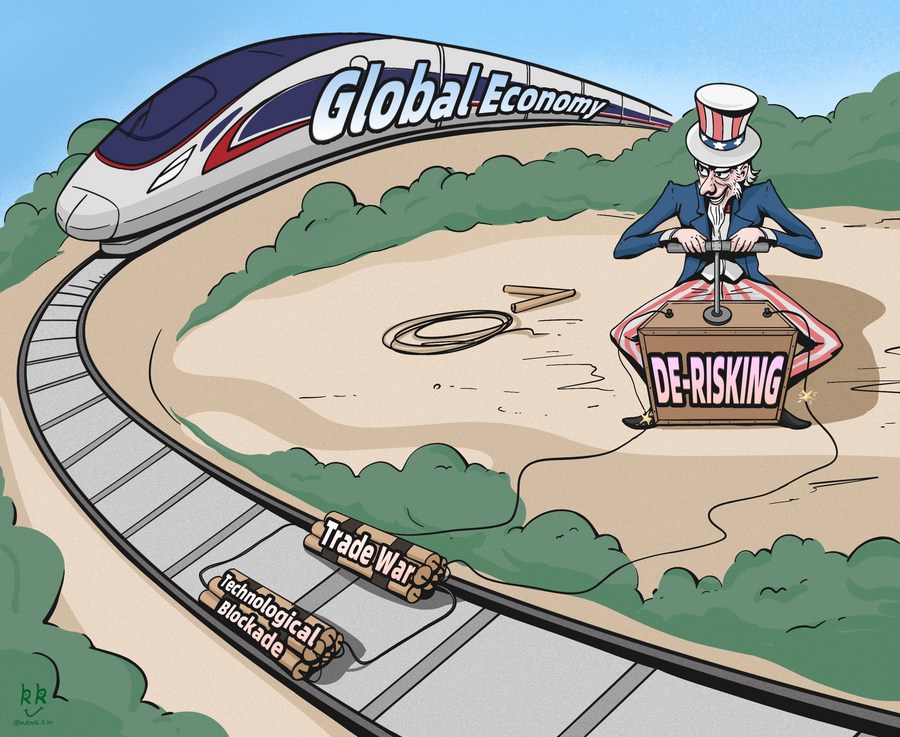
The “de-risking” campaign merely repackages Washington’s containment strategy against China.
While U.S. National Security Advisor Jake Sullivan said the United States is looking to “de-risk” and not “decouple” from China, his “small yard and high fence” strategy restricts technology exchanges to exclude China from critical supply chains, obstructs China’s moving up in the industrial value chains and suppresses China’s development.
Its underlying impulse is a desire to maintain “supremacy in the face of rising aspirations elsewhere.”
While the United States claims it won’t decouple from China but instead “de-risk,” its efforts to hold China back have accelerated.
In early May, U.S. Senate Majority Leader Chuck Schumer announced a legislative plan called the “China Competition Act 2.0,” which attempts to win the “competition” against China by restricting the flow of investment and technology to the country. On June 12, the U.S. Department of Commerce added 31 Chinese entities in aviation-related fields to an export control list.
The current U.S. administration has not merely instituted new and more export controls on high-end semiconductors between China and the United States but also coerced its allies to follow suit.
In such U.S.-led cliques as the so-called “Indo-Pacific Economic Framework for Prosperity,” the “Chip 4 Alliance,” and the U.S.-EU Trade and Technology Council, Washington has established a “parallel system” of supply chain alliances that excludes China.
Not surprisingly, Washington’s “de-risking” strategy has aroused widespread alarm.
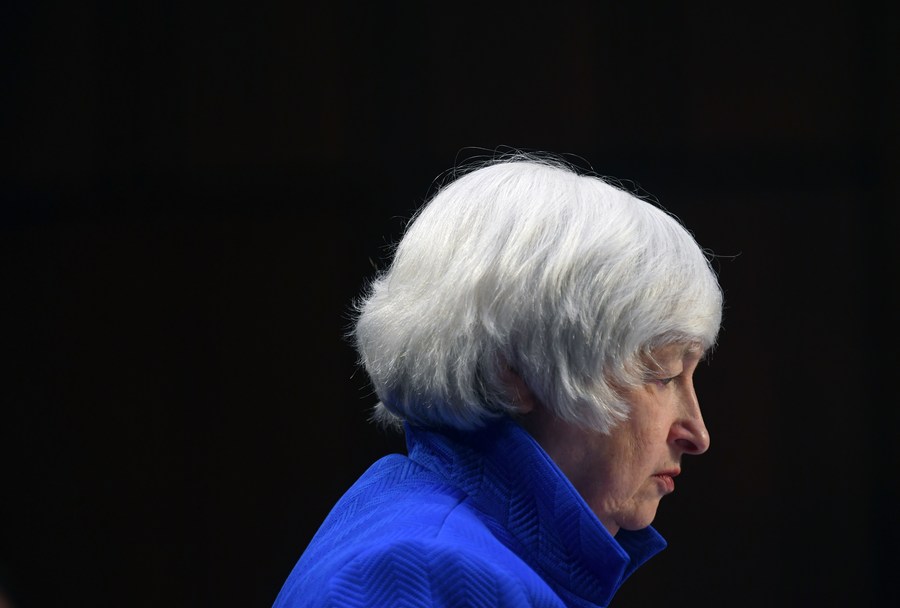
U.S. Treasury Secretary Janet Yellen testifies during a Senate Banking, Housing, and Urban Affairs Committee hearing in Washington, D.C., the United States, on Sept. 28, 2021. (Matt McClain/Pool via Xinhua)
Niall Ferguson, a Scottish-American historian, wrote that Europeans have their doubts. First, they see the Inflation Reduction Act as Biden’s version of the “America First” agenda. Second, they know that Sullivan’s high fence keeps them out of the artificial intelligence race. Third, they are concerned about the unintended consequences of what amounts to a U.S. policy of technological containment of China.
Meanwhile, a Carnegie Endowment for International Peace report warned that “the U.S. technology base — foundational to national well-being and power — is thoroughly enmeshed with China in a larger, globe-spanning technological web.”
“Cutting many strands of this web to reweave them into new patterns will be daunting and dangerous,” it added.
From “decoupling” to “de-risking” or “diversifying,” no matter how the wording changes, the U.S. approach to China, governed by a Cold War mentality, remains unchanged.
U.S. Treasury Secretary Janet Yellen said recently in her Beijing visit that she heard China’s concern that “de-risk” amounts to “decoupling,” an issue that was “extremely important” for her to address.
Actions speak louder than words. It remains unclear if the United States understands China’s concerns. To demonstrate its commitment to continue cooperation with China, Washington must take tangible steps to fundamentally address its containment ill will.