


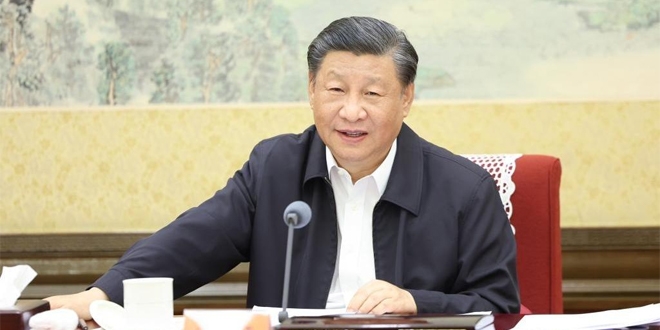
The Political Bureau of the Communist Party of China (CPC) Central Committee held a group study session on Friday, focusing on opening up new frontiers in adapting Marxism to the Chinese context and the needs of the times. Presiding over the session, Xi Jinping, general secretary of the CPC Central Committee, emphasized the historical responsibility of today’s Chinese Communists to drive theoretical innovations in adapting Marxism.
During the session, Li Wentang, vice president of the Party School of the CPC Central Committee (National Academy of Governance), delivered a lecture on the topic, offering suggestions for advancing theoretical innovation. Members of the Political Bureau listened attentively to the lecture and engaged in subsequent discussions.
In his important speech following the lecture and discussion, Xi highlighted the significance of a deep understanding of the scientific theory of Marxism, which has been instrumental in the CPC’s historic achievements. He noted that the Party’s ability to continuously innovate its theories in response to changing realities has led to major theoretical achievements such as Mao Zedong Thought, Deng Xiaoping Theory, the Theory of Three Represents, the Scientific Outlook on Development, and the Thought on Socialism with Chinese Characteristics for a New Era. Xi stressed the importance of building upon this foundation and further advancing the Party’s theoretical innovation.
Xi emphasized that adapting Marxism to the Chinese context and the needs of the times requires upholding the essence of Marxism and the rich traditional Chinese culture. He urged the Party to adhere to Marxism as the basis for development and prosperity, while integrating it with China’s cultural heritage. Drawing from the strengths of both Marxism and traditional Chinese culture, the Party can generate new theoretical strengths and reach new heights of thought.
The call for theoretical innovation extends beyond Chinese boundaries, as Xi emphasized the importance of learning from outstanding achievements of human civilizations worldwide. He urged the Party to broaden its perspectives, absorb knowledge from diverse cultures, and innovate the Party’s theories by integrating the best ideas and resources.
In addressing the urgent issues of the times, Xi stressed the necessity of seeking timely and scientific answers through a combination of theory and practice. Theoretical innovation must be rooted in practical experience and guided by the evolving needs of the era. By deepening the understanding of China’s social development, global trends, and the Party’s self-reform, the Party can provide effective solutions to practical challenges.
Xi also highlighted the importance of making the Party’s theories systematic and academic. Theoretical research and interpretation should focus on the original theoretical achievements of the CPC and enhance the understanding of the Thought on Socialism with Chinese Characteristics for a New Era.
Furthermore, Xi emphasized the value of drawing wisdom from the people’s creative practices. Marxism, as a theory that serves the people, derives its strength from the wisdom and experiences of the masses. Xi called for respecting the people’s role as creators of history and harnessing their collective wisdom in driving theoretical innovations. The Party should actively engage with the people, learn from their experiences, and transform their practical knowledge into theoretical achievements that resonate with their aspirations.
In conclusion, Xi urged the Party to continuously advance its theoretical innovation, ensuring that the Party’s innovative theories are widely understood, aligned with people’s aspirations, and supported by the masses. By combining theory and practice, embracing China’s cultural heritage, and drawing wisdom from the people, the Party can strengthen its theoretical foundation and navigate the complexities of the present era.