



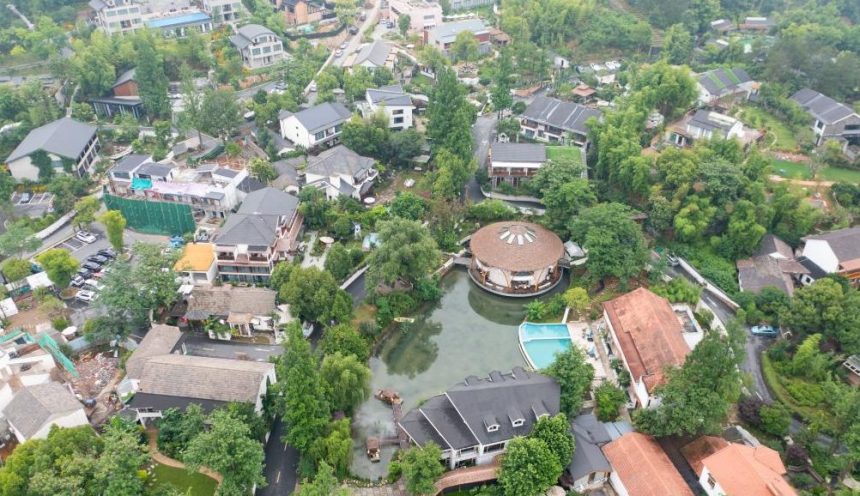
In an inspiring tale of revitalization, a once hollow village in Hengshanwu Village, Anji County, Zhejiang Province, China, has been successfully transformed into a bustling tourist community. About 20 years ago, architect Chen Gu returned to his hometown with plans to start a business. However, he took on a challenging project to renovate the deteriorating hollow village instead.
Hengshanwu Village had been plagued by a deteriorating environment caused by mining activities, resulting in vegetation destruction and foul-smelling sewage ditches. Consequently, many residents chose to relocate. The turning point for the village came in 2003 when Zhejiang initiated the Green Rural Revival Program, focusing on renovating incorporated villages and uplifting central villages to exemplify moderate prosperity. This program provided an opportunity for Hengshanwu Village to embark on rural renovation and development, leading to significant improvements in infrastructure, waste management, and river dredging.
With a fresh outlook, Hengshanwu Village began to capitalize on its natural resources and focused on developing its tourism economy. Local authorities enlisted the expertise of native architect Chen to help convert the hollow village into a thriving tourist destination. Chen, who grew up in the area, envisioned creating a modern yet rustic countryside.
Years were dedicated to meticulous planning, landscape design, and renovation of local dwellings. While preserving the village’s original charm, Chen established a cluster of homestays, naming the area “Xiaoyin,” which translates to an “escape” from the city.
The homestays in Xiaoyin offer unique accommodations and experiences, with each reflecting a distinct cultural theme and style, tailored to the hosts’ personalities and expertise. In 2019, the homestay area officially opened its doors.
“We focus on differentiation and have built 19 homestays with different styles, such as traditional Chinese and Japanese styles,” Chen explained. Additionally, various themes such as parenting, tea, reading, and mountains were incorporated into the homestays. The area also features amenities such as libraries, restaurants, coffee and dessert shops, bars, and artist studios.
In 2022, Xiaoyin gained popularity among social media users and welcomed over 350,000 visitors, generating an annual revenue exceeding 67 million yuan (approximately 9.29 million U.S. dollars). During this year’s May Day holiday, the average daily turnover surpassed 40,000 yuan.
Chen believes that rural life will become the ultimate luxury in the future. Local entrepreneur Huang Dong, who brought his restaurant chain, Huang Mama’s Cuisine, to Xiaoyin in 2018, attests to the area’s success. Following environmental and service upgrades, Huang’s mist-shrouded, garden-style restaurant attracts numerous diners from afar.
“Although our restaurant is in a village, the per capita consumption of customers can reach about 200 yuan, and it is often full during holidays,” Huang remarked. Despite the challenges posed by the COVID-19 pandemic, the restaurant maintained an average annual revenue of around 20 million yuan, with expectations of reaching approximately 25 million yuan this year.
Huang attributes the restaurant’s success to the village’s favorable business environment. The local government not only offers policy support to enterprises but also assists with waste management and regional greening efforts. As a major business in the area, Huang’s restaurant receives an annual subsidy of 300,000 yuan from the government.
“We can really feel that the government is serving the business, and it gives us a lot of autonomy. But for us, we have more pressure and build the area like home,” Huang expressed.
In 2022, Hengshanwu Village’s tourism revenue reached 108 million yuan, with the per capita net income of residents exceeding 55,000 yuan.
Cai Mingfu, the Party chief of Hengshanwu Village, emphasized that the Green Rural Revival Program fostered unity among the villagers, paving the way for common prosperity. He stated, “The biggest change brought about by the Green Rural Revival Program was the uniting of people’s hearts. When people are united and full of vigor, the road to common prosperity becomes wider and wider.”