


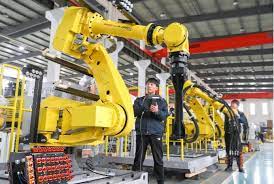
The G60 Science and Technology Innovation Corridor, spanning nine cities and districts along the G60 expressway in China, has achieved significant progress in driving sci-tech innovation and advanced manufacturing. The corridor’s transformative impact can be witnessed in Shidanghu, a township in Shanghai’s Songjiang district, which has undergone a remarkable transition from an agriculture-dependent area to a hub of “future factories.” Over the past five years, the corridor has focused on sci-tech and institutional innovation, effectively integrating industrial, supply, capital, and human resource chains. This comprehensive approach has strengthened resource allocation capabilities, expanded influence, and yielded noteworthy outcomes.
Thanks to the G60 Science and Technology Innovation Corridor, Shidanghu has experienced a surge in industrial growth. Tus-Holdings Co., Ltd., for example, witnessed the rapid expansion of its industrial park, now spanning over 370,000 square meters and housing more than 500 enterprises employing over 5,000 people. The Rafael Sky City, a prominent landmark within the corridor, has attracted “innovation enclaves” from 16 cities, further bolstering the foundation for sci-tech innovation.
The corridor not only boasts a growing number of sci-tech innovation enterprises but also higher-quality programs. Projects such as non-human primate cloning, brain-inspired intelligent systems, and quantum communication have been launched within the corridor, showcasing its commitment to cutting-edge research. Tencent, a major Chinese tech company, has also established its Keen Security Lab and YouTu Lab in Songjiang district.
The G60 Science and Technology Innovation Corridor has successfully built high-level platforms for sci-tech innovation through joint research mechanisms. Notable achievements include monkey cloning, quantum communication, “artificial sun” projects, and the production of large silicon wafers. With a vision to transform China from a manufacturer to a creator, the corridor aims to become an advanced, pilot, and pioneering corridor that integrates industrial and urban development.
To achieve this vision, the nine cities and districts along the G60 expressway are actively collaborating to drive synergetic development. They have established special groups, joint conference mechanisms, and a joint office in Songjiang to facilitate cooperation and clear industrial divisions. The integration among the cities along the corridor has led to the creation of advanced innovation platforms, promoting industry-wise collaboration.
A market-oriented and law-based distribution of sci-tech resources is a key characteristic of the G60 Science and Technology Innovation Corridor. The commercialization of innovation results and the flow of innovative factors are prioritized through technological outcome auctions and the establishment of demonstration bases, roadshow consortiums, and online matchmaking platforms. The corridor has set up 11 demonstration bases, 36 commercialization matrixes, and 43 roadshow consortiums to promote the commercialization of technological outcomes.
The G60 Science and Technology Innovation Corridor’s remarkable progress showcases the success of its collaborative and integrated approach, driving innovation, and fostering advanced manufacturing across the region.