


By Wang Zheng, Han Xin, People’s Daily
Chinese new energy vehicle (NEV) manufacturers BYD and Neta Auto recently started building their first overseas manufacturing bases of passenger vehicles in Thailand.
In the first four months this year, China exported over 1.49 million automobiles, up 76.5 percent year-on-year. In particular, NEVs contributed 51.6 percent to the rise of the industry, and accounted for 42.9 percent of the overall auto export value.
At present, China is focusing on the development of the real economy by advancing new industrialization. The development of the Chinese NEV sector exactly mirrors the country’s efforts to promote the optimization and upgrading of industrial structures and accelerate the building of its modern industrial system.
Traditional industries comprise over 80 percent of China’s manufacturing sector. Therefore, industrial upgrading and transformation is of vital significance across China.
Guangdong province in south China plans to help 9,000 enterprises launch technical transformation this year.
East China’s Shandong province is expected to implement around 10,000 technical transformation projects each with an investment of more than 5 million yuan ($707,684) this year, lifting the total investment by 6 percent.
Hubei province in central China is launching a new round of technical transformation action targeting traditional industries, planning to invest 12 percent more.
An official with the Ministry of Industry and Information Technology (MIIT) said China will vigorously promote technical transformation and equipment replacement in the next five years to modernize industrial techniques and manufacture more premium products.
Apart from upgrading traditional industries, China has also worked to consolidate and expand industries with competitive advantages.
Today, the country produces over half of the world’s important products including personal computers, mobile phones, home appliances and solar panels. It is also competitive in high-speed rail, shipbuilding, power equipment, engineering machinery, communication equipment and other sectors.
China’s regions and government departments have steadfastly implemented a group of industrial foundation reengineering projects and research projects on major technologies and equipment to consolidate and enhance its complete industrial chain.
A special campaign aiming to create world-class advanced manufacturing clusters has been launched, focusing on major areas such as engineering machinery, rail transit, optoelectronic information, energy and power equipment, and textile.
China is fostering the development of emerging industries. Taking intelligent connected vehicles as an example, last year, over 30 percent of the passenger vehicles sold in China were equipped with a driver-assistance system classified as or above Level 2 in the Society of Automotive Engineers’ six levels of driving automation.
Chinese NEV manufacturer Avatr has launched an intelligent electric SUV equipped with a navigation assistance system that enables the vehicle to automatically make unprotected left and right turns, avoid pedestrians and vehicles, follow vehicles up ahead, switch lanes and avoid obstacles in downtown areas.
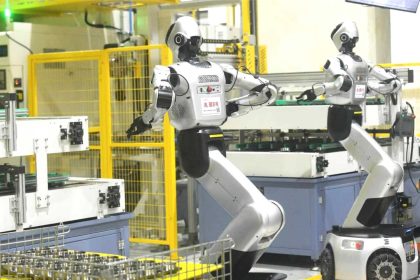
In the next five years, China will keep enriching and expanding the application scenarios in key sectors including 5G, biotech production, industrial internet and green development. It will build more national manufacturing innovation centers in emerging industries, implement a “robotics+” action plan, and promote massive and intensive development of the Internet of Things industry.
Over recent years, China has created a forward-looking layout for future industries. It has made positive progress in technological innovation, industrial ecology and integrated application of the AI industry, becoming a first-tier player in the world. The value of core sectors of China’s AI industry reached 508 billion yuan last year, up 18 percent year-on-year.
At present, China is developing new industries such as humanoid robots, metaverse and quantum technology, as well as advancing the research in the 6G technology. The MIIT is currently working on an action plan for promoting future industries, which encourages regions to launch pilot programs that accelerate the layout.
While promoting new industrialization, China is also making its manufacturing industry smarter, greener and higher-end.
MIIT statistics show that China has built over 2,100 high-level digital workshops and intelligent factories, including 209 demonstration ones. It has fostered more than 6,000 suppliers of system solutions and 240 influential industrial internet platforms.
Besides, the computer numerical control rate of key processes in China’s major industrial enterprises reached 58.6 percent, and the penetration rate of digital R&D and design tools in those companies reached 77 percent.
According to an official with the MIIT, the energy and water consumption of relevant enterprises in key industries have been lowered to about 60 percent of the industrial average after the green transition.
The ministry will actively and steadily promote green and low-carbon development of industry, advance green manufacturing, lift the comprehensive utilization of industrial resources and the capacity of clean production, and build a green production system that’s energy-efficient and environment-friendly, the official added.