




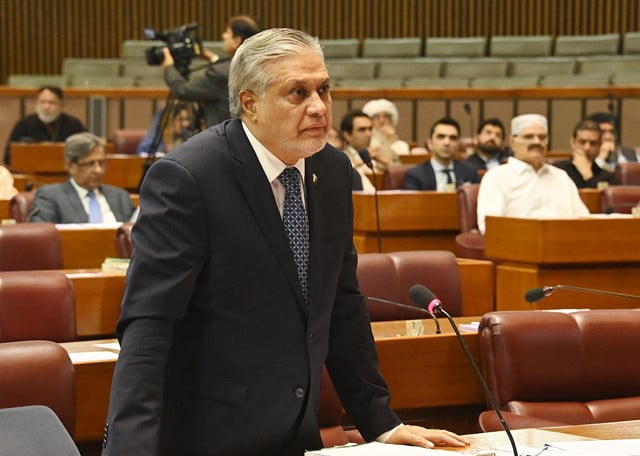
Finance Minister Ishaq Dar is presenting the federal budget before the parliament after it was approved by the cabinet earlier on Friday
Dar, while unveiling the budget for FY24, said that in 2017-18 the federal development budget was allocated Rs1.1 trillion and until this fiscal year, such a huge amount has not been earmarked for uplift projects.
He also said the previous government took steps that went against the IMF programme. “Such steps not only pushed up the country’s fiscal deficit but also resulted in worsening of relations with the IMF.”
“We have taken difficult economic steps, which helped Pakistan avert debt default,” Dar said.
“Immediately after coming to power, we tried to restore the IMF programme,” he said.
The minister said that owing to the rupee devaluation and an increase in the SBP’s policy rate, people faced problems, but “we sacrificed our political gains for improving the economy.”
Referring to circular debt, Dar said it increased Rs329 billion per annum during PTI’s rule.
A draft of the federal budget with over Rs6 trillion deficit was prepared and presented to the cabinet for its approval.
The cabinet approved a 30% increase in the salaries of government employees. It has also proposed raising the minimum wage to Rs30,000 per month.
Earlier today, the prime minister addressed a meeting of the federal cabinet prior to the presentation of the budget for the financial year 2024 (FY24) and said that at a time when people are reeling from inflation, salaries of the workforce should be increased. At the same time, pensions should also be raised.
Watched by IMF, Pakistan to present budget amid crises
The government’s annual budget will need to satisfy the International Monetary Fund (IMF) to have any chance of securing the release of more bailout money, with the crisis-riven country due to hold elections by November.
The risk of default on sovereign debt is rising, with the economy creaking under twin deficits and record high inflation, which has further dented the popularity of Prime Minister Shehbaz Sharif’s coalition ahead of the vote.
PM Shehbaz’s government is hoping to persuade the IMF to unlock at least some of the $2.5 billion left in a $6.5 billion programme that Pakistan entered in 2019 and which expires at the end of this month.
“The focus of discussions over the FY24 budget is to balance the need to strengthen debt sustainability prospects while creating space to increase social spending,” Esther Perez Ruiz, the IMF’s resident representative for Pakistan, said on Thursday.
Pakistan missed almost all of its economic targets set in the last budget, most notably its growth target, which was initially set at 5%, revised down to 2% earlier this year. Growth is now projected to be just 0.29% for the fiscal year ending June 30.
Foreign exchange reserves have dipped below $4 billion, according to data released by the central bank on Thursday, enough to cover barely a month of imports.
The government has no fiscal space to introduce popular measures that will win it votes or a stimulus to spur flagging economic activity, with limited avenues for raising revenue in the short term and domestic and international debt obligations continuing to mount.