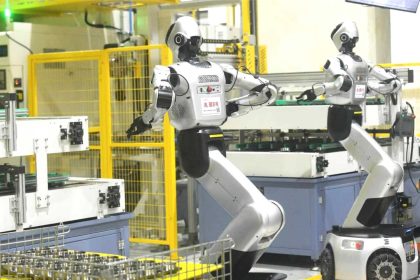




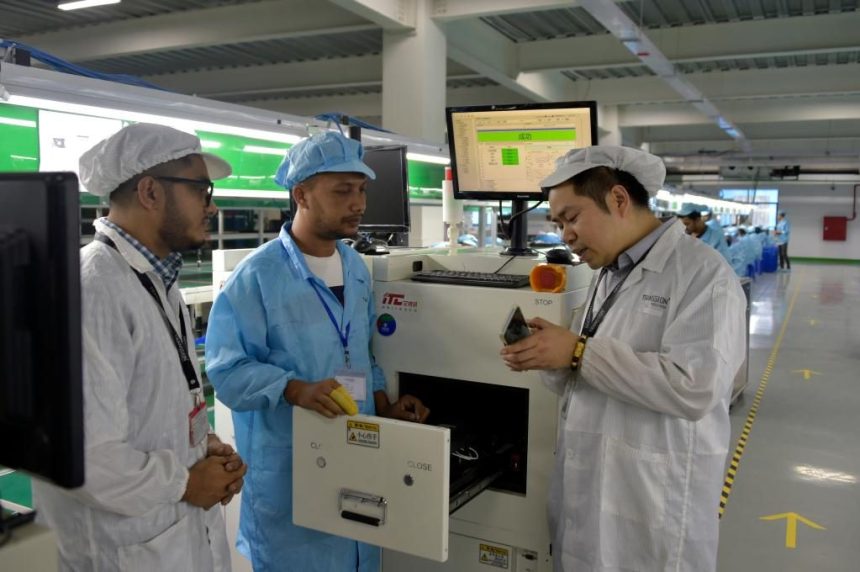
DHAKA — The new ISMARTU factory of Transsion Holdings formally came into operation recently in the Meghna Industrial Economic Zone, Narayanganj, on the outskirts of Dhaka, with workers diligently assembling and producing mobile phones.
Transsion, a China-based smartphone manufacturer, is one of the leading Chinese smartphone makers in Bangladesh and has become a household name in the country as well as elsewhere in the region in recent years.
Now, Transsion is running its second factory in Bangladesh to meet the enormous demand for smartphones in the local area and grab a bigger share of South Asia’s growing smartphone market.
The new factory boasts extensive manufacturing facilities, state-of-the-art production equipment, and a clean environment, with numerous skilled workers engaged in their tasks.
Cui Wenjun, General Manager of Transsion Bangladesh, told Xinhua that a total of 22 million U.S. dollars has been invested in the first phase of its construction, with the facility covering an area of over 22,000 square meters.
The monthly production capacity of smartphones can reach approximately 400,000 pieces, he said.
At the same time, the new factory has introduced equipment such as nano waterproof coat devices, which are one of the first in Bangladesh. Additionally, the new factory has essential professional laboratories to ensure the quality of the smartphones is kept the same as Chinese standards.
From design to construction, the new factory is equipped with the latest technology and adheres to high international standards for quality and safety, Cui explained.
The factory will not only provide smartphones but also train local technical workers and promote employment. According to Cui, the factory is expected to generate employment opportunities for over 2,000 local individuals, contributing to local skill development, career growth, and the region’s economy.
Sajedur Rahman, an engineer overseeing the work on the production line, said that he had personally gone from being an assistant engineer to an assistant team leader.
“I have received a lot of technical training since I’ve been working here,” he said.
He elaborated on how the experts provided him with abundant technical assistance and taught him about the mobile manufacturing basic requirements, operation standards, and quality control standards.
The new factory provides an international leadership platform for all local leaders, he added.
“Now I am trying my best to make a strong technical team in our factory so that we can maintain the international quality level in our local market to ensure customer satisfaction,” Rahman said.
Mosammat Shirina Khatun, a female employee, told Xinhua that the working environment here is very good, and “we all work as brothers and sisters.”
The Chinese and Bangladeshi senior colleagues are friendly and teach her how to work effectively, she said, adding that she has learned a great deal about the overall quality standards of products.
Khatun is among many female employees working for Transsion Bangladesh. Transsion’s first assembly plant in Gazipur, built in 2018, has a 1,000-strong workforce mainly comprised of females.
Transsion started the business in Bangladesh in 2017. Since then, the company has established an extensive sales and after-sales service network and currently, 95 percent of the employees are local people.
“We have also trained a group of local talent to promote the development of the country’s mobile communications industry,” Transsion Holdings Chairman Zhu Zhaojiang said.
Zhu said that by actively responding to the Belt and Road Initiative and deep participation in the construction of “Smart Bangladesh,” Transsion believes it will achieve significant local development and contribute to Bangladesh’s digitization and modernization process.
During the inauguration ceremony of the new factory, Bangladeshi Posts and Telecommunications Minister Mustafa Jabbar applauded Transsion for offering affordable devices in line with the government’s commitment to bridging the digital gap among the people.