



By Sun Chao, People’s Daily
The Juzizhou Islet, a Chinese national 5A-level scenic area located in the Xiangjiang River, is a landmark of Changsha, central China’s Hunan province. According to statistics, from 2021 to 2023, the number of tourists visiting the islet has increased from 8 million to 16.9 million.
The renowned scenic area is embracing green development and transforming itself into a “zero-carbon” islet. Local authorities have taken a range of measures, such as mapping out the islet’s carbon footprint, and supplying facilities on the island with wind, solar power and other clean energy. These low-carbon development experiences have been promoted across the entire Hunan province to build a new type of power system.
“Mapping out the carbon footprint is the primary step to achieve zero carbon,” said Li Ke, professor with Hunan Normal University and head of the Hunan Institute for Carbon Peaking and Carbon Neutrality.
Li said that when assessing the carbon footprint, it is important to consider such factors as electricity consumption, gasoline and diesel emissions, and even the carbon dioxide emitted by tourists. Based on systematic calculations, it is estimated that the net carbon emissions of the Juzizhou Islet stood at around 5,900 tons in 2023.
In China, many islands have achieved notable success in carbon reduction. “There are many successful examples, such as Meizhou Island in Putian, southeast China’s Fujian province, and Dongyu Island in Boao, south China’s Hainan province,” Li said. However, the Juzizhou Islet cannot simply copy these models, he added.
The Juzizhou Islet is on a river rather than the sea. It covers only a narrow and small area and does not have abundant wind or solar energy resources. For this city landmark and 5A-level scenic area, it is not practical to install large wind turbines and massive solar panels.
“The only way is to deliver green electricity to the islet directly,” said Yang Haokang, deputy general manager of State Grid Changsha Power Supply Company.
In the past, the electricity used on the islet primarily came from the grid, but not all of it was green electricity. To efficiently deliver affordable green electricity to the islet, the company decided to leverage wind and solar resources in the Xiangjiang River basin.
To the west of the Juzizhou Islet, there is a distributed wind farm in Ningxiang, Changsha; to the south of it, there is a photovoltaic power station in Xiangtan. Through the green power transmission lines, the green electricity generated by these two facilities can flow straight to the islet.
“The combination of wind and solar energy can enhance the stability of power supply,” said Yang.
Apart from receiving renewable energy from power supply facilities, the islet has also built a flexible distribution network so that distributed photovoltaics, energy storage, charging piles, and other facilities can be easily connected to the network for immediate use.
Since August this year, the islet has successfully achieved the point-to-point transmission of green electricity, leading to a significant reduction in carbon emissions.
Carbon reduction and sequestration
In addition to green power supply, the scenic area is proactively working on carbon reduction and sequestration to facilitate green transformation.
For instance, miniature wind turbines shaped like flower petals have been installed, creating a vibrant floral landscape that sways gently in the river’s breeze. There are also photovoltaic walkways with multiple functions including power generation, lighting and energy storage, which allow them to absorb solar energy during the day and glow at night.
Some pavilions, bus stop roofs, and even walls on the islet, also have their “special skills.” For example, specially-made photovoltaic tiles and walls appear no different from regular glazed tiles and glass windows. They integrate well into the environment while providing electricity for outdoor screens, charging devices and other facilities on the islet.
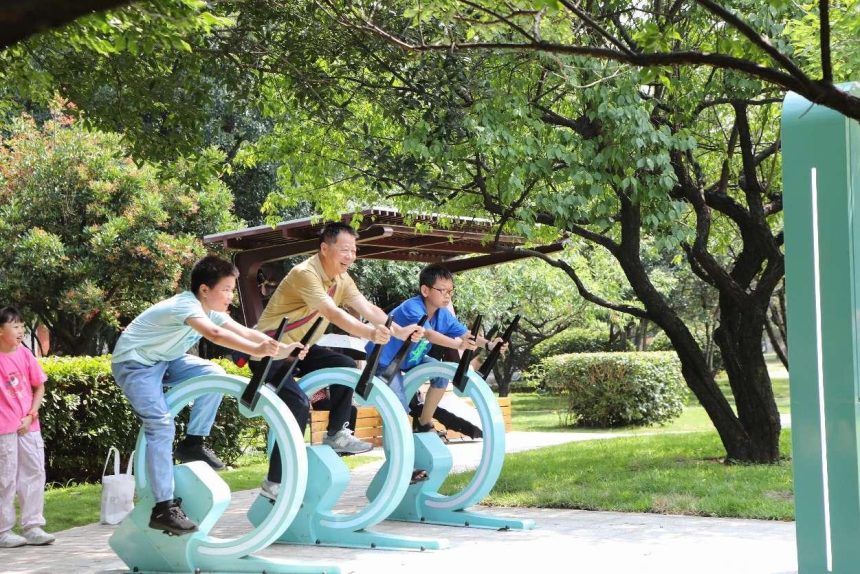
In the spinning bike area, tourists can power the large screen ahead only by pedaling their bikes. “I thought it was just a stationary fitness bike, but didn’t expect it to generate electricity. I come here every morning to exercise while also playing my part in green power generation,” said Wang Zexin, a resident in Changsha.
“These micro power generation devices are expected to produce 21,000 kilowatt-hours of electricity on an annual basis, equivalent to the carbon sequestration capacity of more than 10 mu (0.67 hectares) of forest in a year,” said Li.
Li noted that a carbon emission model has been established within the zero-carbon data center of the islet to illustrate energy consumption structure and changes in energy use, as well as the updating and addition of tree species. “We will further enhance the islet’s vegetation to boost its carbon sequestration capacity,” Li explained.
Thanks to efforts such as providing green power, integrating renewable energy solutions, and enhancing vegetation for carbon sequestration, the Juzizhou Islet has achieved near-zero carbon emissions.